12
min read
12
min read
 Jan 6, 2025
Top 5 CRM Trends 2025: AI, Automation, and Beyond
The boundary between online and physical stores is becoming blurrier by the day, especially regarding customer relationships. Without the right consumer insights, launching an effective product, catering to relevant services, or building a successful CRM design for a marketing strategy is practically impossible.
That’s where customer relationship management (CRM) comes in. CRM has drastically changed from the old days when it was used as a simple contact management tool that e-commerce stores used to flood sales messages. Today’s market demands an edge, and new CRM trends provide just that, as they are now often thought of as a strategic business platform. By helping understand and nurture customer relationships, CRM has found itself a sweet spot in business success.
And let not the seeming complexity of CRM systems deter you – they are equally indispensable tools, no matter the size of your business. 94% of businesses in tech, including 71% of small businesses, use one CRM system or another to manage and analyze customer interactions effectively.
Brief Overview of CRM and Its Evolution
At its core, CRM design is your go-to solution for managing relationships and interactions with customers – both existing and potential. The goal is simple: improving business relationships. What the CRM does is help you stay organized, improve communication with customers, and increase sales – all excellent ingredients for business growth.
However, CRM is far from a static technology. The latest CRM trends show a significant evolution over the years, from manual filing systems to sophisticated software solutions, all well-suited to evolving business needs.
The difference is that primitive CRM systems focused primarily on sales and marketing functions. The world has changed, and so has the importance of customer service. Modern CRM systems now span a broader range of functionalities, including customer support, marketing automation, and sales force automation.
For instance, CRM interface design services have emerged as a brand-new area for businesses to explore and leverage.
CRM core functions are quite simple to understand:
- Sales Force Automation: Automating sales tasks like lead generation, opportunity management, and sales forecasting.
- Marketing Automation: Automating marketing tasks like email campaigns, social media marketing, and event management.
- Customer Service and Support: Managing customer inquiries, complaints, and service requests.
- Customer Data Management: Storing and managing customer information, including contact details, purchase history, and preferences.
- Analytics and Reporting: Generating insights from customer data to inform business decisions.
Importance of CRM in Modern Business
92% of businesses say CRM software is integral to achieving revenue goals. This speaks about the effectiveness of the right CRM tool for your business, no matter what the size, niche, or structure. Here are some proven benefits of the technology:
- Improved Customer Satisfaction: With a CRM design systems, businesses can understand and respond to customer needs more effectively. This translates to higher levels of customer satisfaction and loyalty.
- Increased Sales and Revenue: Automating sales processes and providing sales teams with the necessary tools and information using a CRM is a direct boost to sales and revenue.
- Enhanced Marketing Effectiveness: Businesses following CRM marketing trends can target the right customers with the right messages at the right time – a huge plus for marketing campaign effectiveness.
- Better Decision Making: CRM design gives you all the insights you need into customer behavior and preferences. This is like a magic mantra for businesses when making heavy data-driven decisions.
- Streamlined Operations: CRM helps automate routine tasks and improve collaboration – both necessary to smooth business operations and efficiency.
Consider this: 47% of businesses agree that CRM software has significantly impacted their customer retention measures. This makes the tool no longer a luxury but a necessity if you want to succeed in today’s competitive market.
Current Trends in CRM
While CRM design has come a long way, there are still numerous challenges to effectively using these systems. Many businesses struggle to leverage their complete potential, leading to suboptimal results. Here are some key challenges:
Data Quality and Consistency
Data accuracy and consistency across various systems and sources remain a significant challenge. Inconsistent or inaccurate data often leads to poor decision-making and customer interactions.
User Adoption and Engagement
Encouraging users to adopt and actively use CRM systems can be difficult. Lack of user training, complex interfaces, and a lack of perceived value can hinder user adoption. CRM market trends indicate a steady rise in user adoption with the right resources in place.
Integration with Other Systems
Integrating CRM with other business systems, such as ERP, marketing automation, and customer support, can be complex and time-consuming. On the other hand, seamless integration is paramount for efficient workflows and data synchronization. For instance, our project AG.Drone creates a more sustainable land use system for farmers and ranchers with a holistic interface.
Scalability and Performance
65% of businesses adopt a CRM within their first five years. As they grow, their CRM needs may outgrow the capabilities of their current system. Scalability issues, performance bottlenecks, and limitations in handling large volumes of data can hinder business growth, as per features of recent trends in CRM.
Measuring ROI
Quantifying the return on investment (ROI) of CRM can be challenging. While it is true that CRMs have numerous benefits to offer, directly attributing specific revenue or cost savings to the system is often difficult.
Innovation and continuous adaptation are the answers to addressing these challenges and unlocking the full potential of CRM. Businesses have noted a 300% increase in conversion rate using CRM, but these staggering figures are achievable only once you embrace the latest CRM software trends.
CRM systems can then effectively transcend into strategic assets that drive growth, enhance customer satisfaction, and improve operational efficiency.
Emerging Trends in CRM for 2025
With a tech landscape that is edging by so fast, businesses have it upon themselves to tailor customer interactions for a modern, convenient UX/UI design. We know, we know, easy for us to say. However, CRM systems are at the forefront of this digital transformation, with cutting-edge technologies enhancing customer experiences and driving business growth. The following significant CRM industry trends should give you some insight on how:
#1 AI-Powered CRM
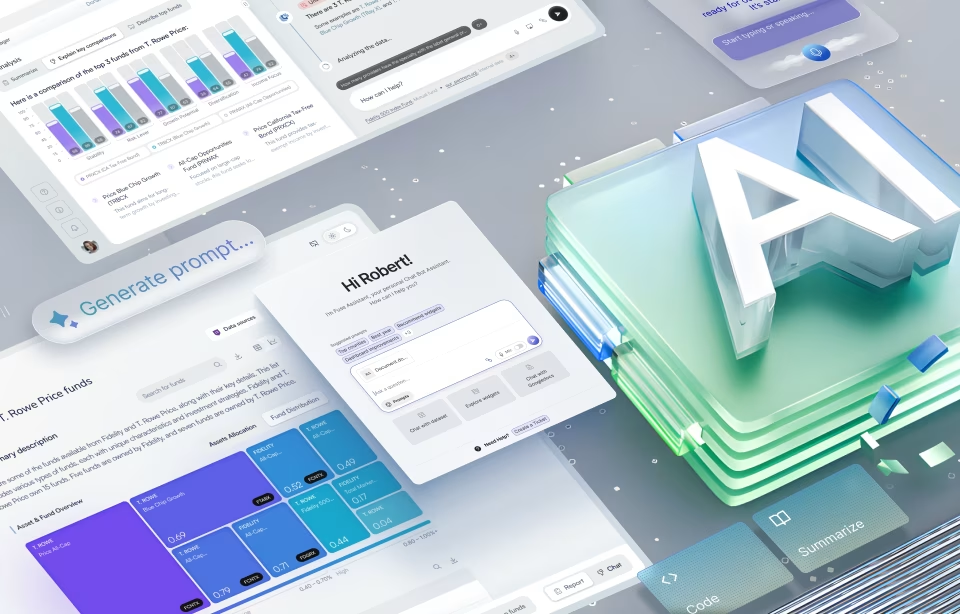
Artificial Intelligence (AI) is a game-changer as far as CRM systems are concerned. More and more businesses are leveraging AI to gain valuable insights from customer data, automate routine tasks, and deliver personalized experiences at scale.
Predictive analytics is one of the most befitting examples of this exciting blend of AI and CRM. AI algorithms are helping break down historical data and extract patterns, which is then helping predict future customer behavior like purchase likelihood or churn risk. Businesses are able to proactively address customer needs, upsell and cross-sell products, and optimize marketing campaigns.
Not to mention, AI-powered chatbots and virtual assistants are taking customer service interactions to the next level as per the latest CRM technology trends. These intelligent systems handle wide-ranging customer inquiries, provide instant support, and resolve issues efficiently. Businesses can automate most of their routine tasks using AI, freeing up human agents to focus on more complex and strategic issues, thus improving overall customer satisfaction and operational efficiency.
#2 Hyper-Personalization
Think about tailoring customer experiences to individual preferences and behaviors – that’s exactly what hyper-personalization tends to achieve. The powerful combination of data analytics and AI in CRM is giving businesses a deep understanding of their customers’ needs and preferences. This helps deliver highly targeted and relevant messages, offers, and recommendations.
CRM software market trends show how crucial data analytics is in understanding customer behavior. Customer data like purchase history, browsing behavior, and social media interactions can give away patterns, trends, and segments.
This data-driven approach allows businesses to tailor their marketing campaigns, product recommendations, and customer service interactions to specific customer segments. For instance, Automatize is a supply chain software platform focused on travel optimization that uses a robust interface design and data analytics for a personalized experience.
Real-time personalization takes hyper-personalization to the next level by delivering personalized experiences in the moment. Say you can leverage real-time data streams, such as website behavior and social media interactions. This helps dynamically adjust brand messaging and offers to individual customers. With this level of personalization, businesses have it all for enhanced customer engagement and conversions.
#3 Omnichannel CRM
Omnichannel CRM is among the upcoming B2B CRM trends for a seamless and consistent customer experience across all touchpoints, including physical stores, websites, mobile apps, social media, and call centers. By integrating various customer channels, businesses can create a unified view of the customer journey and deliver personalized experiences that meet customer expectations.
A key aspect of omnichannel CRM design is to ensure a consistent customer experience across all touchpoints. This means that customers should receive the same level of service and information, regardless of the channel they choose to interact with the business. The role of CRM interface in customer management stands out with the trust and loyalty it builds for the brand.
Centralized customer data management is essential for effective omnichannel CRM. By consolidating customer data from various sources into a single repository, businesses can gain a comprehensive view of customer interactions and preferences. This enables them to deliver personalized experiences, identify opportunities for cross-selling and upselling, and improve customer service.
#4 Customer Journey Mapping
Customer journey mapping does exactly what it says – helps understand the customer experience from beginning to end. With the entire customer journey visualized businesses have all the info they need to identify pain points, opportunities for improvement, and areas where they can delight customers.
Pain points could include long wait times, complex processes, or inconsistent information. Addressing them can improve customer satisfaction and loyalty. Opportunities may include offering personalized recommendations, providing proactive support, or creating seamless transitions between different touchpoints. Optimizing the customer experience this way can help businesses differentiate themselves from competitors and build long-lasting customer relationships.
#5 Social CRM
In this era of mobile CRM trends, social CRM uses social media platforms to engage with customers, build relationships, and gather valuable insights. Social media is a no-brainer for businesses today – the more actively they participate in conversations, the stronger their brand’s visibility and loyalty will be, ultimately driving sales.
It is this presence that social CRM tracks and leverages. Businesses can monitor social media channels to track brand sentiment and customer feedback. They can listen to what customers are saying about their brand, identify potential issues, address concerns promptly, and capitalize on opportunities. It can also help track keywords, hashtags, and mentions of their brand, products, or services.
Future Predictions for CRM Industry Trends
Technology is a wheel on the go, and CRM systems are also moving apace to become even more strategic and powerful. The future of CRM design holds exciting possibilities for businesses to enhance customer relationships, drive growth, and gain a competitive edge.
The Rise of CRM Platforms as a Strategic Hub
CRM platforms are increasingly becoming the central hub for businesses to manage their customer relationships and drive growth. The integration of CRM design with other business systems like ERP, marketing automation, and customer support can create a seamless and efficient workflow.
This enables data to flow freely between systems, providing a unified view of the customer and empowering businesses to make informed decisions. Users may also explore the 5 smart CRM design strategies to grow your business.
Data Privacy and Security in CRM Software Trends
As businesses collect and store increasing amounts of customer data, data privacy and security become paramount. Implementing robust data protection measures is crucial to safeguard sensitive customer information from cyber threats. Strong encryption, firewalls, and access controls can protect data from unauthorized access.
Adhering to data privacy regulations, such as GDPR and CCPA, is also critical to maintaining customer trust. CRM design trends in 2024 call for compliance with these regulations by obtaining explicit consent, providing transparency about data collection and usage, and implementing data breach notification procedures.
Conclusion
The future of CRM is poised to be even brighter in 2025 than possibly any years in the past with all of the emerging add-ons, and other exciting trends on the horizon. From AI-powered CRM to hyper-personalization, omnichannel CRM, customer journey mapping, social CRM, and data privacy and security, business interaction with customers is on the brink of a major overhaul.
Remember that CRM is no longer just a tool for managing customer relationships; it is a strategic imperative for businesses of all sizes. Organizations that embrace innovation, stay updated with the latest trends, and prioritize data privacy and security can leverage CRM to achieve long-term success.
Author