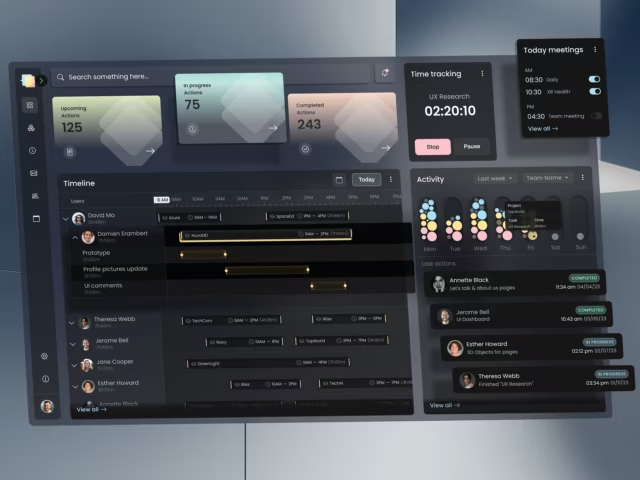
We design internal applications, enterprise dashboards and compliance-grade interfaces for organizations across industries.
Enterprise UX design is the practice of designing internal applications, operational dashboards and data-heavy interfaces that satisfy enterprise constraints on role-based access, audit logging, accessibility and security review. Fuselab Creative provides enterprise UI/UX design services for organizations building or modernizing the internal systems their teams rely on daily.
What enterprise UX design includes
Enterprise UX work splits into a few recurring engagement types. Each starts with the same discovery rigor but differs in scope, integration complexity and what the success metric actually measures. The services below describe how we scope and deliver each.
Internal Application Design
New internal application design covers the end-to-end work of bringing a net-new internal tool from a defined business need to a launched, adopted product. The hardest part is rarely the screens. It is the work of mapping decision-making across departments, identifying the data sources the tool will integrate with, and aligning on a permission model that satisfies both the people who will use the tool and the people who will audit it. Without that alignment in discovery, the design phase produces interfaces that fail security review three months later.

Enterprise Dashboard Design
Enterprise dashboard design is the work of turning data from multiple operational systems into a single interface where users can monitor, drill in, and act. The design challenge is rarely chart selection. It is the work of reconciling data freshness across sources, designing for users at different organizational levels (frontline operators see different views than executives), and keeping the dashboard useful when the underlying data shape changes. A dashboard that needs a redesign every time a new metric is added is a dashboard that will be abandoned within a year.

Enterprise UX Redesign
Most enterprise UX engagements are redesigns, not greenfield builds. An internal application that has been in production for five or more years has accumulated workflow patches, feature debt, and accessibility gaps that block modernization. The redesign work is half archaeology and half design. We map what the current product actually does (often different from what its documentation says it does), what users have built workarounds for, and what the new design needs to preserve so adoption survives the transition.
Enterprise Design Systems
Most large enterprises already have a design system. The work is usually to extend it where it does not cover a new use case, or to consolidate two competing systems after a merger or platform shift. Building one from scratch is rare and expensive (12 to 18 months minimum for a production-grade system). The more common engagement is the targeted extension: documenting where the existing system breaks down, designing the new patterns, and integrating them back into the system in a way the team can maintain after the engagement ends.

AI-Enabled Enterprise Interfaces
AI capabilities are arriving in enterprise software faster than the interface patterns to support them. The design problem is not how to add an AI feature. It is how to surface model confidence, expose graceful fallbacks when the model is wrong, and design role-based access to AI outputs so that decisions made on AI recommendations remain auditable. Enterprise AI interface design draws on the same accessibility, RBAC, and audit-trail constraints as conventional enterprise UX, plus the additional challenge of designing for systems that behave probabilistically.
Enterprise Mobile and Cross-Platform
Field workforces, branch staff, and partner-facing roles often need enterprise functionality on mobile. The design work is rarely a phone-sized version of a desktop interface. It is the work of deciding which tasks belong on mobile (action-oriented, time-sensitive, single-purpose) versus which stay on desktop (multi-table review, complex form entry, configuration). Get the split right in discovery and the engineering team builds two focused products. Get it wrong and you ship one app that fails on both surfaces.
Enterprise UX engagements
we have delivered




How a Fuselab enterprise UX engagement works
A Fuselab enterprise UX engagement runs in four phases. Discovery sets the success metric and audits the existing system. Research and design produces the validated interaction model. Build collaboration carries design quality through engineering handoff. Adoption verifies the work landed after launch. Most enterprise UX projects fail in build collaboration rather than in design, which is why we structure the engagement around that risk.

Stakeholder interviews cover end users, their managers, engineering, security and compliance. The system audit catalogs the business rules embedded in the current interface (most of them are not in any documentation) and produces an accessibility baseline against WCAG 2.1 AA. Internal applications accumulate workarounds over years. Finding them in discovery is what prevents the redesign from breaking workflows nobody knew existed.
Deliverable: a defined success metric the engagement will be measured against, plus a documented map of the workarounds the redesign must preserve.

The permission model is the structural backbone of an enterprise interface. It determines what every screen can show, which actions appear for which role, and where the data audit trail begins. We design it before the visual layer, not after. High-fidelity prototypes test against real data states, not placeholder content. User testing happens with actual role-holders, not surrogates from the design team.
Deliverable: a role-based interaction model, a design system extension covering patterns the existing system does not handle, and documented exceptions where the system breaks down.

Design quality is preserved or lost in the build, not in the design phase that came before. Engineering teams encounter edge-case data states during implementation that were not in the prototypes. The choice in that moment, defend the spec or accept reality, determines what actually ships. Working sessions with engineering exist to make that choice deliberately rather than by drift.
Deliverable: a shipped product whose role behavior, data states and accessibility match the spec, with documented exceptions where they do not.

Enterprise UX work is judged 90 days after launch, not at launch. The first 30 days are about onboarding and training. The next 60 are about whether early adopters tell their colleagues the new tool is better than the old one. Internal projects that lose the early-adopter narrative rarely recover, even when the underlying product is objectively stronger. The adoption work is half measurement and half internal communications.
Deliverable: a 30/60/90-day adoption report tied to the success metric set in discovery, plus the audit documentation the next product team will need.
Industries we design
enterprise UX for
Fuselab Creative has delivered enterprise UX engagements across six core verticals. The constraints differ substantially by industry, which is why we anchor each engagement on the specific compliance, integration and role-coverage requirements that vertical brings.
Every financial interface has two readers: the user who needs a clear view of the data, and the auditor who needs every state change recorded in the underlying log. The work involves reconciling data from multiple transaction systems into a single coherent view, designing role-based access for branch staff and executives, and preserving the audit trail underneath every interaction so compliance review never has to reconstruct what the user did.
Government enterprise UX operates under Section 508 accessibility and public-records requirements that few private-sector projects encounter. Interfaces have to be fully operable with screen readers, low-vision tools and keyboard-only navigation, with the same data accuracy as the technical reporting underneath, and they must survive review by accessibility auditors who test against the published rule rather than the design team’s interpretation of it.
Healthcare interfaces have to handle HL7 and FHIR data integration, HIPAA compliance review, and clinical workflow patterns where every action triggers downstream records. Patient safety considerations constrain how warnings and confirmations behave, and clinician trust in AI-driven recommendations runs into a direct trade-off: the time cost of verifying a model output competes with patient throughput.
AI capabilities are arriving in enterprise software faster than the interface patterns to support them. Enterprise AI interfaces need role-based access to model outputs, confidence indicators that engineers actually trust, and clean ways to surface graceful fallbacks when the model is wrong. The harder design problem is rarely the AI feature itself. It is the auditability of decisions made on AI recommendations.
Industrial enterprise UX has to work at three altitudes at once: the floor operator monitoring a single line, the shift manager coordinating across lines, and the executive watching the whole plant. The same underlying data has to surface as three substantially different interfaces, with role-specific views that hide the source-system complexity rather than exposing it to the user.
Transportation and logistics interfaces handle data at fleet scale where the operational picture changes minute by minute. The design work covers hierarchical data displays that hold up under real-time updates, role-based interaction patterns where dispatchers, drivers and partners each see a different slice of the same dataset, and partner-facing dashboards that work outside the client’s internal user permissions model.
Contact Us
Tell us about your project
Frequently Asked
Questions
Questions we get from VPs of Product, procurement leads and digital transformation owners evaluating Fuselab for enterprise UX engagements.
What is enterprise UX design?
Enterprise UX design is the practice of designing internal applications, operational dashboards and data-heavy interfaces that satisfy enterprise constraints on role-based access, audit logging, accessibility and security review. The work is distinct from consumer or SaaS product design because the user is required to use the product and the design must pass compliance review before shipping.
What does an enterprise UX agency do?
An enterprise UX agency designs the interfaces enterprise organizations rely on internally for operations, decision support and partner-facing data access. The work typically includes discovery interviews with multiple stakeholder roles, design of role-based permission models at the interface layer, accessibility compliance documentation, and design system extension where existing client systems do not cover new use cases.
How is enterprise UX different from SaaS UX?
Enterprise UX is built for users who are required to use the product as part of their job, while SaaS UX is built for users who self-select and can churn. SaaS UX optimizes for trial conversion and onboarding speed, while enterprise UX optimizes for role coverage, compliance review and long-term adoption measured in quarters rather than weeks.
Is enterprise UX the same as B2B UX?
Enterprise UX is a subset of B2B UX focused specifically on large organizations and internal-tool work. B2B UX includes both enterprise products sold to large organizations and SaaS products sold to small and mid-market businesses. Enterprise work requires audit trails, role-based access and accessibility compliance that mid-market B2B SaaS rarely requires.
How much does an enterprise UX project cost?
Enterprise UX projects at Fuselab Creative range from $40,000 for a focused discovery and design audit to $450,000 for a full multi-role enterprise design engagement. Ongoing design partnerships for enterprise product teams range from $35,000 to $80,000 per month depending on team size and scope.
How long does an enterprise UX engagement take?
Enterprise UX engagements at Fuselab Creative typically run four to fifteen months depending on scope. A focused internal-tool engagement runs four to five months, a multi-role enterprise dashboard runs six to nine months, and a multi-product design system runs nine to fifteen months including post-launch adoption work.
How do federal agencies engage Fuselab?
Federal agencies can engage Fuselab Creative directly through GSA Schedule 47QTCA22D00CV without running a competitive bidding cycle. State agencies can engage via cooperative purchasing agreements or direct contract. Federal engagement typically takes four to eight weeks from initial contact to signed statement of work, versus competitive bidding which typically takes a year or more.
Read Our Blogs
Our approach to enterprise UX design services explained in detail.