How long does a UX design project take in 2026
How long a UX design project takes ranges from about three weeks for a focused research engagement to a year for a multi-role enterprise platform, and the deciding factor is complexity rather than the number of screens. A healthcare dashboard with five user roles and two approval workflows can take longer to design than a hundred-screen analytics platform because role counts and permission logic drive the schedule far more than screen counts do.
Four forces set the real timeline: the number of user roles and permission states the product must support, the degree of stakeholder alignment, the cleanliness of the existing research and design system, and whether the product carries regulatory weight. A project with one decision-maker, documented research, and an existing design system runs in the short half of any range. The same scope with four approvers and no prior research can take three times as long.
Teams planning budgets usually ask about the timeline right after they ask about cost, because scope, uncertainty, and stakeholder involvement drive both. Readers weighing the schedule against the budget will find the UI/UX design cost guide useful for seeing how scope definition changes the number.
Typical UX project timelines, by scope: UX research runs three to six weeks, an onboarding redesign six to ten weeks, single-role SaaS product design three to five months, a greenfield design system four to seven months, and a multi-role enterprise platform six to twelve months. Where a project lands within its range depends on the project’s scope complexity and the extent of research and stakeholder alignment before design begins.
How long does a UX design project take: honest ranges
A UX design project runs from about three weeks at the low end to roughly a year at the high end, and the spread reflects how much uncertainty the team must resolve before it can commit to a design. A focused research or activation engagement finishes in weeks, while a multi-team platform redesign takes most of a year.
Industry averages flatten this range in a misleading way. Clutch review data puts the typical agency UX engagement at around ten months, which says less about a normal project than about which projects get outsourced: most agency engagements sit toward the complex end of the spectrum, and that pulls the average up.
The ranges below show where each scope of work typically lands, along with the one variable that drives each timeline up or down.
Add twenty to thirty percent to any range above for a product without an existing design system or documented user research.
UX design phases and typical durations for each
Most UX design projects move through six phases: discovery and research (2 to 6 weeks), information architecture (1 to 3 weeks), wireframes and interaction design (2 to 6 weeks), usability testing (1 to 3 weeks per round), visual design and design system (2 to 6 weeks), and engineering handoff (1 to 2 weeks). Each phase is set by a different constraint, which is why compressing one rarely shortens the whole project.
Discovery and research (2 to 6 weeks) sets the objectives, constraints, and success criteria before design starts. Teams review business goals, analytics, customer feedback, and technical limits, then define user roles and workflow boundaries through interviews and data review. The facilitated discovery sessions usually take a week to ten days; the remaining two to six weeks go to participant recruitment and synthesis, which expand or contract depending on how much usable research already exists.
Discovery is also the phase teams cut first under deadline pressure, and the data suggests otherwise. NNGroup’s survey of UX practitioners found that time pressure was the most common reason organizations skip discovery, and the outcomes diverge sharply: 83 percent of respondents who ran a discovery called their last project successful, against 52 percent of those who did not. As the saying goes, we don’t know what we don’t know. If discovery is skipped and designers just use what is given to them, they are exponentially more likely to have to implement late-stage, costly design updates.
Information architecture and user flows (1 to 3 weeks) turn the research into a structural model: how information is organized, how each role moves through the product, and how permissions shape what each role sees. This phase looks short, but it is where most enterprise timelines are quietly decided. The permission model decided here is expensive to revisit later, because every conditional state it creates carries forward into wireframes, visual design, and testing.
Wireframes and interaction design (2 to 6 weeks) is where the architecture becomes a testable interface, with layouts, states, interactions, and system behavior defined before visual design begins. Complex products spend longer in this phase because each screen needs its full set of states, empty, loading, error, and edge case, resolved before visual design can begin.
Usability testing, one round (1 to 3 weeks), covers participant recruitment, session facilitation, and synthesis. One round is the minimum for any engagement involving new information architecture or a changed onboarding flow. Two rounds, one after wireframes and one after beta, is standard at Series B and above, where the cost of failure exceeds the cost of another testing cycle.
Visual design and design system (2 to 6 weeks) add hierarchy and brand consistency. Teams building new component libraries spend longer here because documentation and engineering alignment become deliverables in their own right. For mature products the work is faster, but it carries the added job of preserving design familiarity.
Engineering handoff and documentation (1 to 2 weeks) is the phase agencies most often underestimate. Annotating component behavior, documenting responsive rules, and answering engineering questions about edge cases can take more time than producing the design file itself.
To see how those phases stack into a single schedule, take a mid-complexity product dashboard built for one primary user role, with documented research and an existing design system already in place.
That is roughly four months under favorable conditions. Make the dashboard multi-role, add a compliance review for a healthcare or fintech context, or build the design system from scratch, and the same product moves into the six-to-twelve-month range, not because there are more screens, but because there are more roles, approvals, and validation cycles to clear.
Timeline by project scope
Every scope of work has one binding constraint that sets its timeline, and knowing which one lets a buyer judge whether a quoted schedule is realistic. For research, it is recruitment, for a design system, it is the inconsistency already sitting in the product, for an AI interface, it is trust-state design, and for an enterprise platform it is the permission model. A schedule that compresses one of these without addressing its constraint is the schedule that slips.
Research is gated by recruitment, not by analysis. Finding and scheduling six to ten participants who match the target profile takes longer than the interviews and synthesis combined, and in enterprise or clinical products, where the right users are senior and hard to reach, that single step can stretch a three-to-six-week engagement by another week or two.
Activation and onboarding redesigns are predictable because the scope is deliberately narrow: one role, one critical workflow, one outcome metric. The work is still real, understanding behavior, redesigning flows, validating the change, and preparing engineering-ready deliverables, but the bounded scope is what keeps it inside the six-to-ten-week window growth-stage teams plan around. Widen the scope to a second role and the predictability disappears.
A design system’s timeline is governed by how much inconsistency already exists in the product, not by the component count. Every mismatch found in current screens becomes a decision about which pattern is now correct, and those decisions, plus token alignment, documentation, and engineering implementation, are what carry a greenfield system into the four-to-seven-month range. A product with disciplined existing patterns finishes near the bottom of that range; one with years of drift finishes near the top.
AI work varies more than any other scope because the timeline depends on how deeply the model shapes the product. A supporting AI feature bolted onto an existing product runs eight to twelve weeks. A production-ready AI interface on a mid-complexity product runs four to seven months. An AI-native workflow, where model behavior defines the product itself, takes longer still. What separates the tiers is trust-state design, not screen count.
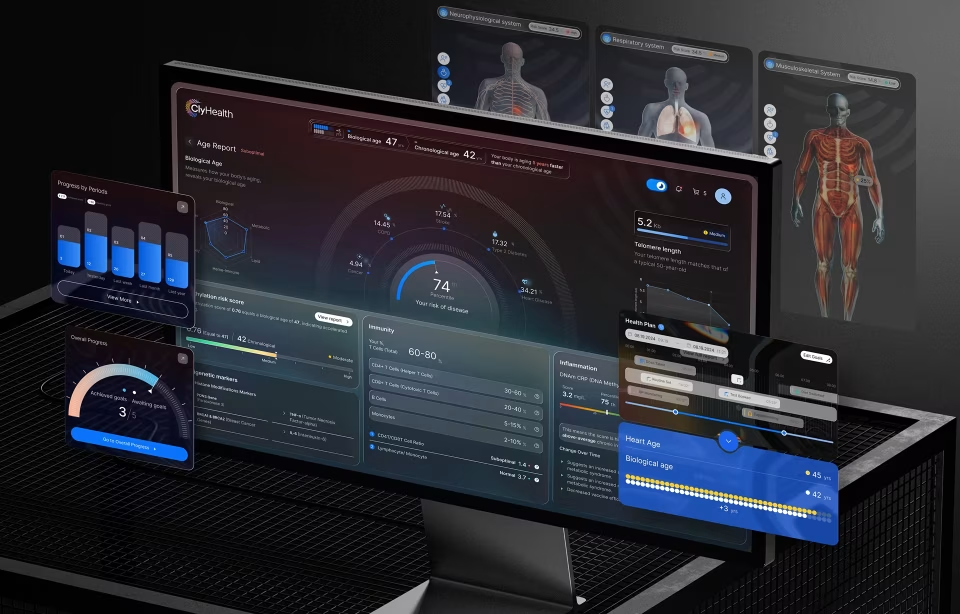
In our work on a clinical AI platform, ClyHealth, the difficulty was rarely drawing the interface. It was deciding how uncertainty should appear on screen without overwhelming the clinician or undermining trust in the recommendation. Letting a clinician read a recommendation, weigh the evidence, and decide whether to act without leaving the screen can take several rounds of clinical testing to settle, which is one reason healthcare UX projects run longer than comparable commercial work.
Enterprise platforms carry the widest range because they stack the hardest version of every other constraint into one engagement. Information architecture, a design system, third-party integrations, and regulatory review all run together, and each has to stay consistent with the others every time one of them changes. That convergence, not the screen count, is what commonly stretches the work to six to twelve months.
How long a UX design project takes by team size and complexity
Adding designers does not reliably make a project faster. How long a UX design project takes depends on complexity and stakeholder structure more than on headcount. A project with one decision-maker, documented research, and an existing design system runs in the shorter half of any scope range, while the same scope with four phase-gate approvers, no prior research, and a legacy interface runs far longer.
In scheduling terms, complexity is mostly a measure of how much has to be worked out from scratch. A project that begins with documented analytics, session recordings, and prior research can cut the discovery phase roughly in half, and that head start compounds, because every later phase inherits cleaner inputs. A project starting cold pays that time back across the whole schedule.
Simple products, MVPs, and focused redesigns are often handled by a single designer. The advantage is speed: decisions happen quickly and ownership stays clear. The limitation is that one person cannot run parallel workstreams, so the work proceeds in sequence and that sets the pace.
Most mature product engagements run with small teams of two to four designers, which lets research, interaction design, and design-system work move at the same time. Larger teams of five or more become necessary on enterprise transformations spanning hundreds of screens or several products. Past that point, more designers mean more reviews, more dependencies, and more chances for inconsistency, and adding people starts to consume the very time it was meant to save.
What lengthens a UX project (and how to avoid it)
Most schedule overruns are organizational problems disguised as design problems. Projects run late far more often because of changing priorities, unclear ownership, and slow decisions than because designers underestimated the work. Design itself is rarely the bottleneck, but blaming the designer is often the easiest way out of the heat from a superior.
Stakeholder count and availability are the usual causes of timeline extension. A two-week review cycle that needs sign-off from four stakeholders is normal in enterprise software, and we have watched the same review take one week when those people are aligned and four weeks when they are not. The fix is structural: designate a single point of contact on the client side and grant that person decision-making authority.
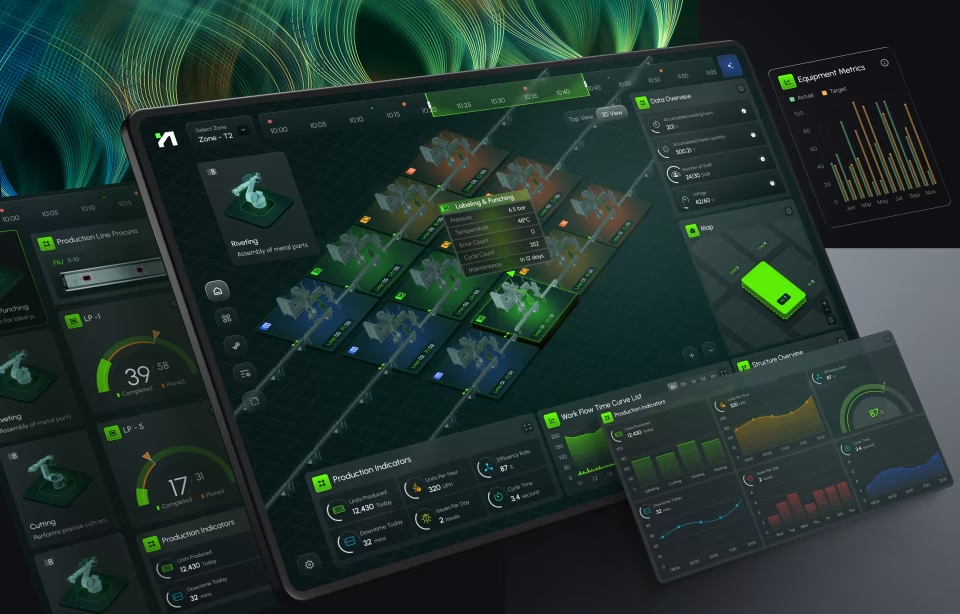
The pattern is consistent. On one enterprise dashboard engagement, the design work finished on schedule, but the project still ran two months long because a single decision, which roles could override an automated flag, needed sign-off from three departments that had never had to agree on anything before. None of that delay was built into the design. It lived in the org chart.
Scope expansion during an active engagement is the second major driver. Requirements evolve, priorities move, and new ideas surface the moment stakeholders see working prototypes. Some change is inevitable, but a scope gone rogue can turn a twelve-week project into a six-month one. The defense is to write scope gates explicitly into the contract.
Late engineering involvement is the third reason weeks appear without warning. When engineering waits until handoff to weigh in, it surfaces technical constraints that force rework on decisions that looked settled. Building shared milestones where engineering tests the prototype early keeps those constraints from arriving at the worst possible moment. This point can not be emphasized enough!
Compliance-heavy products in healthcare, fintech, and AI need explicit extra time. Accessibility requirements, security review, approval workflows, and edge cases all add validation before implementation can start. Making sectoral compliance clear from the first scoping conversation is the simplest way to get a realistic timeline with no late surprises.
Timelines also depend on whether the work runs through an agency or a new in-house team. A new in-house hire typically needs two to three months to reach productive output on a complex product, while an agency usually starts delivering within the first two to four weeks.
What shortens a UX project (and the tradeoffs)
The reliable ways to shorten a UX project are documented user research, an existing design system, a single engaged decision-maker, and engineering involvement throughout. Each one removes either a phase that would otherwise be built from scratch or a bottleneck that would otherwise stretch every review cycle.
Products with existing research, such as analytics, customer interviews, and historical insight, move faster because the team can design without re-validating fundamentals. The tradeoff is that older research may no longer fit the current context. Skipping research altogether is a different matter, and that cost tends to surface only after the product reaches the market.
Direct coordination between the agency and an engineering lead shortens timelines, because the questions that stall a design review get answered in conversation rather than through a formal channel. Running design and engineering sprints in tandem can compress the total schedule further.
The tradeoff is cost. Overlapping cycles catch mistakes early, but once engineering is already building, every structural change a review surfaces becomes both a development and a design cost. Cycles should only overlap once the design is stable at the component level.
Mature design systems with existing component libraries and patterns cut design effort substantially, freeing the team to spend its time on workflow problems rather than reinventing common interactions. The tradeoff is that legacy patterns sometimes hold back a better approach.
How to plan realistic timelines
A realistic answer to how long a UX design project takes starts from the scope of the design problem, not the product launch date. Working backward from a launch date produces commitments that collapse once research uncovers new requirements, priorities shift, or engineering constraints surface late. The goal is a schedule built to survive contact with reality.
Realistic planning maps each phase against the constraint that actually sets its duration, using the phase breakdown above. It then adds two variables most plans leave out: stakeholder review cycles, modeled as days of availability per week rather than as milestones, and a scope buffer of ten to fifteen percent for the decisions that surface during engineering handoff.
Leaving room for iteration is useful, but it is just as important to identify what cannot move. Product launches, regulatory dates, funding milestones, and conference announcements create fixed deadlines. Once those are clear, the team can decide how much flexibility exists elsewhere and where to absorb the adjustments.
If you are scoping a UX initiative and are not sure where it falls, a discovery workshop is the fastest way to turn a guessed deadline into a defensible range. It pressure-tests your scope against the variables that actually move a schedule and produces a timeline you can take to engineering and finance. You can start that conversation through our UX research and discovery service.
Frequently asked questions
How long does a UX design project take for a SaaS product?
A focused activation or onboarding redesign for a SaaS product runs six to ten weeks from kickoff to engineering handoff. A full product design engagement covering discovery, architecture, core user flows, and a design system runs four to seven months. Compliance-heavy or AI workflow integrations push these timelines higher.
What are the main phases of a UX design project?
A full UX project moves through six phases: discovery and research (2 to 6 weeks), information architecture and user flows (1 to 3 weeks), wireframes and interaction design (2 to 6 weeks), usability testing (1 to 3 weeks per round), visual design and design system (2 to 6 weeks), and engineering handoff (1 to 2 weeks). Each phase answers to a different constraint, so compressing one without understanding that constraint usually costs more time later.
How long does UX research take?
A standalone UX research engagement, including participant recruitment, interviews, synthesis, and a findings report, usually runs three to six weeks. Participant recruitment is the most variable part, especially for enterprise and regulated-industry products where target users are hard to reach and have limited availability.
How long does it take to design an AI product?
Designing a production-ready AI interface on a mid-complexity product runs four to seven months, longer than general SaaS design because it adds model-behavior documentation, trust-state design, and clinical or operational validation of confidence and override patterns. A supporting AI feature on an existing product is shorter, closer to eight to twelve weeks.
What is the most common reason UX projects take longer than planned?
Schedule overruns are usually organizational rather than design problems. Scope changes, slow approvals, competing priorities, and unclear ownership delay projects more often than the design work itself does.
How is a UX design timeline different from a development timeline?
A UX design timeline runs ahead of development and then overlaps it, typically adding two to three months at the front of a project before engineering reaches full speed. The two are not strictly sequential in practice: the strongest schedules overlap design and build once the design is stable at the component level, which shortens total delivery without forcing rework.
How long do enterprise UX projects take?
Enterprise UX projects commonly take six to twelve months. Larger platform redesigns that involve research, a design system, and several stakeholder groups land toward the upper end, nine to twelve months, and longer when compliance is involved.