Turn your concept into a functional first release with senior product designers and engineers, working as one team from discovery to delivery.
Fuselab’s MVP development services combine product discovery, UX/UI design, front-end and back-end development, and QA, all in-house. Get a clearly defined scope, a fixed price, and full ownership of your source code, design files, and intellectual property at handover.









What You Need to Know
A strong engineering team cannot compensate for an unvalidated idea. An MVP tests your core assumptions with real users and confirms demand before you commit to a larger investment.
Know what to build first
The decisive work happens before the first sprint: research that pins down the real problem, scoping that shapes a testable release, and design that makes the core value obvious in the first session. Get these three phases right and the build phase becomes the easy part, a matter of execution rather than guesswork.
One team, research to release
This is why Fuselab runs MVP design and development as one team. The people who run your discovery research also design the interface and write the production code, so the thing that ships is still the thing the evidence pointed to. When the same people carry the idea from research to release, nothing gets lost in translation between firms.
Fewer features, better answers
In practice, this means challenging every proposed feature early, testing assumptions with users, and deciding what belongs in the MVP on evidence, not internal preference. Those conversations are easier before launch than after it, and the features that get cut are usually the ones real usage data would have killed anyway.
Numbers from week one
An MVP isn’t defined by how small the product is, but by whether it has the minimum functionality needed to test its core value. From week one, analytics are mapped to the questions the product exists to answer, so launch results produce evidence rather than impressions, and the data decides what comes next.
What our MVP development services include
Complete MVP development services cover discovery research, feature prioritization, UI/UX design, front-end and back-end engineering, QA, and launch support. Every stage is delivered by Fuselab's in-house team, including AI feature integration where the product calls for it. Here's what our process includes:
Scoping
Most clients do not need every phase. A founder with strong customer evidence can skip straight to product definition, while an enterprise team with an approved concept may only need design and engineering. The scope follows what you already know, which is the first thing a discovery call establishes.
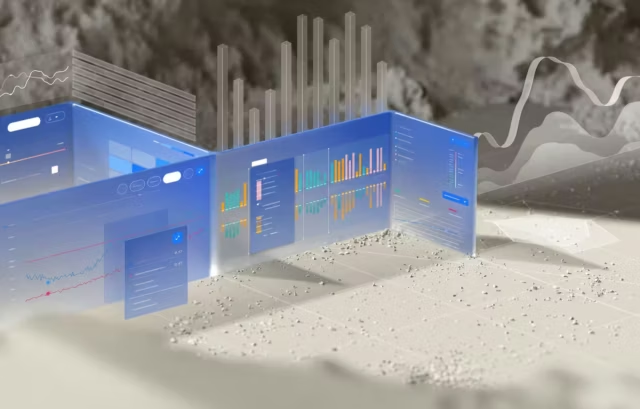
Discovery and validation research
Interviews, competitive analysis, and demand signals that establish what the MVP has to prove, run by the same UX research practice we apply to enterprise discovery work.
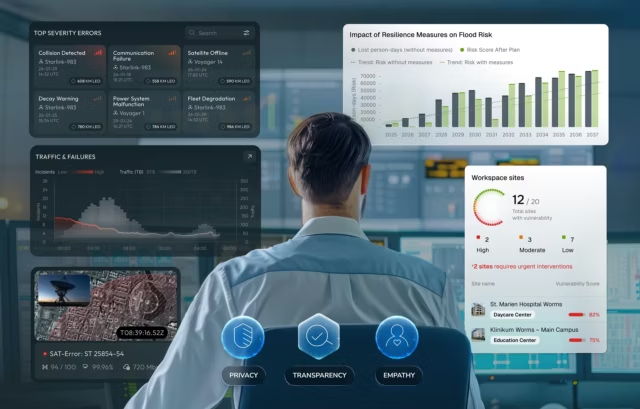
Product strategy and feature prioritization
A defended list of what makes version one and why, so investors and internal reviewers can see the reasoning behind every feature that made the release or missed it.
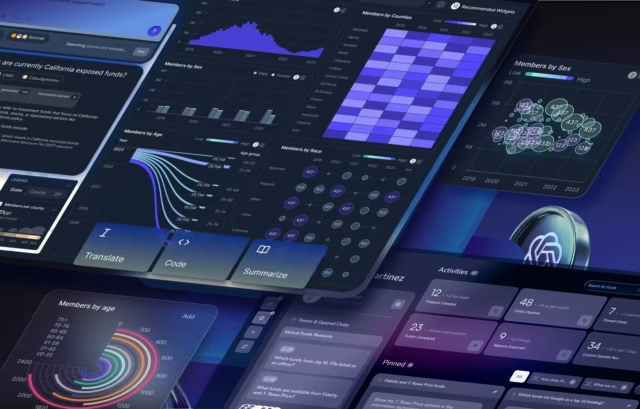
UI/UX design
Interface design from wireframes to a tested high-fidelity prototype, including the design foundations your next hires will build on.
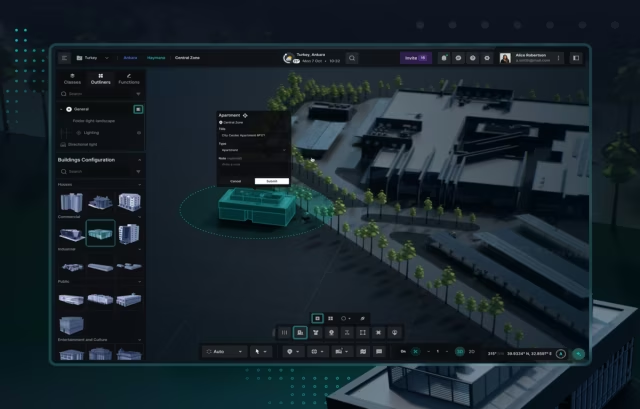
MVP app development
Front-end and back-end software engineering for web and mobile, QA, and release management, handled by Fuselab engineers rather than a partner shop.
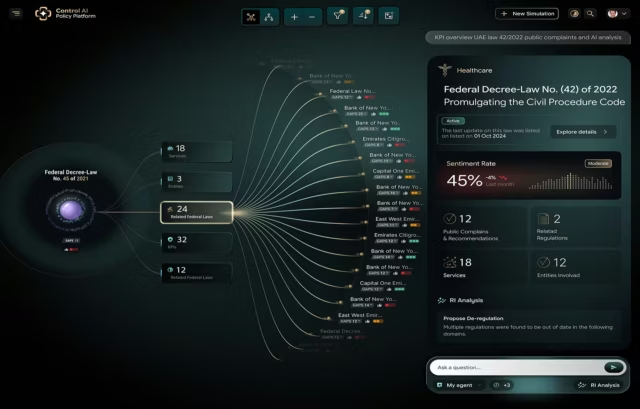
AI feature integration
Model selection, prompt and interaction design, and fallback behavior for products whose core value depends on an AI feature working credibly in front of users who abandon what they do not trust.
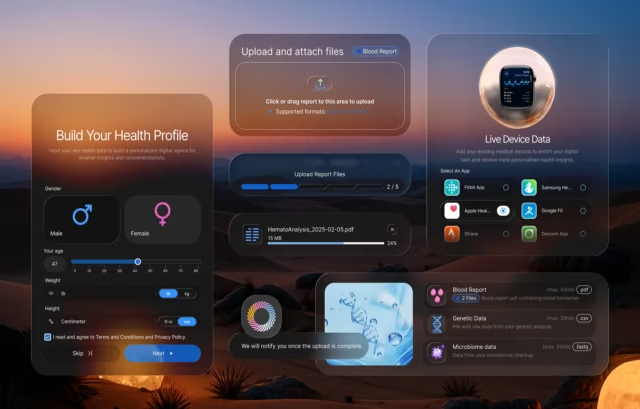
Launch measurement
Analytics, event tracking, and feedback capture built in before release, so clients see what users actually do from day one.
Discovery and Scope Lock
3 days that decide what gets built. We interview stakeholders and target users, pressure-test the concept, and end with a signed screen inventory: the numbered list of what makes the release and why. Concepts change here more often than founders expect, and changing on day 3 costs hours, not sprints.

Design Direction and System
One visual direction, built on the hardest screens first, then the design system that makes the rest fast: tokens, components, type, and contrast, expressed in code-ready form. You approve the direction before a line of screen code exists, and iteration inside that approval stays free and fast.

Build, Live Weekly
Three weeks of engineering with a weekly demo on a real URL, not a screen share. You watch the core flow work in week 2, walk the whole product in week 3, and see states, responsiveness, and accessibility land in week 4. Misalignment surfaces in days, and the build stays honest.
Launch and Learning
Launch is treated as the start of the measurement period rather than the end of the project. Analytics events, funnels, and feedback channels go live with the product, and we read the first weeks of data with you against the hypothesis from discovery. What you learn decides the next build cycle, a pivot, or a confident scale-up.

MVP Development Services by Industry
Fuselab builds MVPs for startups proving demand, enterprise teams testing a new line of business, and fintech, healthcare, and government products that must clear compliance at launch. Each one has to get its first version right.

Startup MVPs often need to demonstrate a credible path from concept to adoption. MVP development services for startups focus discovery on the highest-risk assumptions, prioritize the core user flows, and give investor-facing product experiences the same attention as everyday workflows.

An enterprise MVP has three extra audiences: procurement, security review, and the internal politics around any new product. We scope it to produce evidence an executive sponsor can defend, run design reviews that include IT and compliance early, and build on infrastructure your security team has already approved.

In fintech, compliance decisions are scope decisions: KYC, data handling, and audit constraints determine what version one can even be, so we settle them alongside the feature list rather than after it. Payments, account linking, and reporting are each scoped to the rule they fall under, so the first release passes its first audit without a rebuild.

A healthcare product is regulated before its first user ever logs in. HIPAA and Section 508 are launch requirements in our scoping, so the review gates are set before the first screen is designed, not after the build. Patient data flows, access roles, and audit logging are defined in discovery, where changing them costs hours rather than sprints.

Government product teams can work with Fuselab directly through GSA MAS Contract 47QTCA22D00CV, with no separate competitive bid process, which saves time when a pilot needs to move before the fiscal year ends. Public-sector MVPs get scoped to their own rules: Section 508 from day one and procurement-ready documentation at handoff.

An AI product behaves in ways deterministic software does not: outputs vary, latency shapes trust, and users need a way to challenge the system when it is wrong. Fuselab designs and builds AI MVPs with fallback behavior and confidence display treated as core features, so users can check the system before they trust it.
After the MVP
An MVP that proves its case becomes version one, and the cost of that transition is set months earlier. Fuselab builds on production-grade foundations, so growth means extending the product rather than rewriting it: the design system and the codebase both carry forward into the next release.
Post-launch work runs as a monthly engagement with the same team: feature expansion, new integrations, and a second round of research against live data. Some clients continue with our digital product development team, and others take the codebase in-house with our help hiring. Both paths are planned before launch, not negotiated after it.
MVP development services: frequently asked questions
Minimum viable product development services raise the same questions in every sales conversation: coverage, cost, timeline, and ownership. Here are the answers we give buyers, with numbers where we have them.
What are MVP development services?
MVP development services cover the strategy, design, engineering, and launch of a first product version built to test market demand before a full investment. A complete engagement includes discovery research, feature prioritization, UI/UX design, front-end and back-end development, QA, and the analytics needed to judge the release against its goal.
How long does MVP development take?
MVP timelines run by tier: a clickable prototype in 2 weeks, a working proof of concept in 4, and a pilot with real users in 6 to 8. A full market release typically lands at 12 to 20 weeks, depending on integrations, user roles, and platforms.
How much does MVP development cost?
Fuselab prices MVP development in fixed tiers: $14,999 for a 2-week clickable prototype, $30,000 for a working product in 4 weeks, and from $60,000 for a pilot with real users. Inside a tier, the number moves with scope: user roles, integrations, and compliance review.
What is the difference between a prototype, a proof of concept, and an MVP?
A prototype is a clickable Figma build for testing a concept. A proof of concept is working code with realistic data for demos and user tests. An MVP adds real sign-in, roles, and live integrations on a production-lean backend for a controlled pilot.
Who owns the code and design after the project?
The client owns everything. Fuselab engagements end with full assignment of the code, design files, documentation, and research artifacts, plus a documented handoff that an internal team or another vendor can pick up without us in the room.
What does design-led MVP development change?
Design-led MVP development sets the feature cut from user research before engineering starts, so the release tests a product hypothesis instead of a feature list. Effort-led scoping tends to ship MVPs that run well and reveal little about demand.
Who is on a Fuselab MVP development team?
A Fuselab MVP development team is a senior UX lead, a lead designer, and in-house front-end and back-end engineers, with discovery run by the same people who build. Nobody hands the project to a partner shop between research and launch.
Contact Us
Tell us what you're building.
MVP and Product Strategy Blogs
Practical writing from the team that scopes, designs, and builds first releases.