In fintech, trust is the product. Fuselab has worked as a fintech UX design agency since 2017, for banks, payments platforms and insurers: onboarding people finish, dashboards teams open every morning, and disclosures that clear compliance the first time.
Financial services UX design expertise
Built for: banks and credit unions · payments and transfers · insurance · lending · wealth · financial data platforms
Every engagement starts with a regulatory map: verification steps, disclosure placement, and what each role is allowed to see. Those decisions shape the flow before the first wireframe.









How a fintech UX design agency runs an engagement
The rules come first. KYC verification steps, AML display requirements, PCI-DSS data handling and consent placement decide information hierarchy and flow logic, so a fintech UX design agency maps them in research and settles them before wireframing begins.

Financial UX Research · weeks 1–2
- User Interviews
- Financial Behavior Analysis
- Regulatory Mapping
- Competitor Flow Audit

Compliance Architecture · weeks 2–4
- KYC Flow Mapping
- AML Display Requirements
- PCI-DSS Data Rules
- Consent Disclosure Placement

Flow Design · weeks 4–7
- Transaction State Mapping
- Verification Sequences
- Error Recovery Patterns
- Multi-Step Confirmation Logic

Interface Design · weeks 7–13
- Trust-First Visual Hierarchy
- Data Density Management
- Role-Based View Architecture
- Financial Component Library
- Interactive Prototyping

Usability Testing · weeks 12–16
- Task-Based Financial Workflows
- Edge-Case Transaction Scenarios
- Compliance Flow Validation
- Multi-Role Access Testing
- Error Recovery Testing

Design System Delivery · weeks 16–20
- Component Library
- Compliance Annotations
- Developer Handoff Specs
- Design Token Documentation
Financial UI and UX design examples
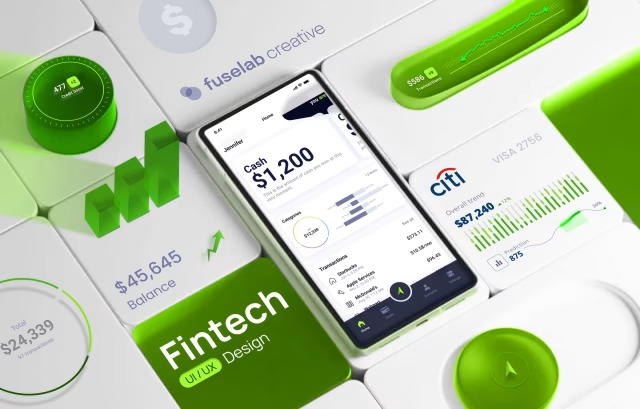
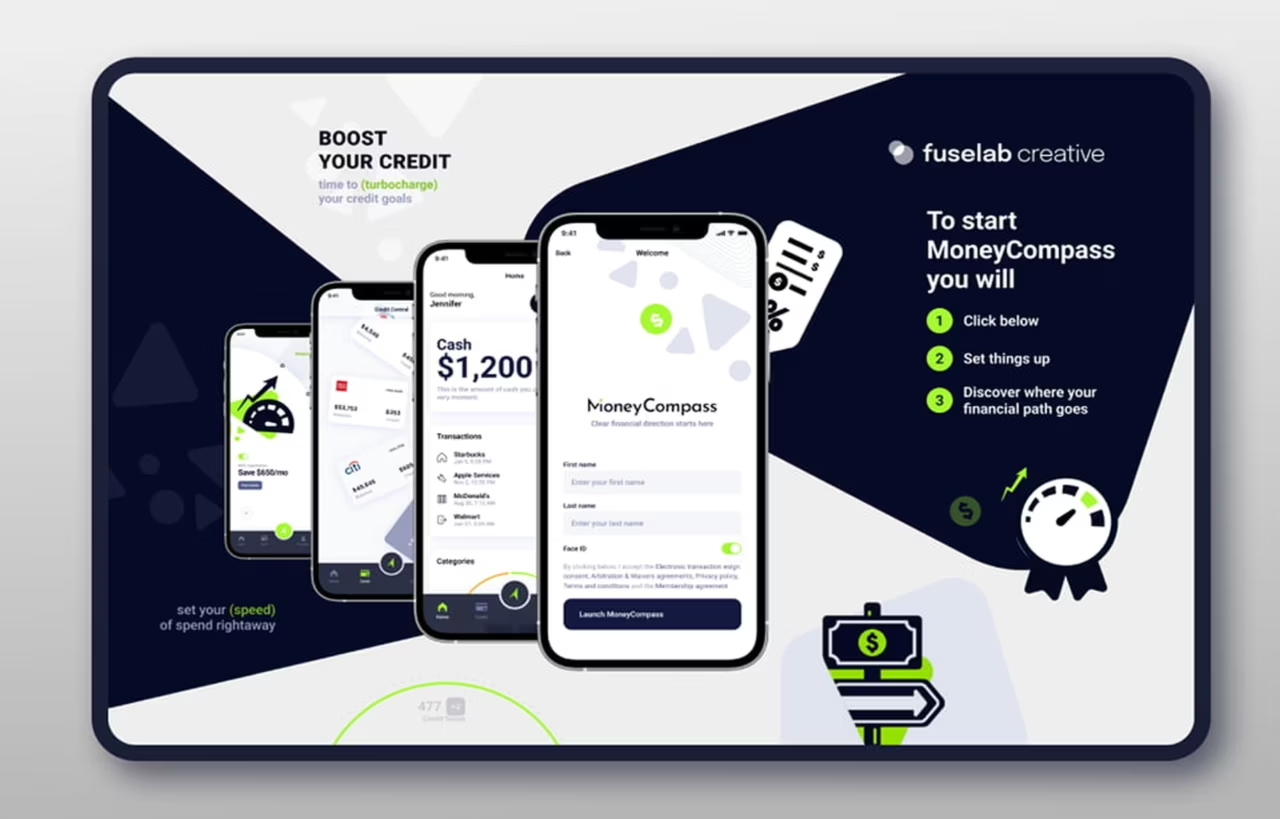
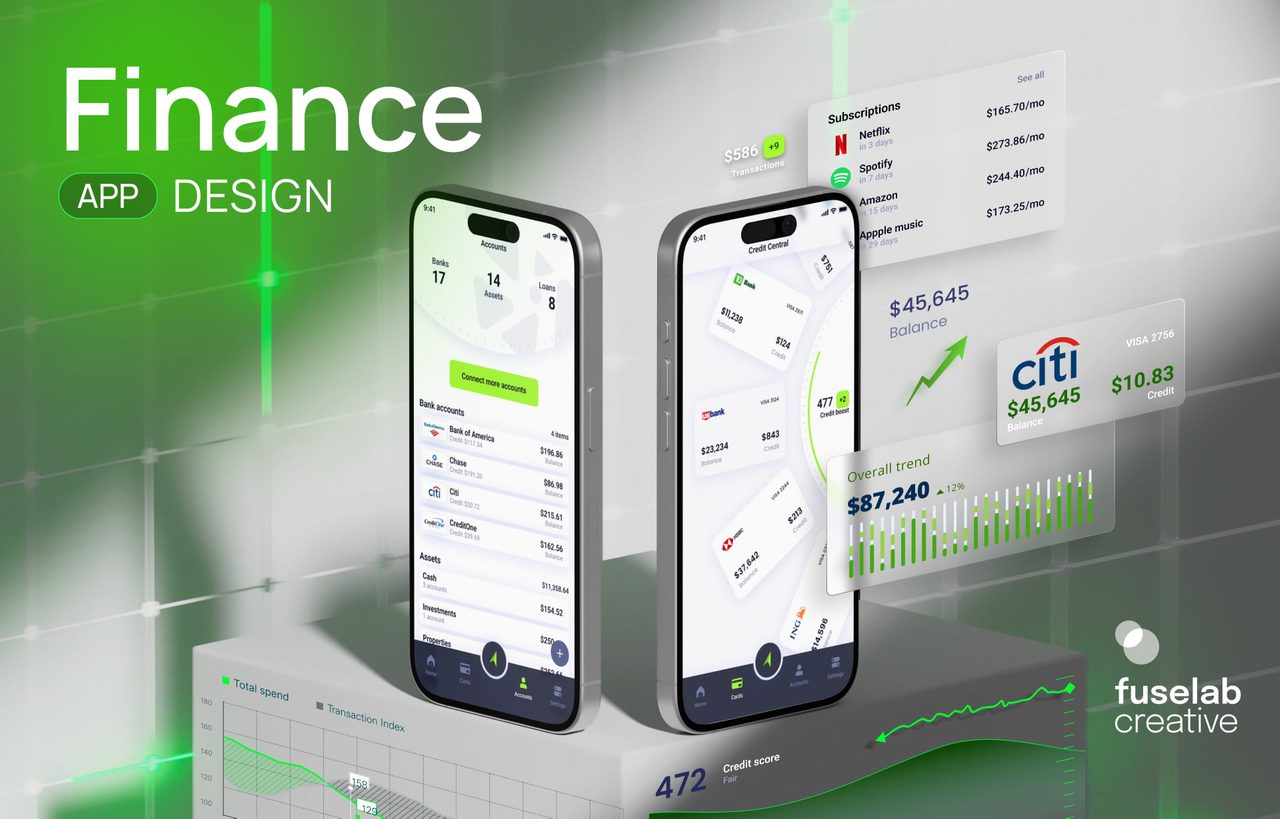
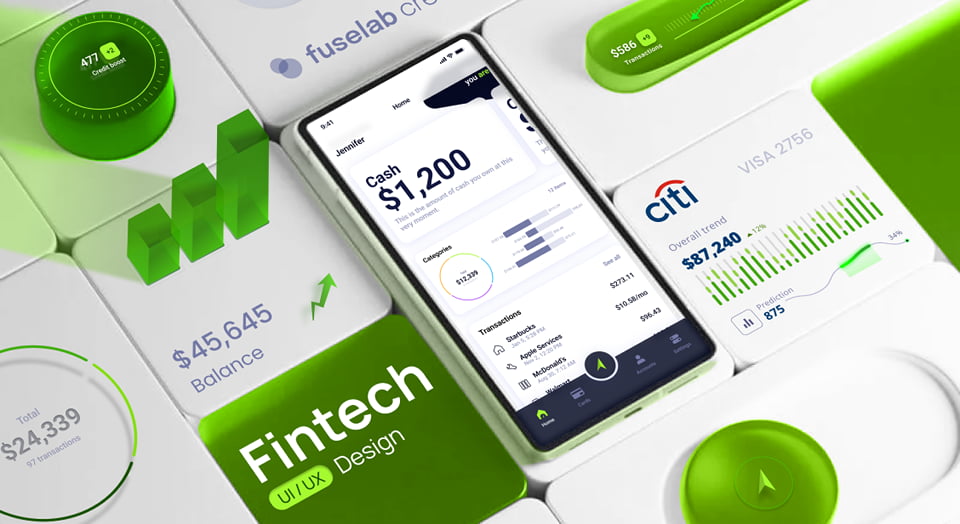
These are consumer money products: budgeting, credit tracking, account aggregation. The design problem in this category is density. People open these apps for one number, several times a day, so the first screen has to answer that question without making them navigate to it.
Financial Product Design Portfolio


Financial sectors we design for
Fintech UX design services start from the rules, and each sector below is regulated differently.
Banking and credit unions
Banking UX design services for account, transfer and servicing flows built against a core system nobody is replacing. A batch posting window shapes most of this work: a balance accurate at 6pm and stale at 9pm needs an interface that says which one you are looking at.
Payments and transfers
Payment interfaces where the confirmation screen is the product, not the send flow. Dispute initiation, reversal paths and fee disclosure carry the design weight, because a user who cannot find how to reverse a transfer will call support before they try the feature again.
Insurance
Quote funnels, policy servicing and claims. Claims is the hardest work in the category: the user is having a bad day, every required disclosure makes the screen longer, and insurance UX design has to keep it readable while the form gets more demanding.
Lending and underwriting
Application flows where an abandoned form is a lost loan and a mis-ordered disclosure is a compliance finding. Progressive disclosure here is a regulatory question before it is a usability one, because the order fields appear in is often written into the rule itself.
Wealth and investment
Portfolio views, performance reporting and trade confirmation for products where a misread chart is an incorrect decision with money attached. Time range is the decision that matters most: a default that flatters recent performance is a compliance problem, not a design preference.
Financial services platforms
Multi-tenant products banks and insurers buy rather than build. The buyer, the administrator and the end customer are three different people with three different default views, which makes financial services UX design a question of whose default the product opens on.
UX/UI Design
Trust in financial products is constructed through interface behavior, not through copy. A payment confirmation that shows transaction details, processing status and a clear reversal path earns more confidence than reassurance language ever will.
Users judge reliability by how an interface handles errors and uncertainty, not by how it handles the success state. A product with clean onboarding and opaque transaction processing loses people at the moment it needs their confidence most.

Mobile Banking and Payment App Design
Biometric authentication, transaction alerts and balance displays compete for a screen where space forces hard choices about what appears first. Shrinking a desktop layout to a smaller viewport fails at the architecture level.
Touch target sizing on high-consequence actions is specific to financial apps. A $50 transfer and a $50,000 wire should not require identical interaction effort, so mobile banking UX design services separate action zones proportionally to transaction weight.

Fintech Website Design
Several user types share one product and define a successful session differently. A retail customer checking a balance, an analyst comparing portfolio performance, and a compliance officer reviewing flagged activity need three different default views inside one navigation.
These are not marketing websites. A marketing site optimizes for conversion and a product platform optimizes for repeated daily use across large data sets, and a fintech web design agency has to build each on its own framework.

Finance Data Visualization
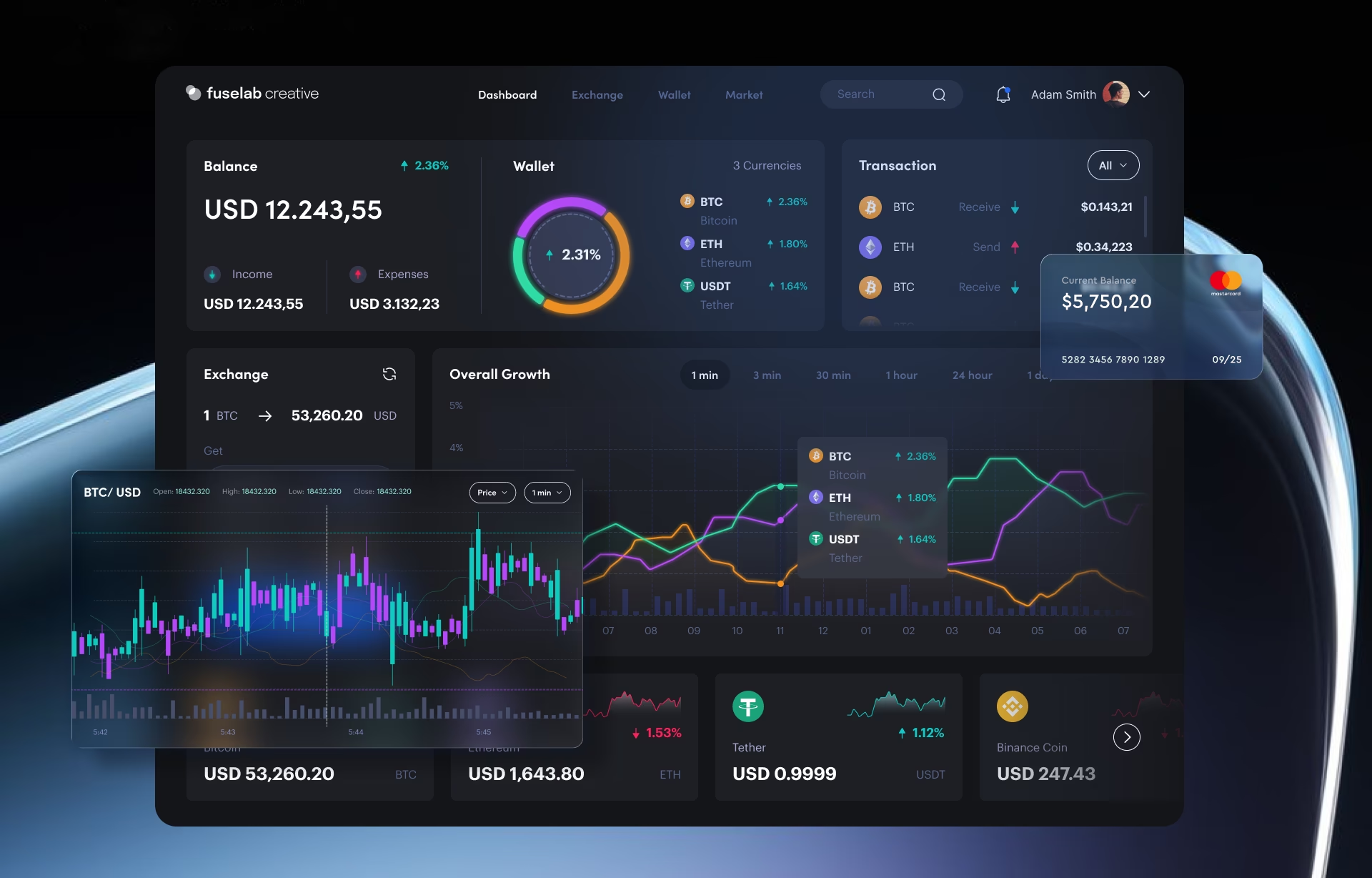
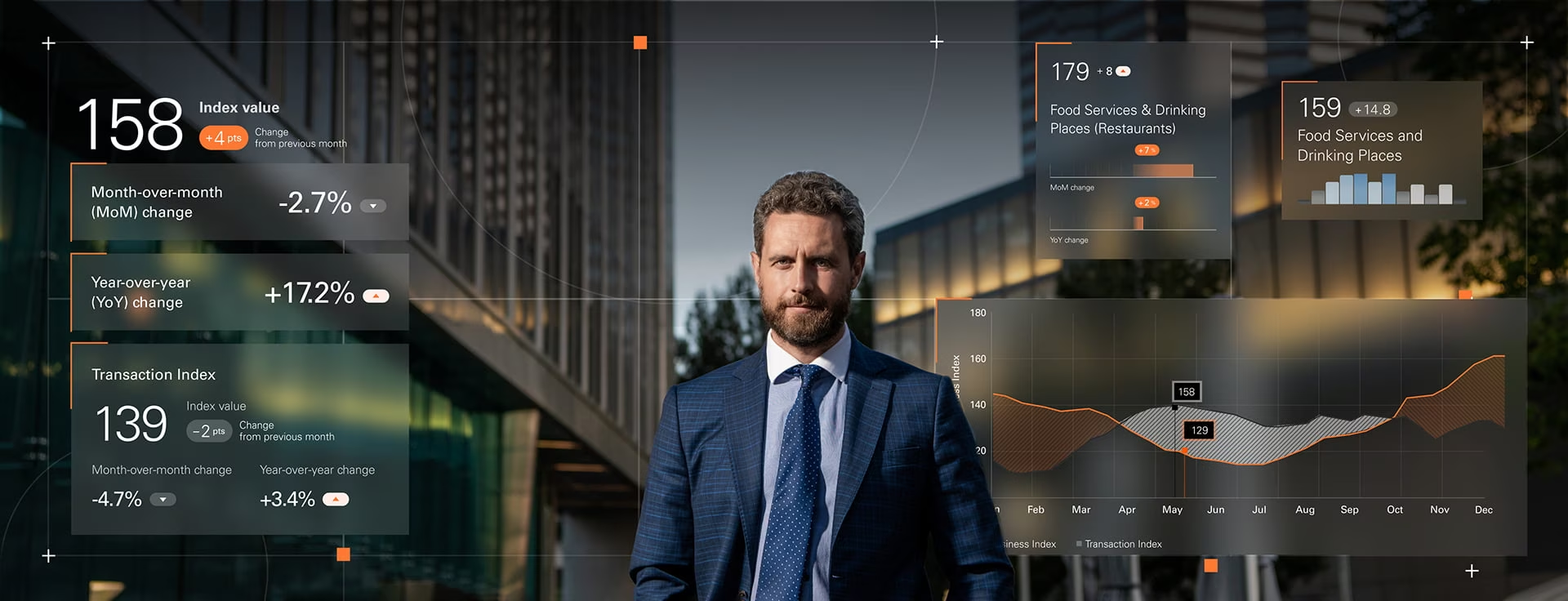
Transaction records, market metrics and risk indicators become displays where a misread chart is a compliance violation or an incorrect trade. Every axis label and default time range carries more weight here.
Financial charts carry explicit scale indicators, benchmark lines and colour systems tested for colour vision deficiency. In financial data visualization these are accuracy requirements rather than accessibility extras, because ambiguity produces decisions with money attached.

Fintech Dashboard Design
Role-based interfaces separate portfolio views, monitoring feeds, risk indicators and compliance alerts by who needs them. The difficulty is not displaying data. It is deciding what each user type should not see by default.
Real-time data adds a problem static dashboards avoid. When numbers move while someone is reading them, fintech dashboard design has to signal what changed and whether it matters, through transition patterns, timestamps and threshold highlighting.
Fintech Design Systems
and Developer Handoff
Fintech design systems require field-level compliance documentation that general design system deliverables do not include. Every component specifies data sensitivity classification, input validation rules, display format constraints and masking requirements, so engineering knows how each field must behave before implementation.
Delivery is a Figma component library with design tokens, compliance annotations at field level, and handoff specs written for teams working inside review cycles.

Figma

Miro

Principle

ProtoPie

Zeplin

Storybook
Don't Listen to Us, Read What Our Clients Are Saying.
We know that trusting an outsider with your vision can be scary. This is why if you're not satisfied with us after the first two weeks, you can walk away owing us nothing.
"We went from prototype to usable software lightening fast, and our customer reviews have never been better."


"Their creativity and mastery of UX UI design has made our years of working together enjoyable and incredibly successful!"

"If you need to re-think your product and need some truly unique design talent , Fuselab Creative design team is your answer."

"We needed a nimble team of UI UX designers to work with our development team and they quickly became one of our most vital resources and far exceeded our expectations."


Related Services and Solutions


Frequently asked questions
What is fintech UX design?
Fintech UX design covers interfaces for banking, investment, payment and insurance products, where regulatory compliance, data security and user trust act as design constraints rather than as later review steps. Verification flows, consent mechanisms and transaction sequences all have to satisfy the regulator and the user at the same time.
Do you work with banks and insurers, or only fintech companies?
Fuselab designs for both. Banking and insurance work runs against core systems, disclosure rules and approval cycles that fintech products do not have, so those engagements start with a longer regulatory mapping phase. The process is the same; what gets mapped in week one is different.
What compliance frameworks affect fintech UX design?
Fintech UX design operates within KYC verification requirements, AML transaction monitoring rules, PCI-DSS data display restrictions, and regional data privacy regulations like GDPR and CCPA. Each framework imposes specific interface constraints on which data fields can appear, how verification steps must be sequenced, and what consent mechanisms users must complete. These requirements shape the interface architecture from the first wireframe, not as a review step before launch.
How long does a fintech UX design project take?
Fintech UX projects run 10 to 20 weeks from research through design system delivery depending on the number of user roles, transaction flow complexity, and compliance review requirements. Products with KYC onboarding, multi-factor authentication, and role-based dashboards sit at the longer end of that range. A focused MVP with a single user type and limited transaction types can complete in 8 to 12 weeks.
What should I look for in a fintech UX design agency portfolio?
A credible fintech UX portfolio shows named financial clients with shipped products, not concept work or visual mockups without production context. Look for compliance-aware design evidence: KYC onboarding flows, transaction confirmation patterns, role-based dashboard views, and data visualization built against real financial data structures. An agency that cannot show a shipped financial product has likely not encountered the constraints that define this work.
What does a fintech UX design project cost?
Fintech UX design projects with Fuselab start at $25,000, at hourly rates of $100 to $149 as published on Clutch. The number moves on three things: how many regulated flows are in scope, how many user roles need distinct default views, and whether a full design system is included or screens only.
Contact Us
Fill out the form!
Blog
Recent fintech and financial design writing