UI UX design agency cost guide for 2026
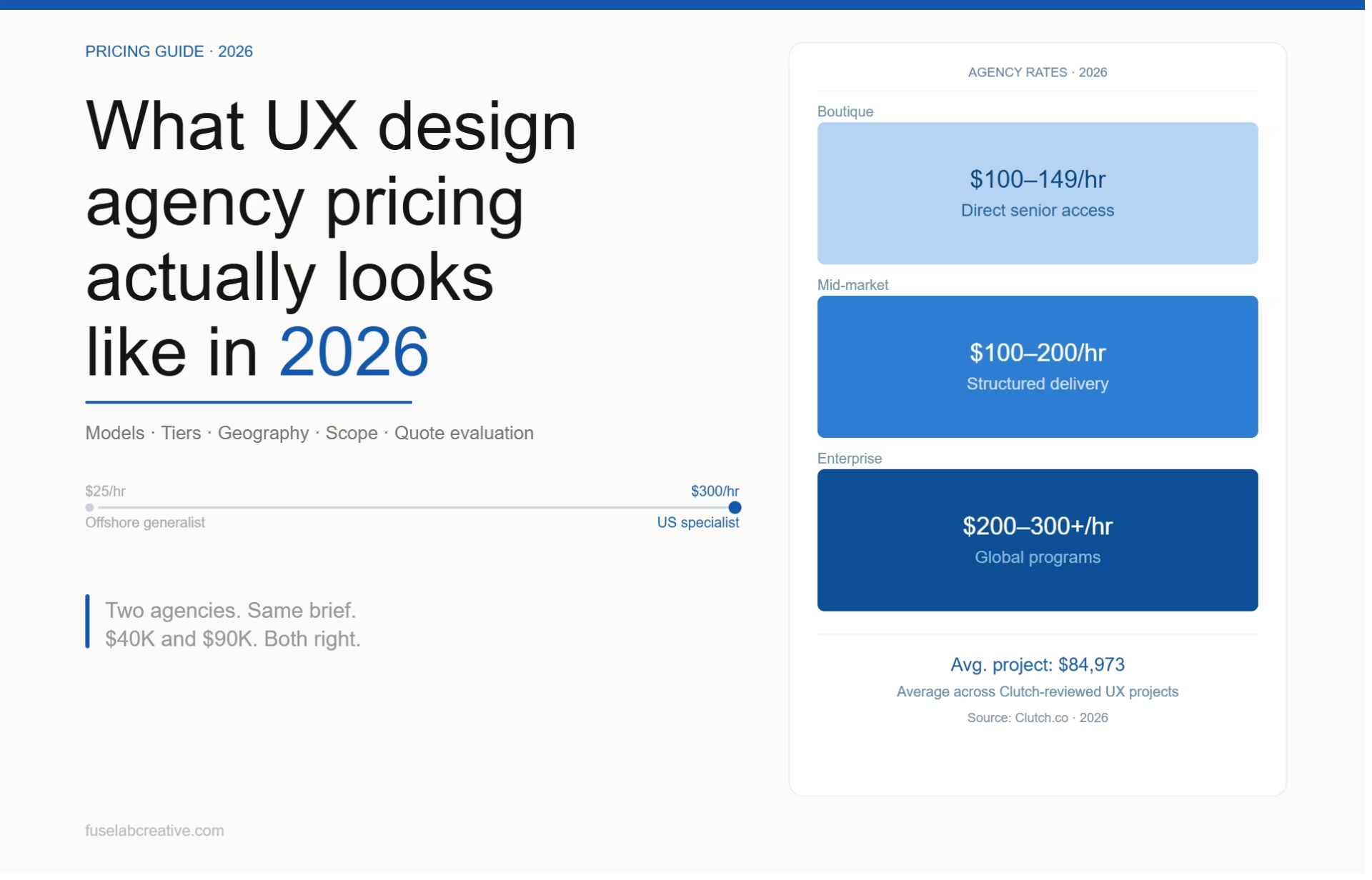
Most UX design agency pricing conversations fail for the same reason: the buyer is comparing hourly rates while the agency is comparing its read on how complex the work actually is. Two agencies quoting the same project at $40,000 and $90,000 can both be right. Not because one is overcharging, but because each one saw a different project in the same document.
What UI UX design agency pricing actually looks like in 2026
Rates run from $25 per hour for offshore generalists to $300 per hour for US specialist firms working in regulated industries, with full engagements landing between $25,000 for a focused scope and $250,000 or more for enterprise product design with multi-role research and compliance requirements. The biggest spread isn’t between small and large agencies. It’s between agencies doing work in healthcare, fintech, and the federal government and those doing commercial product work where those constraints don’t exist.
Clutch’s UX design pricing guide, drawn from thousands of completed agency projects logged on the platform, puts the average UX engagement at $84,973 with a typical timeline of ten months. That number covers the full market, from small commercial redesigns to complex enterprise platforms, which is exactly why it’s useful: an hourly rate cannot tell you where on that spectrum your project lands. Oh, and by the way, an inexperienced team will be cheaper by the hour and take three times as long to complete a project and end up costing a whole lot more. So keep this in mind when comparing quotes.
Complexity drives pricing more reliably than deliverable count. A five-screen clinical workflow requiring HIPAA-compliant data handling and WCAG accessibility validation can cost more to design than a thirty-screen marketing platform, because the decisions behind each screen are more constrained and the review and approval cycles are longer. Screen count in a brief is not a reliable proxy for what a project will cost.
Clients often ask whether AI has made UX design cheaper. For commercial product work without compliance requirements, sometimes. For healthcare, fintech, and federal work, almost never. The compliance overhead on those engagements has grown faster than AI tools have simplified anything, and agencies doing that work are pricing higher than two years ago, not lower. Expecting a discount on regulated-industry work because the industry uses AI tools is going to lead to a frustrating first call.
The activities that actually determine whether a product works rarely get headline treatment in a proposal. Research, stakeholder workshops, usability testing, accessibility validation, and design system planning. These are the things that separate a $40,000 quote from a $90,000 one for what looks like the same brief. When a buyer takes the lowest proposal, they’re usually cutting those steps without realizing it.
McKinsey’s Business Value of Design, a five-year study of 300 publicly listed companies, found that top-quartile design performers achieved 32% higher revenue growth and 56% higher total returns to shareholders than industry peers. The study also found that more than 40% of companies were not talking to their end users during development. That gap in outcomes does not come from better visual execution. It comes from the disciplines most proposals bury in the small print.
Common pricing models: hourly, project-based, retainer, and equity-light
The pricing model an agency proposes tells you something about how that agency thinks about risk. Hourly means no one is committing to an outcome, just to time. Fixed pricing means someone has made a confident call about what the work contains. A retainer makes sense when design demand is predictable enough to justify reserving ongoing capacity. The right model for any given project is not a preference. It is determined by how clearly the scope can be defined before work starts.
Hourly billing is the right call when neither side can honestly scope the work upfront. Early-stage product development, enterprise modernization, and AI initiatives where requirements are still forming are the right cases for it. It adapts as the picture gets clearer. It works poorly for buyers who need budget certainty. Without a detailed statement of work and change-order discipline on both sides, hourly engagements expand.
Hourly rates across the US market in 2026 run from $100 to $149 per hour at the mid-market specialist level, $150 to $200 per hour for senior boutique studios and larger enterprise-focused agencies, and $200 to $300 per hour for highly specialized firms or engagements with significant compliance overhead. Offshore teams with US-adjacent delivery models typically run from $50 to $99.
Project-based fixed-scope pricing defines the deliverables, the timeline, and the cost before work begins. This is the most common model for product redesigns, design system builds, UX audits, and defined research engagements where the output is clear at the outset. For it to work, the buyer needs a clear brief and the agency needs to scope carefully rather than quote low to win the work. The most consistent source of friction in fixed-fee engagements is scope left ambiguous at the start: a feature not in the original brief, additional rounds of stakeholder feedback that reopen settled decisions, or a user role that was not in the research plan.
Monthly retainers work best for organizations shipping continuous product updates or managing ongoing digital products with a predictable design demand. The risk is underutilization: a $15,000 monthly retainer that consistently generates only $8,000 of work is not a good commercial arrangement for either party, and both sides usually know it within two months.
Some agencies offer hybrid arrangements that combine reduced fees with limited equity participation, most commonly with venture-backed startups managing tight budgets. For this model to work on both sides, the agency must have genuine conviction about the product, and the expectations around involvement, revision cycles, and exit conditions must be explicit in writing before work starts.
Pricing by agency tier: boutique, mid-market, and enterprise
Choosing an agency tier is not choosing a quality level. It is choosing an infrastructure model. Boutiques at $100 to $149 per hour give you direct access to senior designers from start to finish, with no account management layer in between. Mid-market agencies at $100 to $200 per hour add structured delivery capacity but carry a consistent risk: the team that ran the pitch is rarely the team doing the work. Enterprise agencies at $200 to $300 per hour or more were built for global transformation programs, not focused product design. The overhead is real, and you pay it regardless of whether the project needs it.
Boutique agencies run five to twenty people, with direct principal involvement. The senior designer who runs the pitch is usually the same person managing the engagement week to week. For startups, focused SaaS products, and engagements requiring tight iteration cycles, boutique agencies often produce better outcomes per dollar than their larger counterparts. The constraint is capacity: for engagements requiring extensive user research, large-scale stakeholder management, or coordination across multiple organizational departments, smaller teams face resource limits that affect delivery timelines.
Mid-market agencies run roughly fifteen to seventy-five people, with dedicated research and design disciplines operating as separate functions. The rates overlap with what boutiques charge, but the delivery model is different: more structured, more process-driven, and more likely to have a layer between the buyer and the designers actually doing the work. This structure handles platform redesigns, multi-stakeholder enterprise projects, and engagements requiring documented processes and formal delivery standards. The trade-off is the most consistent source of buyer disappointment at this tier. Ask before signing who will be on the work day-to-day, not who will be on the pitch call. And don’t forget to ask for references, which is pain to track down, we know, but it’s worth it!
Enterprise agencies, including global consultancies with embedded UX practices, carry overhead structures that reflect genuine infrastructure costs: global coordination, senior stakeholder management, legal and procurement support, and multi-office delivery capacity. For organizations running large transformation programs across multiple business units with international user groups and long-duration modernization needs, that infrastructure is worth paying for. For a focused twelve-week product design engagement, it is not.
Pricing by geography: US, Western Europe, Eastern Europe, Latin America, and Asia
Geography influences UX design agency pricing in two ways that rarely get discussed in the same conversation. The obvious one is labor cost. US agencies charge more than Eastern European or Southeast Asian ones, and the table below shows where things actually land. The less obvious one is regulatory alignment: for healthcare, federal government, or fintech work, the cheaper offshore option often turns out to be more expensive once you account for the extended review cycles and rework that comes from working with a team that has never navigated a US compliance environment before.
US-based agencies earn their premium on regulatory-heavy projects more than on general product design. Section 508 accessibility compliance, FedRAMP alignment, and OMB documentation are requirements where direct experience compresses timelines. An agency learning Section 508 on a live engagement is learning it on the client’s schedule. The same applies to state healthcare systems, HIPAA-governed platforms, and fintech products operating under FFIEC guidance. Federal contracts using GSA procurement vehicles can engage federally vetted agencies directly without competitive bidding, which matters more than most buyers realize until they’ve gone through a federal procurement without one.
Western European agencies often sit at a similar pricing tier to US firms, particularly in the UK, Germany, Switzerland, and Scandinavia. Many have deep specialization in enterprise software, industrial systems, fintech, and public sector services. For organizations with EU operations, GDPR compliance requirements, or products built for European user populations, Western European agencies provide regulatory proximity that US agencies cannot offer from offshore.
Eastern European agencies in Poland, Romania, and the Czech Republic have developed strong design talent pools, particularly in product design, where the primary deliverable is a Figma file and an engineering handoff package. They are less well-positioned for projects requiring US regulatory compliance experience, on-site research at US facilities, or a security clearance. For buyers prioritizing cost efficiency in product execution who already have a stable design system in place, they are a serious option.
Latin American agencies in Mexico, Argentina, and Colombia offer time-zone proximity to US teams that Eastern European agencies cannot match. Southeast Asian agencies in India, Vietnam, and the Philippines offer the lowest market rates. For high-volume UI execution against a defined design system, this is a legitimate option. For products requiring deep user research in US markets or regulated-industry compliance design, the rate advantage is typically offset by extended review cycles and rework.
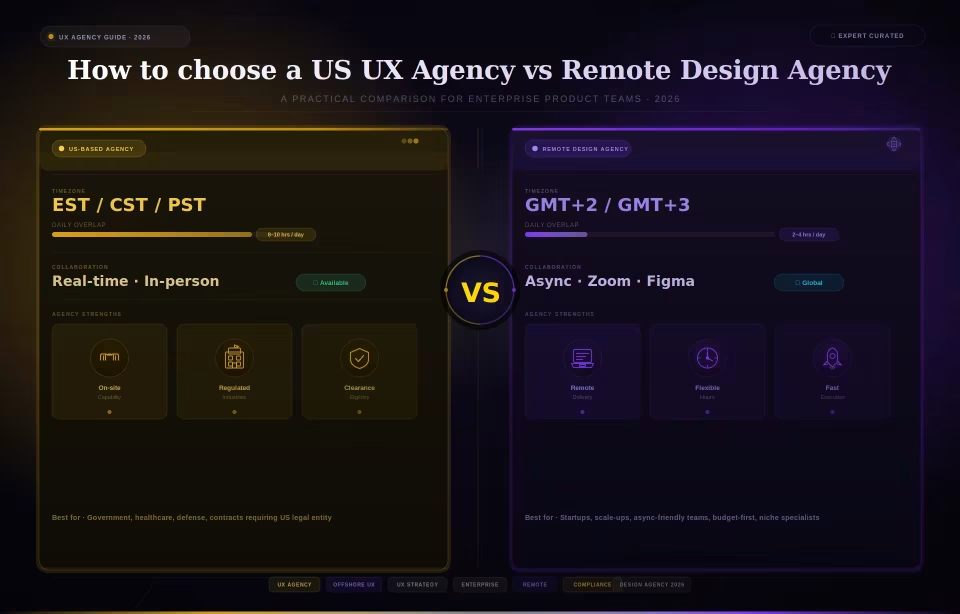
For a detailed evaluation of when US-based agency engagement is the right decision versus distributed or offshore delivery, the US UX agency vs. remote design agency comparison covers the decision framework in full.
Source: Clutch agency marketplace median rates by location, verified June 2026. US rates for regulated industry and AI interface work by specialist agencies regularly exceed the median range shown.
Pricing by project scope
UX design agency pricing by project scope runs from $15,000 to $30,000 for a focused research or audit engagement with a US specialist agency, $40,000 to $150,000 for a full product design engagement covering discovery, user research, design, and engineering handoff, and higher still for AI interface design in regulated industries or federal government systems where compliance requirements add materially to research, testing, and documentation cycles. Hourly rates and tier comparisons tell you the ballpark. Scope tells you the actual number, and it is the conversation most buyers skip until they’re already comparing proposals.
Research-focused engagements are consistently undervalued in pricing conversations because the deliverable is a report rather than a designed interface. In Fuselab’s work for DHCS Medi-Cal health care services, coordinating research access among state healthcare administrators, county eligibility workers, and Medicaid and Medi-Cal recipients under state-specific data-handling requirements was categorically different from the eight user interviews at a startup. The methodology is the same. The coordination, access logistics, and compliance overhead are not. The UX research process Fuselab applies to enterprise and regulated-industry clients starts at $25,000 for a structured discovery engagement and scales based on participant access complexity and regulatory environment.
Design system projects have evolved from visual style guides into operational infrastructure that enables product teams to build continuously without redesigning core components. Cost is determined by the number of products and teams the system must support, the maturity of the existing design infrastructure, accessibility requirements, and governance processes. Building a system for a single product is a fundamentally different project from maintaining one across multiple business units or engineering teams working in parallel.
A full product design engagement covers discovery, user research, information architecture, wireframes, high-fidelity visual design across primary and secondary user flows, a component library or design system, and an engineering handoff package. Ranges are wide because the variables (user roles, screen count, data complexity, compliance requirements, and iteration depth) can expand costs substantially. Structuring scope in defined phases with clear checkpoints, rather than treating the engagement as one deliverable with a single handoff, is the most reliable way to avoid the late-stage scope expansion that causes most fixed-fee cost overruns in enterprise UX work.
AI interface design carries requirements that general product design does not: confidence calibration, override paths, uncertainty communication, and in regulated contexts, audit trail visibility and explainability documentation. In non-regulated commercial applications, AI interface design runs close to standard product design in cost. In healthcare, fintech, or federal government, the compliance overhead for those AI-specific requirements adds materially to both timeline and total cost.
Federal and government UX design is its own pricing category, driven by procurement structure as much as design complexity. Fuselab holds a GSA Schedule, which allows federal clients to initiate an engagement without a lengthy competitive procurement process. That advantage changes the timeline, not the design complexity. Section 508 compliance, FedRAMP alignment, OMB documentation obligations, and AI explainability mandates for systems making consequential decisions all add UX requirements that are absent from commercial software.
What drives UX design pricing up or down
Every UX design agency pricing quote reflects the same underlying variables: the number of distinct user roles the interface must serve, the compliance overhead imposed by the product’s regulatory environment, the maturity of the client’s existing design system, the depth of research required, and the timeline. A five-screen product with three user roles, HIPAA compliance requirements, and no existing design system costs more than a twenty-screen product with one user role and a mature component library.
The number of user roles is the largest cost multiplier in enterprise and B2B product design. Each role requires its own research, information architecture, and set of primary and edge-case flows. A product with two user roles does not cost twice as much as a single-role product. In practice it costs closer to three times as much, because the interactions between roles, including handoffs, approval chains, role-based data permissions, and shared views, add a layer of design complexity that has no equivalent in a single-user product. In Fuselab’s work on enterprise financial platforms, dashboards serving multiple user types consistently surface complexity that was not visible in the original brief until the research phase revealed the interaction points between roles.
Compliance requirements add cost in ways most buyers do not anticipate until they are mid-engagement. In Fuselab’s work for DHCS, a state health care system serving 15 million beneficiaries, the design and development of numerous data visualization interfaces and dashboards were required, and the compliance review and accessibility validation process continuously added substantial time to the project’s initial timeline, as the scope suggested. That pattern is consistent across regulated-industry work: compliance overhead is real, routinely underestimated, and tends to surface as extended scope rather than a visible line item in the original proposal. Each regulatory framework, whether HIPAA, FDA guidance, FFIEC, Section 508, or FedRAMP, imposes interface-level requirements that add to the workload in distinct ways.
The organizations that most severely underestimate compliance overhead are those entering a regulated context for the first time after experience with commercial product work. The assumptions that worked before (how quickly decisions are made, how many stakeholders need to approve a wireframe, how much documentation accompanies a handoff) do not carry over. The work is not more complex because the design is harder. It is more complex because the environment surrounding the design is harder.
Legacy system constraints increase costs in specific, often underestimated ways. A modern product designed for a clean technical stack can make interface decisions based purely on what users need. A product modernizing an interface connected to an ERP system built in 2008, or a backend architecture with API limitations that cannot be changed without a separate engineering program, has to accommodate what the engineering team can actually build. Every design decision that requires a workaround for a technical constraint adds design time.
Research depth is a cost driver that buyers control more directly than most other variables. A project with structured field research, user interviews, and detailed synthesis costs more than one that begins with a stakeholder briefing and a design sprint. The question worth asking is whether the research investment matches the actual uncertainty in the project. A product designed for a well-understood workflow does not require the same level of investment as one designed for clinical decision-making or an unfamiliar enterprise process.
Several factors reduce engagement cost. A clear scope with documented user roles and a realistic screen count allows the agency to price accurately without introducing ambiguity into the estimate. A functioning design system at the client side gives the agency a foundation to build on. A single decision-maker on the client side reduces the feedback cycles that extend timelines on both sides.
How to evaluate a UX design quote
A quote worth taking seriously names its deliverables and its exclusions, identifies who is doing the work and at what seniority, describes how scope changes are handled, and includes a handoff description clear enough that an engineering team can build from it without coming back to ask questions. A quote that lists only a total cost and a timeline is not a scope document. It is an opening position for a later disagreement about what was agreed.
Every complete proposal should name what is in scope and what is explicitly out. An agency quoting a full product design engagement without specifying what that phrase covers leaves room to interpret the scope in their favor when work begins. Before signing, ask the agency to list the actual deliverables: wireframes, high-fidelity screens, usability test sessions, design system components and edge-case documentation. Ask them to confirm in writing what is not included in the fee.
Ask for the names and roles of the people who will work on this project, not just the team the agency would like to introduce on the pitch call. The seniority of the assigned team is a more reliable quality signal than the agency’s overall portfolio.
Ask how scope changes are handled. Every project involves decisions that cannot be made until earlier decisions are resolved. Agencies that can describe their change-management process (how out-of-scope requests are identified, how they are priced, what the approval process looks like) have actually thought about this. Agencies that can’t answer the question don’t have a process.
Ask what a developer receives at the end of the engagement. A production-ready handoff includes documented edge cases, component specifications, interaction states, accessibility annotations, and enough context that implementation proceeds without a second design phase to answer questions the original deliverables left open. Agencies that describe the handoff vaguely are usually delivering a Figma file and calling it done.
There is one question almost no buyer asks during the proposal phase, and it tells you more about an agency than their portfolio does: how will we know this worked? Agencies focused on deliverables will say the answer is in the Figma file. Agencies that actually build products will name a metric (task completion rate, adoption at thirty days, reduction in support volume attributable to interface changes) and propose measuring it before the project starts. If an agency cannot describe how it defines success at the proposal stage, that is the answer. The measurement framework should exist before the first research session, not after the final screen is handed off.
Conclusion
The best pricing conversation ends with both sides looking at the same project. What that takes is not just agreeing on a number but agreeing on what the number covers, who is doing the work, and what done actually looks like. In fifteen years of running these engagements, the projects that go wrong at the contract stage almost always went wrong in the proposal stage. Not because the agency was dishonest, but because both sides assumed they were aligned and never really checked to make sure this was 100% true. Buyers who use the proposal stage to evaluate scope rather than just negotiate cost consistently come away with better work.
Frequently asked questions
How much does a UX design agency cost in 2026?
The honest answer to UX design agency pricing is that the total depends almost entirely on what is actually in scope. Full product design engagements with US specialist agencies typically run $40,000 to $150,000; focused research or audit engagements start at $15,000 to $30,000. But two proposals at similar numbers can represent completely different amounts of work, which is why comparing quotes by scope rather than by total cost is the only approach that tells you anything real.
What is the difference between hourly and project-based pricing for UX design?
Hourly billing works when neither side can honestly commit to a scope up front. Requirements are still forming, legacy constraints aren’t fully understood, or the engagement is in early discovery. Fixed-fee pricing works when both sides understand the deliverables well enough to define them before work starts. When a fixed-fee engagement goes significantly over budget, it is almost always because the scope was not actually agreed. It was assumed.
How does boutique agency pricing compare to enterprise agency pricing for UX work?
Boutique agencies at $100 to $149 per hour typically offer direct senior involvement from pitch through delivery, with lower overhead and faster decision-making cycles. Enterprise agencies at $200 to $300 per hour carry infrastructure (global coordination, multi-office delivery capacity, senior stakeholder management) built for large transformation programs. For a focused product design engagement under twelve months, that infrastructure adds cost without adding the capability that justifies it.
What makes AI interface design more expensive than standard UX work?
AI interface design raises questions that standard product design never needs to answer: how to communicate model confidence, how to surface override options, how to make system behavior predictable enough that users can rely on consequential outputs. In regulated contexts, AI interfaces also require explainability documentation and audit trail visibility. In commercial applications without compliance requirements, the cost difference over standard product design is modest. In healthcare, fintech, or the federal government, the additional requirements add materially to both scope and timeline.
What does a full UX design project scope typically include?
A full engagement typically covers discovery, user research, information architecture, wireframes, high-fidelity visual design across primary and secondary flows, a component library or design system, and an engineering handoff package. Accessibility review, usability testing, and design system governance are sometimes included, sometimes scoped separately. Worth asking explicitly. The variables that expand cost most significantly are user role complexity, compliance requirements, and what already exists at the client in terms of design infrastructure.
How do I evaluate a UX design quote to know if it is reasonable?
Compare proposals at the scope level, not the total. Two quotes for the same brief that differ by 50% are almost certainly scoping different amounts of work. Ask each agency what is explicitly included and excluded, who will work on the project at what seniority, how scope changes are handled, what the engineering handoff contains, and how success will be measured at the end. A proposal that cannot answer all five clearly is not a complete proposal.
What should be included in a UX design proposal?
A solid proposal defines scope, deliverables, exclusions, research activities, team structure and seniority, timeline, the change-order process, accessibility requirements, and what a successful handoff looks like. It should also say how the work will be measured. Proposals that list a cost and a timeline without defining scope are starting positions, not agreements, and should be treated accordingly during negotiations.