Best healthcare AI UX design agencies in 2026
A healthcare AI UX design agency designs the interfaces that clinicians use to read an AI recommendation, assess how much to trust it, and act on it, all within healthcare’s regulatory and workflow constraints. The work demands fluency in two fields that rarely share a roof, clinical interface design and AI interaction design, and the quickest way to tell who genuinely has both is to ask which AI product they have worked on inside a real clinical setting and what that interface does when the model is uncertain.
Search “healthcare UX agency,” and you find dozens of firms fluent in patient journey mapping, EHR interface design, and accessibility compliance. Search “AI UX agency,” and you find a different skill set entirely: prompt interface design, automation, model-output visualization, and human-AI interaction patterns. Ask either group whether they have participated in bringing an AI medical device through FDA clearance, and the room gets much quieter. Agencies that do both well are still rare.
Healthcare AI is no longer a niche. The FDA has authorized more than 1,400 AI-enabled medical devices to date, and 2025 was the biggest year on record, with close to 300 clearances. Behind almost every one of those products is an interface a clinician has to trust: a dashboard a care coordinator relies on, an alert a physician acts on, a risk score that changes a treatment decision. Those interfaces are frequently the last checkpoint between a wrong output and the patient who receives it.
What makes this category genuinely difficult is that it inherits the operational complexity of healthcare and the ambiguity of AI at the same time. The danger in a clinical AI product is rarely that the model is wrong. The danger is that a wrong output looks trustworthy, and the interface is what decides whether it does.
So the screen cannot just present a recommendation clearly. It has to help a clinician judge whether to believe that recommendation, by showing what evidence supports it, how confident the model is, what data the model may be missing, and where the model tends to fail. At that point the interface stops being a presentation layer and becomes part of the clinical reasoning itself.
What healthcare AI UX design actually requires
Designing the interface for a healthcare AI product is its own discipline, not a variation on standard UX work. The constraints are regulatory, clinical, technical, and ethical at once, and they do not exist in this combination in consumer or enterprise AI design. The agencies that handle it have usually learned each layer the hard way, on shipped products instead of from a framework.
Regulatory fluency is the requirement that separates the strongest healthcare UX design teams from the rest. The FDA’s Software as a Medical Device framework governs software that performs a medical function, and AI products sit at its most demanding end. In January 2025 the FDA published draft guidance on AI-enabled device software functions covering lifecycle management and marketing submissions, and almost all of it touches the interface. If an AI highlights an image or produces a risk score, the agency expects evidence that clinicians were trained to understand it.
HIPAA compliance lives in the data architecture of the interface layer, not just the back end. Where protected health information appears, how it is masked in shared views, what happens to patient data inside AI feedback loops, and how consent is communicated in real-time are all UX decisions with legal exposure. Agencies that have only worked in consumer AI or non-regulated enterprise software routinely underestimate how large that surface area is, and how painstaking and costly it can be if not managed correctly.
Explainability is a design surface, not a feature. The FDA’s transparency guidance for machine-learning-enabled devices expects that clinicians and patients receive appropriate information about the logic behind a recommendation, its risks, and its limits. Translating that expectation into an actual interface is specialized work, because it requires both clinical context and a real understanding of how people reason about probability under pressure.
Clinical workflow integration is where most healthcare AI products stumble, and usually not because the model is wrong. They stumble because the interface does not fit how clinicians actually work: how a nurse documents across a shift, how an attending reviews alerts under stress, how one screen has to serve several patients at once. That knowledge comes from watching real users in real settings, not from a requirements document.
Human factors documentation is the last non-negotiable. FDA submissions for AI/ML devices require evidence that representative users can operate the device safely and effectively, produced through structured research with defined protocols, documented error analysis, and findings that feed the regulatory record. A standard usability test report will not satisfy this requirement. An agency that cannot produce this level of analysis and findings cannot design a regulated AI product.
Why most healthcare UX agencies cannot do AI well, and the reverse
The healthcare UX market and the AI UX market developed in parallel for most of a decade, with very little overlap, and the firms that dominate each one built fundamentally different design instincts. Healthcare UX grew out of operational complexity, organized around compliance, workflow structure, and administrative legibility. AI UX grew out of probabilistic interaction, optimized for adaptive systems, conversation, and automation. Expecting a specialist in one to be fluent in the other usually ends in a product that disappoints.
Established healthcare UX agencies built their reputations making complex clinical data legible: EHR usability, patient portals, care coordination dashboards. That work is genuinely hard, and the best of them have real depth in clinical workflow and accessibility. But it trained them to treat the interface as a structured display of known data, such as lab results, medication orders, or protocols. The interface shows the information; the clinician decides.
AI breaks that model at the root because AI output is probabilistic and can be wrong in ways invisible to the clinician reading the screen. Which, in all honesty the top of the the healthcare AI heap, when it comes to problems in this space. However, the failure pattern is specific and easy to spot once you know it. A healthcare team applying its fixed-data instincts to AI renders a confidence score as a static number beside the recommendation, the same way it would show a lab value.
Clinicians read that number once, decide the model seems confident, and stop checking. A signal meant to provoke scrutiny, designed as a data field, does the opposite. The interface looks correct in a demo and then erodes clinician trust within the first few weeks of real use, which is the point where most of these products quietly stall.
AI-first agencies make the mirror-image mistake, and three things tend to be missing. Regulatory knowledge is the obvious one: FDA human factors expectations, HIPAA constraints on the interface, SaMD classification. Clinical context is subtler and more damaging. A team that has spent three years on consumer copilots ships a clean single-answer interface optimised for one user exploring one question, then deploys it into the workflow of a care coordinator triaging nine patients at once. That coordinator needs the recommendation, the evidence behind it, and the override visible in the same glance, not one tap deeper.
The error tolerance, the trust threshold, and the cost of a miscalibrated confidence signal are all far higher than that team is used to. The third gap surfaces only at deployment: most AI interface design teams have never shipped anything that runs inside Epic or Cerner, and the technical constraints, workflow hooks, and adoption realities of those systems break designs that tested cleanly in isolation.
This is why the set of agencies genuinely capable of healthcare AI work stays small. The strongest can point to specific clinical AI engagements and explain exactly how they handled model uncertainty, explainability, and clinician override workflows. Bolting AI services onto a healthcare practice, or adding a healthcare page to an AI practice, does not produce that.
What to look for in a healthcare AI UX design agency
The best healthcare AI UX design agencies build systems that make AI reasoning visible and verifiable inside environments where clinicians have to weigh risk and uncertainty under time and cognitive pressure, while staying compliant with the sector’s regulations. To find the right partner, look past the pitch deck for evidence in a few specific areas: shipped AI products in real clinical settings, demonstrated command of healthcare regulation, direct knowledge of clinical workflow, and a clear approach to explainability and human-in-the-loop review.
Portfolio evidence comes first, and it has to be specific. Not speculative case studies, not AI features added to a wellness app, not concept prototypes. Ask directly: which AI product did you ship, in which clinical setting does it run, and what does the interface do when the model is uncertain? The answer to that last question separates teams who have wrestled with healthcare AI interaction from teams who have designed around it.
Regulatory familiarity matters more than most AI agencies expect. Healthcare introduces requirements general AI firms rarely meet: HIPAA constraints, auditability, traceability, documentation standards, and FDA-adjacent considerations for clinical systems. Ask how the team approaches HIPAA-constrained interface design, or whether they have produced FDA human factors submissions. An agency with real experience names specific interface decisions and explains why they mattered. Others stop at general data-privacy principles. In healthcare, recommendation traceability is part of operational accountability, and confidence communication can materially change how a clinician relies on an AI output.
Clinical workflow understanding has to come from direct observation. Find out how the agency runs clinical research. The answer should include shadowing, contextual inquiry in actual care settings, and iterative testing with nurses, physicians, or other staff. Agencies that lean on sponsor-side interviews and secondary research produce designs that do not survive contact with a real ward.
Buyers in federal or state health agencies face requirements most firms never encounter, including Section 508 accessibility, ATO processes, and government contract vehicles. For that segment, an agency’s government health track record functions as a baseline qualification, and most agencies on any healthcare list simply do not have one.
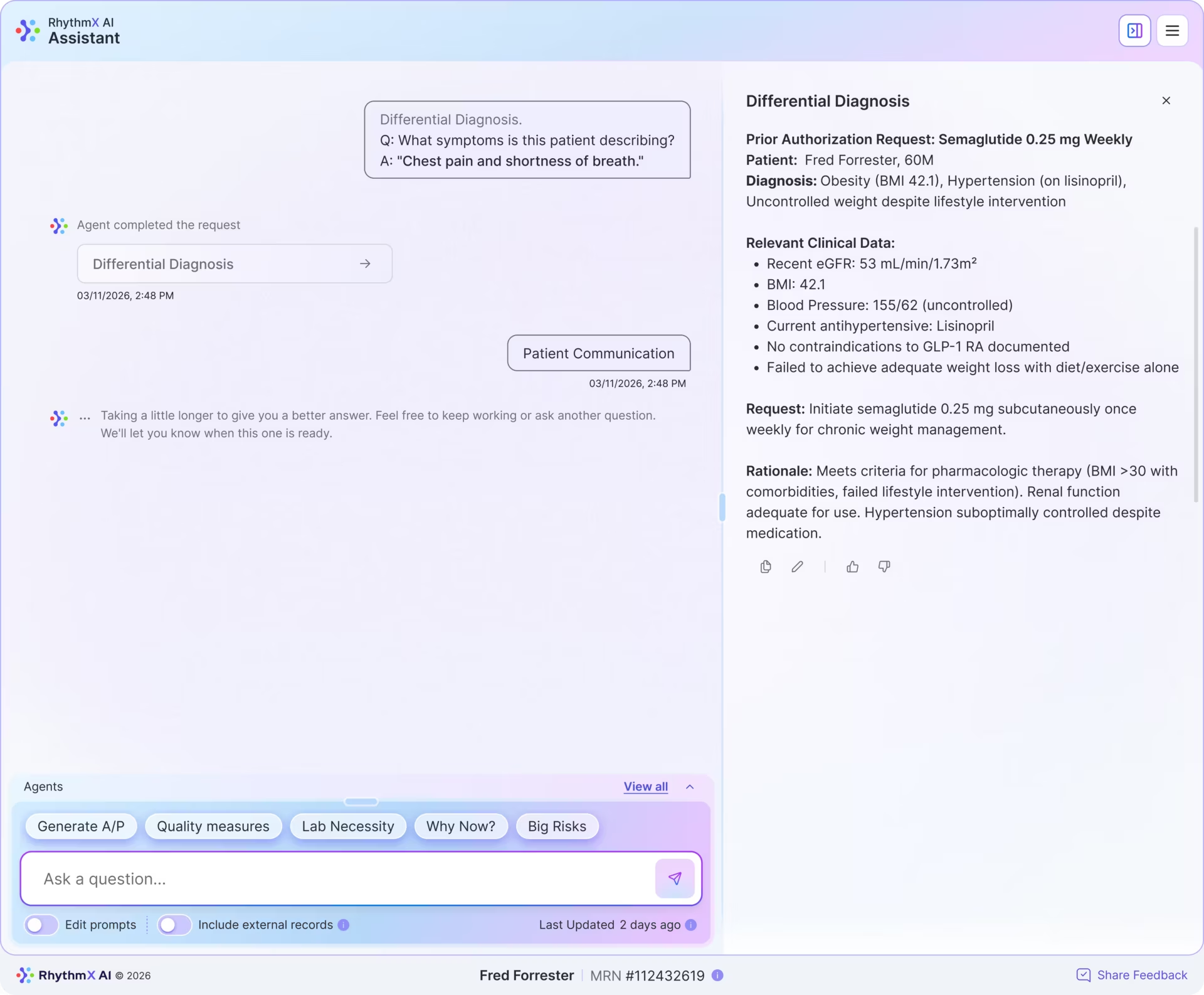
How an agency handles transparency and explainability is arguably the single biggest differentiator in healthcare AI UX today. Most AI products are optimized to generate an answer. Healthcare AI has to support the evaluation of one. A clinician needs to see why a recommendation exists, what evidence backs it, and how confident the system is, and none of that can sit behind a secondary workflow. Clinicians are not browsing the system the way a consumer explores a chatbot, they are making judgment calls under pressure across several patients at once. The moment explainability becomes a “view sources” link or an accordion detached from the recommendation, the interface has failed at its clinical job.
Finally, look for genuine human-in-the-loop expertise. Most successful healthcare AI systems are collaborative, not autonomous: clinicians validate outputs, override recommendations, escalate edge cases, and audit decisions. The override path is often the feature clinicians test first and trust least when it is buried, and how an agency designs that path tells you quickly whether it has watched clinicians use AI under pressure or only read about it. An agency that pushes for maximum automation and treats override and validation as edge cases has not designed for a real clinical environment.
Best healthcare AI UX design agencies in 2026
No agency on this list is best for every healthcare AI project. Each is strongest in a different segment, and which firm to shortlist depends on the kind of work: federal procurement, FDA-regulated products, enterprise platforms, patient-facing tools, or earlier-stage discovery and category development. The entries below describe what each agency is genuinely good at, not a single overall ranking.
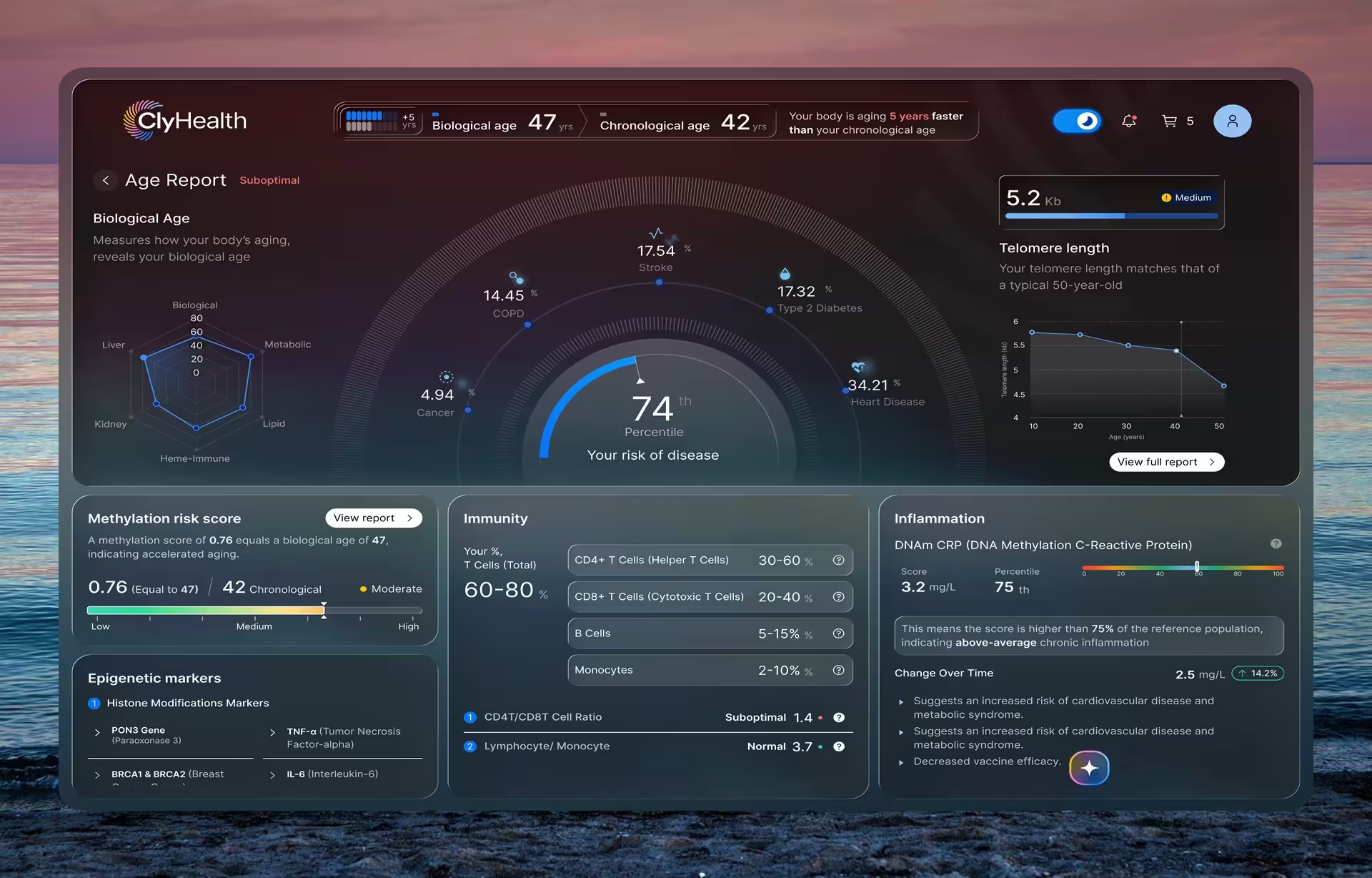
Fuselab Creative works where clinical data, AI output, and regulation meet. For ClyHealth, a personalized healthcare platform, Fuselab designed an AI assistant that answers from each patient’s own record and a screen that shows the AI’s reasoning so providers can review it before approving. DHCS brought state-Medicaid scale and its accessibility constraints, and NIH added federal research credentialing.
Where it wins: regulated, clinician-facing AI products, especially for buyers in or near government health systems, where Fuselab’s GSA Schedule shortens procurement.
Watch out for: buyers taking a digital therapeutic through FDA submission should compare its submission-stage record with Guidea’s.
Pricing: $100 to $149 per hour, from $25,000
Location: McLean, Virginia
Clutch rating: 5.0. Fuselab Creative on Clutch
2. Guidea (now part of Invene)
Guidea has spent more than two decades in regulated digital health and reports contributing to over 300 live products, for clients such as Amgen, AstraZeneca, and Humana. Its AI work includes clinical decision support, population health with ClosedLoop.ai, and digital twin design for radiology operations with Quantivly. The team also worked on two of the earliest digital therapeutics to win FDA approval and reimbursement.
Where it wins: FDA-regulated digital therapeutics and SaMD products that need design support through submission.
Watch out for: the highest rates on this list, and less focus on federal or state health procurement since the Invene acquisition in May 2025.
Pricing: $150 to $199 per hour, from $50,000
Location: Austin, Texas
Clutch rating: 4.8. Guidea on Clutch
3. Momentum
Momentum builds from the infrastructure up, pairing healthcare product design with software engineering, AI implementation, and compliance-focused architecture. Its open-source tooling, including HealthStack, FHIRboard, and AI documentation processing, shows a team that works below the interface, where clinical data is stored, exchanged, and processed. Named clients include VillaMedica and zdroVeno, with others under NDA.
Where it wins: AI-heavy operational platforms and healthcare SaaS products that need design and engineering from one team.
Watch out for: the engineering-led model is less suited to products whose hardest problem is how clinicians read and trust an AI recommendation.
Pricing: $50 to $99 per hour, from $50,000
Location: Wrocław, PolandClutch rating: 4.8. Momentum on Clutch
Koru approaches healthcare AI from a human-centered, behavioral angle, focusing on emotional usability and patient trust in AI-assisted experiences. The agency reports more than 1,500 healthcare UX projects spanning EHRs, AI and LLM features, pharmacy management, patient portals, dashboards, and analytics, with communication clarity treated as seriously as function.
Where it wins: patient-facing AI products where clear, reassuring communication matters as much as what the product does.
Watch out for: an India-based team may be a limit for buyers who need US-based staff or close involvement in regulated enterprise procurement.
Pricing: $50 to $99 per hour, from $50,000
Location: Pune, IndiaClutch rating: 4.7. Koru UX Design on Clutch
5. Cieden
Cieden built its reputation on complex B2B products where dense information and operational workflow shape the interface. In healthcare AI, that shows in analytics-heavy workflows and operational dashboards, where information hierarchy and decision visibility carry the weight. Its strength is making complicated systems usable without oversimplifying them, rather than patient engagement.
Where it wins: care-operations and internal healthcare platforms built around dashboards and analytics.
Watch out for: the distributed model keeps pricing low, but heavily regulated US environments may find limits in security governance and cross-team coordination.
Pricing: $50 to $99 per hour, from $10,000
Location: Ivano-Frankivsk, Ukraine, and Toronto, CanadaClutch rating: 4.8. Cieden on Clutch
6. IDEO
IDEO works upstream of the execution specialists on this list. Its healthcare practice has dedicated leadership across San Francisco, Chicago, and London, including a Harvard-trained emergency medicine physician. The portfolio includes Omada Health, which grew from an IDEO research project into a billion-dollar chronic disease company, along with Teal Health’s at-home cervical cancer screening and UCSF’s Prime mental health app.
Where it wins: organizations defining a new product category or redesigning care delivery at scale.
Watch out for: it is not built for shipping a specific clinical interface to FDA submission, and its pricing is not published.
Pricing: not listed on Clutch
Location: San Francisco, California, with studios across the US, Europe, Asia
Clutch rating: not listed
How we evaluated these agencies
This list was built around a single filter: agencies that demonstrate both healthcare domain depth and a shipped AI product. Neither credential alone qualified an agency for inclusion.
The evaluation drew on four inputs. Portfolio evidence carried the most weight, which meant shipped products in clinical or regulated health environments, not speculative case studies or AI features bolted onto non-regulated products. Regulatory process depth was the second filter and the one most agencies failed on: direct involvement in FDA human factors studies, HIPAA-constrained interface design, or government health procurement, plus the ability to describe that work in specifics rather than generalities. AI UX maturity covered comfort designing around explainability, confidence scoring, uncertainty communication, and human-in-the-loop review. Operational model was the last filter, covering location, team structure, pricing, and procurement fit, and it was the one that most often decided which credible agency was actually engageable.
Clutch ratings, public portfolio documentation, and agency website content were used to verify claims. Agencies that could not show shipped healthcare AI work were excluded regardless of general reputation. For the broader category that sits one step out from AI, our guide to the best healthcare UX design agencies in 2026 covers firms strong in clinical UX without a deep AI specialism.
This list is the healthcare-specific cut of a wider field. If your product is an AI interface outside healthcare, our broader roundup of the best AI UX design agencies in 2026 ranks firms across enterprise, fintech, and consumer AI without the clinical and regulatory filter applied here.
Healthcare AI UX design agency comparison
What drives the cost of a healthcare AI UX project
Healthcare AI UX costs more than general AI UX work for reasons that have little to do with the screens and everything to do with what has to be proven about them. Oh, and by the way, it costs more because this stuff is really hard to do right. A consumer AI interface is done when it tests flawlessly. A clinical AI interface is deemed complete when there is documented evidence that representative users can operate it safely and in a timely manner, and that accounts for most of the cost.
Three things move the number, and the biggest is the human factors validation study: structured protocols, recruited clinical participants, recorded error analysis, and a report written to survive an FDA reviewer rather than an internal sign-off. Traceability and documentation come next because, in a regulated product, every recommendation, confidence signal, and override must be auditable, and designing for auditability is more work than designing for a clean demo. And not to be dramatic, but we are talking about a person’s health and well-being. Last is the research method, where real clinical shadowing and contextual inquiry cost more than remote interviews, and where less specialized agencies most often cut corners.
This is why the ranges on this page spread so widely. A smaller, well-scoped clinical AI engagement runs roughly $25,000 to $75,000, while an enterprise program with full submission support and multi-role workflows reaches several hundred thousand. An agency quoting consumer-AI prices for a regulated product has almost always left the documentation and validation work out of scope, and that gap reappears later as either a failed submission or a second engagement.
How to choose the right healthcare AI UX agency
The right healthcare AI UX design agency depends on three things: the kind of AI product you are building, the regulatory environment it must navigate, and the procurement vehicle your organization uses. Federal agencies, digital health startups, and enterprise health systems each shortlist different firms, usually for non-overlapping reasons.
If you are a federal or state health agency, the shortlist starts and largely ends with firms that hold government contract vehicles, have Section 508 experience, and understand ATO processes. Fuselab’s GSA Schedule contract (47QTCA22D00CV) allows direct engagement without a full competitive RFP. Every other agency on this list will mean a longer procurement path and a steeper compliance learning curve, and most will struggle with federal accessibility and authorization requirements they do not encounter in commercial work.
If you are a digital health startup or biopharma company building a regulated product, the filter is FDA process depth. Guidea is one of the most credentialed pure-design options in that category, with submission-stage involvement on early FDA-cleared digital therapeutics. For products that also need full-stack design and engineering capability under one roof, Momentum’s infrastructure-oriented model is worth a look. For earlier-stage ventures still defining the product category or care delivery model, IDEO’s strategic healthcare practice is a natural fit before execution-focused engagement begins.
If you are a health system or enterprise building internal AI tools or patient-facing platforms, prioritize demonstrated human-in-the-loop experience, where Koru is strong. For data-dense internal platforms where enterprise B2B depth matters more than regulated submission experience, Cieden’s analytics and dashboard work is worth considering.
Healthcare AI is still a narrow overlap market. Most healthcare UX agencies do not deeply understand AI systems, and most AI UX agencies do not deeply understand healthcare operations. The partnerships that work tend to be the ones where the agency’s operational background already matches the environment the product will run in.
Frequently asked questions
What is a healthcare AI UX design agency?
A healthcare AI UX design agency specializes in designing AI-enabled clinical and health products and the workflows around them. Unlike traditional healthcare UX firms, these agencies also handle AI-specific interaction problems such as explainability, confidence visibility, uncertainty communication, and human-in-the-loop review.
How is healthcare AI UX different from general AI UX design?
General AI UX design focuses on making AI outputs usable for a broad audience. Healthcare AI UX adds constraints that change the design problem entirely: FDA human factors requirements, HIPAA interface compliance, clinical workflow integration, and the high stakes of clinical decisions. A pattern that works in a consumer AI product, such as hiding supporting evidence behind a secondary tap, can actively harm adoption and regulatory standing in a clinical setting.
What is the difference between a healthcare AI UX agency and a general healthcare UX agency?
A healthcare UX agency designs interfaces for clinical environments such as EHRs, patient portals, and care dashboards, where the data is fixed and the job is to show it clearly. A healthcare AI UX agency does all of that and also designs for what AI introduces: probabilistic outputs, model uncertainty, explainability, override workflows, and regulatory documentation.
Why is explainability important in healthcare AI UX?
Explainability matters because clinicians evaluate AI recommendations rather than simply accept them. And most providers have very little time to waste on any given day. The strongest agencies build systems that expose supporting evidence, confidence indicators, and source references inside the workflow, where a clinician sees them at the point of decision. In clinical settings, trust comes from transparency more than from automation alone.
What is human-in-the-loop healthcare AI design?
Human-in-the-loop healthcare AI describes systems where clinicians or health operators stay actively involved in reviewing, validating, editing, or escalating AI-generated outputs. Most successful healthcare AI products are built to support human judgment rather than replace it.
Can a general AI UX agency design healthcare AI products effectively?
General AI UX agencies can sometimes design healthcare AI products well, but healthcare brings regulatory and operational complexity that many underestimate at the start. Consumer AI patterns tend to prioritize speed and conversational simplicity, while healthcare AI demands transparency, workflow integration, accountability, and clinician trust under pressure.
How much does healthcare AI UX design typically cost?
Healthcare AI UX cost varies with regulatory complexity, workflow depth, enterprise integration, and research scope. Smaller engagements typically range from $25,000 to $75,000, while enterprise healthcare AI programs can run into the several hundred thousand-dollar range, depending on scale and compliance requirements.