Best healthcare UX design agencies in 2026
The best healthcare UX design agencies in 2026 specialize in clinical workflow design, HIPAA-compliant data architecture, and health system interoperability rather than general digital product work, making domain experience the primary differentiator when selecting a partner. US-based specialist agencies typically charge $100 to $199 per hour for healthcare UX design, with projects starting at $25,000 for focused scopes and reaching $150,000 for enterprise clinical systems with multiple user roles and compliance requirements.
What healthcare UX design must address in 2026
A qualified healthcare UX design agency in 2026 must demonstrate verified experience across HIPAA data architecture, HL7 and FHIR interoperability standards, WCAG 2.1 AA accessibility, and clinical workflow design for EHR systems. Agencies without this track record are general design firms operating in regulated environments, not specialist healthcare UX partners.
Every healthcare UX engagement begins with compliance. A healthcare UX design firm must be fluent in HIPAA (Health Insurance Portability and Accountability Act) requirements around patient data privacy, Protected Health Information (PHI), and security controls. This shapes everything from user authentication patterns to audit logs, session timeouts, and role-based data visibility throughout the product.
Biotech and clinical research environments layer a second compliance requirement on top of HIPAA: 21 CFR Part 11, which governs electronic records and signatures. Agencies without direct experience here create real liability for their clients. Non-compliance can lead to regulatory action, product recalls, and invalidated clinical trial data, which is not a recoverable situation.
Digital healthcare products rarely exist in isolation. They exchange data with hospitals, insurers, and government systems continuously, and the interface must reflect that data flow at every touchpoint. Standards like HL7 (Health Level Seven) and FHIR (Fast Healthcare Interoperability Resources) define how data moves between platforms. A strong health tech UI design agency understands how these standards shape decisions across dashboards, patient records, and clinical data visualization.
Clinical workflow design is where healthcare UX most directly affects patient safety. Clinicians operate under time pressure in high-stakes environments where a poorly sequenced interface does not just reduce efficiency. It increases decision error risk, contributes to documentation gaps, and worsens the cognitive fatigue that leads to clinical burnout across emergency, surgical, and primary care settings.
EHR and EMR interface redesign is the engagement type we see most consistently in clinical UX work, and the complexity is not exaggerated. These systems carry decades of accumulated constraints: regulatory requirements layered onto legacy data structures, departmental workarounds, and design decisions made by people who left the organisation years ago. The agencies that improve them effectively start by mapping what clinicians actually do before proposing anything new.
In practice, clinical workflow design means mapping the literal steps a nurse or physician takes before the interface is drawn. A well-designed clinical tool accounts for multi-step workflows from diagnosis to documentation to prescription, the reality of interruptions and task-switching mid-workflow, information density across multiple patient records, and clear error prevention paths when high-stakes decisions are made under time pressure.
Accessibility carries a specific legal standard in healthcare: WCAG 2.1 AA, covering high contrast ratios, screen-reader compatibility, and large touch targets for patients with limited dexterity. Federal systems and their contractors face an additional layer. Section 508 of the US Rehabilitation Act extends requirements to keyboard navigation, multilingual support, and low-connectivity functionality, and it applies to every contractor in the delivery chain, not just the agency holding the government contract.
When designing for medical devices, agencies must also adhere to human factors engineering principles under IEC 62366-1 to reduce the risk of use errors that could result in patient harm. An agency that cannot speak fluently across all of these compliance layers before a project begins is learning on your budget, and in healthcare that is a cost no one recovers easily.
Top 10 best healthcare UX design agencies in 2026
The best healthcare UX design agencies listed here were selected on the basis of verified clinical portfolio work, named government and enterprise healthcare clients, and demonstrated compliance knowledge across HIPAA, FHIR, and accessibility standards. General UX agencies with one or two health-adjacent projects are not represented.
1. Fuselab Creative
Washington, DC area (McLean, VA) Hourly rates: $100 to $149. Minimum project size: $25,000. Clutch rating: 5.0
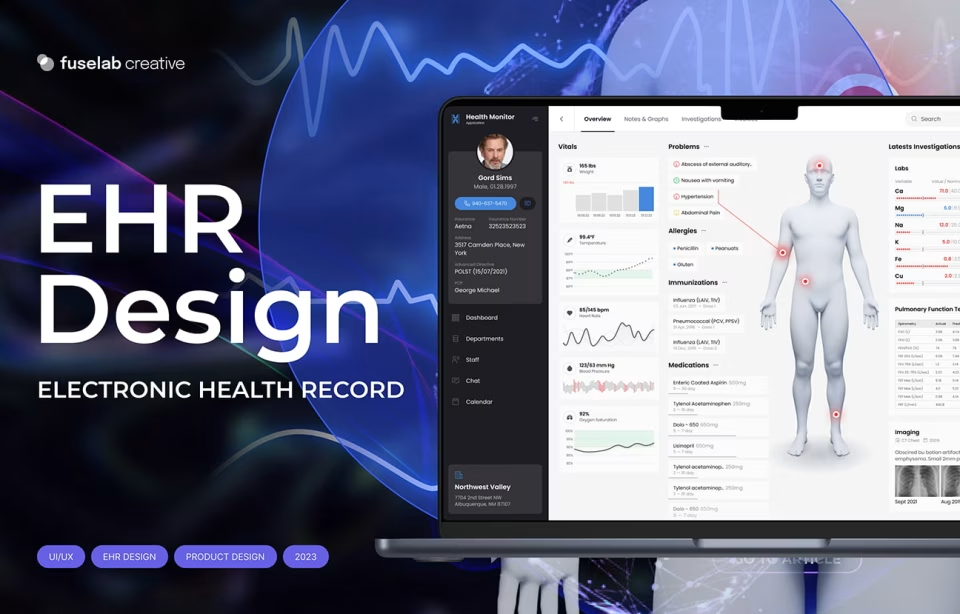
What separates Fuselab Creative from most agencies on this list is not the number of healthcare projects but their type. Founded in 2017 and holding a GSA contract, the McLean, VA firm has delivered interface work for NIH, DHCS (California Department of Health Care Services), NASA, Fiserv, and Uber, a government health portfolio that most general UX agencies cannot access, let alone replicate.
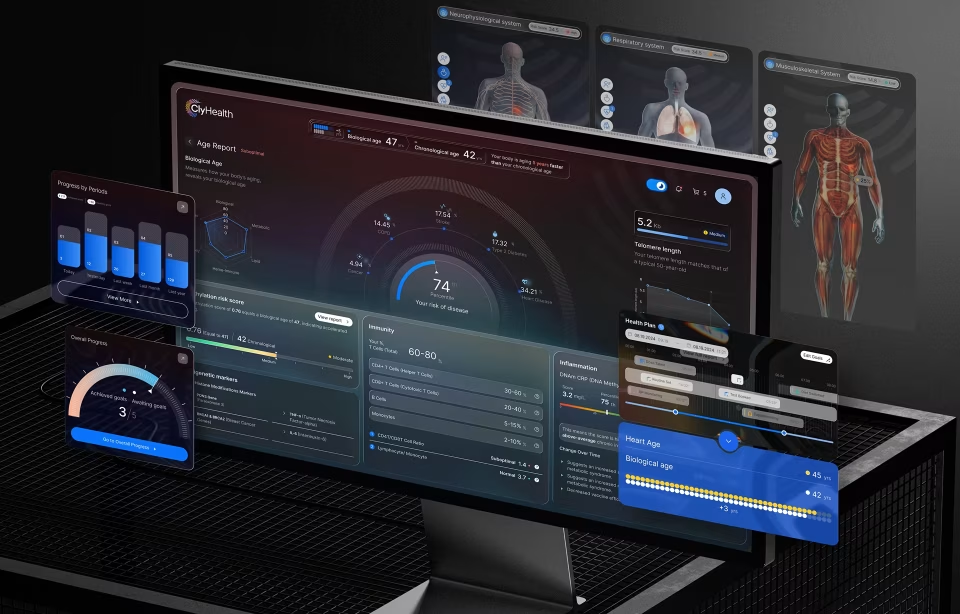
Our healthcare work includes CRISP (a state-designated health information exchange in Maryland), ReferralMD (a care coordination platform), ClyHealth (an AI health dashboard), and Vasolabs (an artery scan platform). Each of these required navigating interoperability layers, multi-role data systems, and sensitivity requirements that general UX firms rarely encounter at this depth.
Strongest for: Government healthcare agencies, public health systems, and enterprise platforms requiring compliance-heavy UX, GSA procurement access, and large-scale clinical system design.
2. Momentum Design Lab
San Mateo, CA, USA Hourly rates: $150 to $199. Minimum project size: $25,000. Clutch rating: 4.6
Momentum has been running enterprise UX programs since 2002, which gives it a process track record most agencies on this list cannot match. Acquired by HTEC Group in 2021 and operating across San Mateo, New York, and London, the firm regularly handles Fortune 500 healthcare environments where product teams, engineering leads, legal, and compliance stakeholders all have to agree on the same design decisions before anything ships.
For large healthcare organizations where product, engineering, legal, and compliance teams all hold approval authority over the same design decisions, Momentum’s process maturity is the thing being purchased, not just the design output. That distinction is worth understanding before engaging an agency at this price tier.
Strongest for: Enterprise healthcare companies, hospital systems, and large digital health platforms that need structured UX systems built for multi-team delivery across complex internal organizations.
3. Neuron
San Francisco, CA, USA Hourly rates: $150 to $199. Minimum project size: $25,000. Clutch rating: 4.7
Neuron built its reputation in San Francisco’s B2B enterprise market and has expanded steadily into healthcare through clients like Acuity, a clinical trial management platform, and Flo, a patient-facing reproductive health tool. Founded in 2016, the firm’s particular skill is translating dense medical requirements into interfaces that feel like consumer applications without losing clinical precision, which is harder to achieve than most product teams expect.
Neuron is particularly active in the San Francisco biotech hub, working with firms that need to bridge the gap between complex science and software that clinicians and researchers can operate without training overhead. Its usability engineering process is well-suited to environments where workflow efficiency directly drives clinical or research outcomes.
Strongest for: Healthcare product teams building or refining complex platforms where usability, workflow efficiency, and product clarity are critical to adoption across clinical and research environments.
4. Cieden
Lviv, Ukraine (offices in North America) Hourly rates: $50 to $99. Minimum project size: $10,000. Clutch rating: 4.8
Cieden is headquartered in Lviv, Ukraine, with North American offices, and has built a specific niche: research-depth UX at startup pricing. The agency invested early in healthcare by dedicating a design director with 45 or more healthcare projects to the practice, which means new clients spend less of the first engagement explaining clinical context to the team before design work begins.
Notable healthcare work includes Hygrid Health (a dashboard structuring healthcare records), MedEntry (a health and wellness educational platform), Prioritized (a telehealth platform), and Lykon (a personalized health platform). Its approach is grounded in user research and role-based interface design for complex systems.
Strongest for: Health tech startups and mid-market platforms that need research-led UX, strong information architecture, and cost-efficient delivery for HIPAA-compliant products at MVP or growth stage.
5. Think Company
Philadelphia, PA, USA Hourly rates: $150 to $199. Minimum project size: $50,000. Clutch rating: 4.7
Think Company has been operating since 2007, long enough to have worked with organizations that do not hire agencies without a compelling reason. Based in Philadelphia, the firm has delivered work for CSL Behring, Nemours Children’s Health, Merck, and Recovery Centers of America, which together represent pharmaceutical, pediatric, and addiction care environments, each with different compliance demands and clinical workflow constraints.
Their $50,000 minimum project size is not a pricing threshold. It reflects what aligning UX decisions across legal, clinical, and product stakeholders inside a large healthcare organization actually costs to do properly. Organizations operating below that scale are generally better served by agencies built for faster iteration cycles.
Strongest for: Healthcare enterprises and hospital systems that need research-led UX aligned across complex internal stakeholder groups, clinical operations, and regulatory requirements.
6. Orbix Studio
New York, NY, USA Hourly rates: $50 to $99. Minimum project size: $10,000. Clutch rating: 5.0
Orbix Studio is the youngest agency on this list, founded in 2023 in New York. That is worth flagging directly, because healthcare buyers typically want years of domain experience. What Orbix offers instead is fast execution, competitive pricing, and a full-cycle service model that suits early-stage health tech teams moving from wireframe to working product without managing separate design and development vendors.
Services span the full UX lifecycle from usability audits and wireframing through visual design, prototyping, and front-end development. This makes Orbix a flexible end-to-end partner for healthcare teams without established in-house design capability who need to move from brief to working interface quickly.
Strongest for: Startups and mid-sized healthcare companies that need cost-effective UX design and front-end execution for early-stage patient-facing products or digital health platforms.
7. Azuro Digital
Toronto, Canada (offices in Ottawa and Calgary) Hourly rates: $100 to $149. Minimum project size: $10,000. Clutch rating: 4.8
Azuro Digital belongs on this list and also deserves clear positioning. Founded in 2018 in Toronto and ranked the number one web design agency in Canada on Clutch with 94 reviews, the firm does strong work for healthcare providers. Its healthcare practice is website design and SEO for clinics, dental practices, and private medical organizations, not clinical systems, not EHR interfaces, and not government health infrastructure.
Azuro’s healthcare work centers on patient acquisition and digital engagement, combining UX with technical performance and local SEO for private practices, doctor-led clinics, and dental agencies seeking to grow their patient base online. It is not structured for clinical system or application work.
Strongest for: Private healthcare practices, clinics, and medical service providers that need SEO-aligned websites for patient acquisition rather than clinical system or application design.
8. Phenomenon Studio
Wroclaw, Poland (offices in US, Switzerland, Canada, Estonia) Hourly rates: $50 to $99. Minimum project size: $10,000. Clutch rating: 4.9
Phenomenon Studio occupies the space between budget-tier agencies and expensive US specialists. Founded in 2019 in Wroclaw, Poland, with offices in the US, Switzerland, Canada, and Estonia, the agency has earned HIPAA certification and assembled a team of 60 or more in-house designers and developers who operate as an integrated product partner. Its healthcare work spans EHR interfaces, telehealth systems, and patient-facing applications.
The agency is recognized on Clutch with strong client feedback highlighting its responsiveness and delivery consistency, and it operates as a vertically integrated UX and engineering partner suited to teams moving from MVP to growth stage without managing separate vendors.
Strongest for: Health tech startups and scaling digital health platforms that need an integrated UX and development partner to move from MVP to production with measurable product outcomes.
9. Yalantis
Warsaw, Poland Hourly rates: $50 to $99. Minimum project size: $50,000. Clutch rating: 4.6
Yalantis is not primarily a design agency. Founded in 2008 in Warsaw with a globally distributed team of 500 or more specialists, it operates as a full-cycle engineering partner where UX sits inside a broader software, hardware, and AI systems engagement. Its healthcare portfolio reflects this: remote patient monitoring, telemedicine systems, and connected medical device ecosystems where the interface and the underlying technical architecture cannot be separated.
The focus is on building production-ready systems that balance usability with technical reliability in regulated environments. Yalantis is most effective when the UX and engineering scopes are inseparable and the client needs a single partner accountable for both the interface and the underlying system behavior.
Strongest for: Healthcare companies building connected health platforms, remote monitoring systems, or IoT-driven medical products that require integrated UX and engineering delivery at scale.
10. Creative Navy
London, UK (office in Berlin) Hourly rates: $100 to $149. Minimum project size: $5,000. Clutch rating: 4.9
Creative Navy has spent 15 years building a reputation in the environments where healthcare UX is hardest: medical devices, embedded clinical systems, and software where a design error has regulatory consequences. Founded in 2010 in London with offices in Berlin and Basel, its medtech client list includes Medtronic, Siemens Healthineers, B Braun, Gilead, UnitedHealth Group, and Humana, the most credible device and enterprise health portfolio on this list.
Its methodology combines user research, usability testing, and interaction design grounded in empirical evidence rather than convention. This approach is well-suited for contexts where clarity, interaction safety, and accuracy carry direct clinical consequences and where design decisions feed into regulatory submissions or device certification processes.
Strongest for: Medtech companies, clinical software providers, and healthcare enterprises that require research-driven UX and senior-level expertise for complex, high-risk systems with direct patient impact.
How we evaluated these healthcare UX design agencies
We built this list through a four-part evaluation: verified portfolio evidence of completed healthcare projects with named clinical clients, demonstrated compliance knowledge across HIPAA, FHIR, and accessibility standards, Clutch-verified pricing confirmed on the publication date, and location data checked against Clutch headquarters records rather than agency website copy.
Portfolio evidence came first, and proved most decisive. Every agency we included has at least one named healthcare client with a documented project type, whether an EHR interface, a telehealth platform, a health information exchange, or a medical device system. Agencies that list healthcare as a served industry without naming a specific clinical project were excluded, regardless of reputation or Clutch rating.
Compliance credentials were checked against each agency’s own published materials, not taken from their marketing copy. Each entry was assessed for demonstrated familiarity with HIPAA requirements, FHIR interoperability, and the accessibility obligations governing clinical interfaces. Agencies positioning themselves for government health work were additionally evaluated for GSA contract status, Section 508 documentation, and named government health clients.
Pricing was verified from each agency’s Clutch profile on the publication date, not from third-party aggregators or outdated rate cards. Location data came from Clutch headquarters records, not agency website copy, which can reflect registered agent addresses rather than physical offices. No agency paid for inclusion. The list was built on verifiable portfolio evidence, compliance credentials, and documented client work.
Comparison table: healthcare UX design agencies in 2026
How to choose the right healthcare UX design agency for your project
Not every healthcare UX design agency is built for every type of project, and using the wrong type is more common than most buyers expect. Three factors determine fit: the regulatory environment, the technical complexity of the system, and your budget tier. An agency built for government health cannot simply pivot to a biotech startup engagement, and the reverse is equally true.
Government health platforms require federal compliance experience that goes well beyond HIPAA. If the product is a Medicaid portal, a state health information exchange, or a federally contracted clinical system, the agency needs a GSA contract, Section 508 documentation, and a verifiable government health portfolio. We are the only agency on this list that meets all three criteria, with documented work for DHCS, NIH, and CRISP.
Enterprise hospital systems and biotech environments represent the highest complexity on this list. For multi-stakeholder enterprise delivery, Momentum Design Lab, Think Company, and Neuron have the process maturity to coordinate across product, engineering, legal, and compliance teams simultaneously. For biotech requiring 21 CFR Part 11 validation, Neuron’s San Francisco biotech depth and Cieden’s dedicated healthcare design director make both strong candidates at different budget tiers.
Early-stage health tech startups should weight budget flexibility and integrated delivery more heavily than compliance depth at MVP stage. Phenomenon Studio and Orbix Studio both operate below $100 per hour with low minimum project sizes. Phenomenon’s HIPAA certification gives it an edge for products that will eventually need clinical compliance, making it the stronger choice for seed-stage teams building toward a regulated environment.
Medical device UX requires the most specific expertise on this list. Products subject to FDA 510(k) clearance or CE marking need an agency that has worked inside a regulatory submission process, not just one familiar with compliance terminology. Creative Navy’s named medtech clients, including Medtronic, Siemens Healthineers, and B Braun, are the only verifiable evidence of this experience among the agencies reviewed here.
Government healthcare vs. private health tech: key design differences
Government healthcare and private health tech look like the same industry from the outside. Inside a project, they operate almost nothing alike. Government systems measure success by stable, accessible operation across millions of users. Private health tech measures it by engagement, conversion, and speed to market. The agency that excels in one is often wrong for the other.
Compliance runs deeper in government healthcare than most agencies account for. Medicaid platforms, public health exchanges, and state-level systems operate under HIPAA and the broader CMS guidelines governing quality, safety, and billing standards for Medicare and Medicaid reimbursement. On top of these, state-specific regulations apply that a federally focused firm may miss entirely if it only tracks federal-level requirements.
Section 508 is the compliance layer that surprises enterprise teams most, and we have seen this on nearly every government engagement we have run. The US Rehabilitation Act applies it to all federal systems and every contractor in the delivery chain, covering keyboard navigation, screen reader support, multilingual access, and low-connectivity functionality. Most commercial agencies encounter this scope for the first time mid-project.
Private health tech, by contrast, operates with more flexibility. While HIPAA still applies to any product handling patient data, the design emphasis shifts toward product-market fit, user retention, and conversion optimization alongside compliance. Startups building telehealth applications or AI health dashboards can prioritize onboarding flows and engagement metrics in ways that government systems cannot.
User complexity is also more demanding in government work. These platforms serve patients, providers, administrators, and policymakers simultaneously, often across wide socioeconomic and demographic ranges. Each role requires different permissions, workflows, and data views, and the UX must accommodate varying degrees of education, technical literacy, and language proficiency. Private platforms design for fewer user types, which allows more focused experience patterns and shorter iteration cycles.
Government systems must also connect with infrastructure that private health tech companies do not encounter. Legacy EHR and EMR systems and national or state data exchanges using HL7 and FHIR create UX constraints that sit entirely outside the agency’s control. Private health tech generally builds on modern API stacks, giving designers more authority over data consistency, error handling, and the continuity of the user experience across sessions.
Risk tolerance is where the two contexts diverge most sharply. Government healthcare UX favors stability over experimentation, particularly in life-critical environments where a design change can affect patient safety at population scale. The success metric is consistent, accessible operation across a broad and diverse population, not conversion rate or engagement time.
Private health tech can experiment more aggressively with AI-driven interfaces and new interaction models, particularly in lower-stakes categories such as wellness applications or supply chain tools. Understanding this distinction matters when selecting from the best healthcare UX design agencies, since the right firm depends on whether the product is a government system or a targeted clinical application serving a defined user population.
Healthcare UX compliance checklist
A healthcare UX design agency’s compliance readiness should be verifiable across seven specific areas before engagement begins: HIPAA data handling, FHIR and HL7 interoperability, 21 CFR Part 11 electronic records, WCAG 2.1 AA accessibility, clinical workflow mapping, human factors engineering, and IEC 62366-1 medical device standards. Each directly affects product approval, patient safety, and legal liability.
Use the following checklist when evaluating an agency’s compliance capability or assessing your product’s design readiness before submission or launch:
- HIPAA compliance: Verify that interfaces handling Protected Health Information (PHI) include encrypted data transmission, automatic session timeouts, role-based access controls, and documented audit trails across all user actions.
- FHIR and HL7 integration: Confirm the UX supports FHIR R4 standards to allow consistent data exchange between clinical systems. The interface should surface data consistently regardless of the source system it originates from.
- 21 CFR Part 11: For biotech and clinical trial environments, the system must support validated electronic signatures, time-stamped audit trails, and access controls that satisfy FDA requirements for regulated electronic records.
- WCAG 2.1 AA accessibility: Implement high-contrast ratios (minimum 4.5:1 for normal text), screen-reader compatibility tested with NVDA and VoiceOver, keyboard-only navigation throughout, and large touch targets for users with limited dexterity.
- Clinical workflow mapping: Verify that interface flows mirror real-world clinical procedures. Review the research methodology behind each workflow decision and confirm it was validated with actual clinicians, not only product stakeholders.
- Human factors engineering: Confirm the agency conducted usability testing designed specifically to identify and mitigate potential use errors that could result in patient harm, following IEC 62366-1 or FDA human factors guidance.
- Medical device GUI standards: For devices subject to FDA 510(k) or CE marking, adhere to IEC 62366-1 standards covering functional safety and usability of medical
Conclusion
Selecting from the best healthcare UX design agencies means prioritizing compliance depth, clinical domain experience, and verifiable portfolio work over general UX reputation. We have worked across government health systems, biotech platforms, and early-stage health tech, and the requirements do not overlap as much as buyers tend to assume. Matching agency type to project type is the decision that determines whether an engagement succeeds.
electrical equipment throughout the design process.
Frequently asked questions
What makes healthcare UX design different from other industries?
Healthcare UX design differs from standard product design at the point where almost every interface decision touches a regulatory requirement. Authentication patterns, data visibility controls, session timeouts, and error states all carry legal obligations that a general UX agency rarely encounters elsewhere. A firm without direct clinical portfolio evidence is designing to standards it has not yet had to defend in a real project or compliance review.
What is FHIR and why does it matter for healthcare UX?
FHIR (Fast Healthcare Interoperability Resources) is the modern standard for exchanging healthcare data between systems. It matters for UX because interfaces must reflect how data is structured, updated, and shared across platforms accurately, and inconsistencies in that data flow produce confusing or contradictory user experiences. A health tech UI design agency that does not understand FHIR will make interface decisions that conflict with how the underlying data actually moves.
What is HL7, and how is it different from FHIR?
HL7 is a broad set of healthcare data exchange standards developed over three decades, while FHIR is a modern, web-based framework built within that ecosystem using RESTful APIs. FHIR is easier to implement in modern applications and aligns more naturally with current development practices. Healthcare UX designers need to understand both because many enterprise systems still rely on older HL7 messaging formats alongside newer FHIR-based integrations.
Does my biotech UX agency need HIPAA experience?
Any agency working on products that handle patient data should understand HIPAA requirements, including secure data handling protocols, role-based access controls, and audit trail documentation. Without this experience, design decisions may introduce compliance gaps that require costly rework after a legal or regulatory review. For biotech environments that also fall under 21 CFR Part 11, the compliance burden is higher and the consequences of gaps more severe.
Which healthcare UX agency has government healthcare experience?
The best healthcare UX design agencies for government work combine federal compliance credentials with a verifiable portfolio of public health systems. Fuselab Creative holds a GSA contract and has delivered interface work for DHCS (California’s state Medicaid system), NIH, and health information exchanges including CRISP, giving it a documented government healthcare portfolio. Most agencies on this list focus on private health tech rather than regulated public health infrastructure.
How long does a healthcare UX project typically take?
Most healthcare UX projects run between three and nine months from discovery kickoff to design-ready handoff. Smaller applications or MVPs can be completed in ten to fourteen weeks, while enterprise systems with multiple integrations, compliance requirements, and clinical stakeholder reviews take longer. Projects involving human factors engineering testing or FDA submission support add four to eight weeks to the timeline regardless of overall scope.