Best AI UX Design Agencies in 2026: Who Actually Have AI Product Development Experience
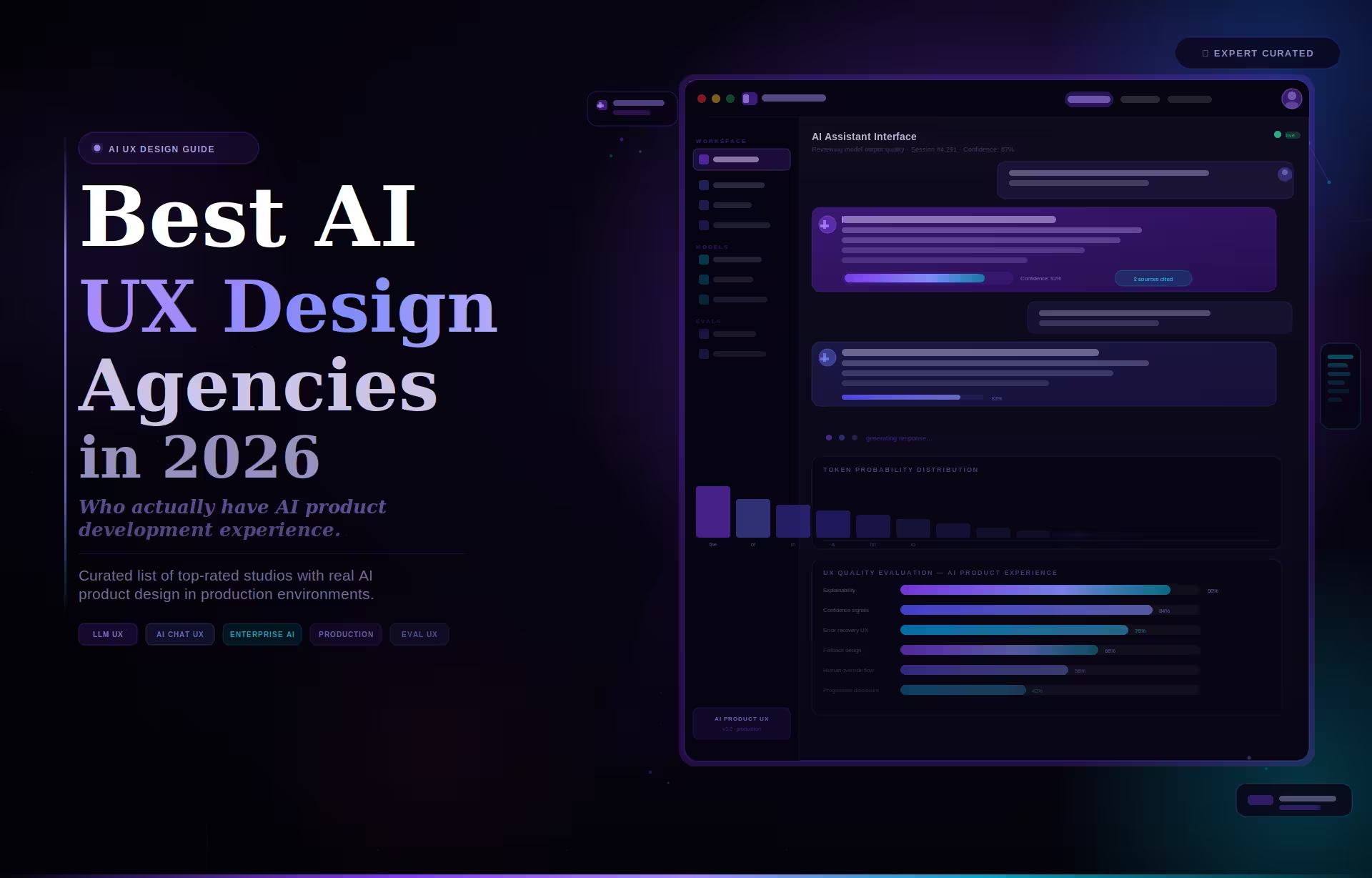
The best AI UX design agencies in 2026 are firms that have shipped production AI systems where model outputs directly affect user decisions, workflows, or business outcomes, not firms that added an AI section to their website after ChatGPT launched. Gartner projects that 40% of enterprise applications will integrate task-specific AI agents by end of 2026, and the gap between agencies that understand AI theoretically and those that have designed production AI interfaces is widening every quarter.
What AI interface design requires that regular UX doesn’t
AI interface design requires designing for probabilistic outputs, uncertain system behavior, and autonomous actions that traditional UX never accounts for. In standard software, a button click produces a predictable result. In AI-powered systems, outputs vary, confidence fluctuates, and errors are statistical rather than binary. The interface must communicate this difference honestly without overwhelming the user.
This distinction changes the role of UX from defining flows to managing the system’s behavior, building user trust, and supporting decisions where the system itself is uncertain. Most conventional UX teams are not trained for this work. The agencies that handle it well have designed against these specific challenges in production environments, not in concept decks.
Designing for uncertainty
Real-world AI systems deal with incomplete information, ambiguous data, and unpredictable outputs. The interface must communicate this uncertainty accurately rather than hiding it behind confident-looking screens. This means showing confidence levels, presenting alternative outputs, and letting users refine prompts when results are ambiguous. An interface that presents every AI output as definitive is lying to the user.
In our work with Stardog on the Voicebox knowledge graph conversational AI, query results carried varying certainty depending on the completeness of the underlying graph. The interface had to distinguish between high-confidence answers derived from well-connected nodes and low-confidence answers where the graph had sparse data. Treating both the same would have destroyed user trust within days.
Trust indicators and explainability
Users interacting with an AI interface are often working with a system whose internal reasoning is invisible. The interface must include signals that make the system’s behavior understandable: source attribution showing where data came from, confidence scores indicating how certain the model is, and clear visual distinction between user input and system-generated content. Without these layers, users either over-trust the system and act on incorrect outputs or reject it entirely.
NNGroup’s research on explainable AI found that users rarely verify AI citations even when they claim those citations increase their confidence. The design implication is that source indicators must be visible and contextual, not buried behind a click. Surface-level attribution creates false confidence. Genuine trust requires showing reasoning at the decision level.
Human-AI handoff design
The most consequential moment in AI UX is the handoff, when the system reaches the limits of its capabilities and requires human intervention. The interface must make this transition clear, providing the user with full context of the agent’s previous actions so they do not restart from scratch. The design must define when the system acts autonomously, when it escalates, and how users take control.
This is particularly critical in healthcare, finance, and autonomous systems. Our work with CYNGN on autonomous vehicle AI interfaces required clear escalation paths from AI decisions to human control. The operator needed to see what the system had decided, why it reached its limit, and what the recommended manual action was, all within the two-second window where the handoff mattered.
Error transparency and recovery
In traditional UX, errors are exceptions. In AI UX, they happen frequently and users have come to expect them. What matters is how the interface handles them. Acknowledging uncertainty with a message like “this output may be incorrect” is the starting point. Providing correction mechanisms that let users iterate without penalty is the minimum standard. Hiding errors or presenting probabilistic outputs as definitive destroys trust faster than the errors themselves.
The design pattern that works in production is the three-state error model: acknowledge what went wrong, explain why the system produced that result, and suggest what the user should try next. A generic “something went wrong” message is not sufficient because the user needs to know whether the failure was in their input, the model’s interpretation, or the data source. The recovery path differs for each.
Hallucination handling through UX
Large language models produce plausible but incorrect outputs regularly. The interface must include safety rails that help users verify AI-generated content: persistent citations linked to original sources, toggles between AI-generated summaries and source material, outputs structured into verifiable segments, and nudges that remind users to validate before acting on results. These patterns are standard in well-designed AI workflow interfaces and ML operations platforms.
The most effective hallucination mitigation we have implemented uses a “source view” toggle that lets users switch between the AI’s synthesized answer and the raw source material. When sources do not support the synthesis, the discrepancy is visible immediately. This works because it places verification in the user’s hands without requiring them to leave the interface. An inline toggle removes the friction that prevents checking.
Progressive disclosure for AI outputs
AI systems generate large volumes of information that can overwhelm users if presented all at once. Progressive disclosure shows the most relevant top-level insights first, then lets users drill into underlying data through expandable layers and context-aware suggestions. Technical users access the full ML detail when they need it. Executive users see the summary and act on it. Both use the same system. The interface adapts depth to role.
This pattern appears most often in ML operations platforms and AI dashboards where operators need both speed and depth. The default view shows three to five metrics with the AI’s interpretation. Expanding any metric reveals underlying data, confidence level, and influencing factors. A third layer shows raw data for full verification. Each layer adds cognitive load, which is why disclosure gates access behind deliberate user actions.
Top AI UX design agencies in 2026
The best AI UX design agencies in 2026 demonstrate production AI product experience, not just AI-adjacent service capabilities added to an existing UX practice. The agencies listed below were evaluated based on shipped AI systems with named clients, Clutch-verified pricing, and the technical depth of their AI interface work.
Fuselab Creative
McLean, VA (DC area)Hourly rate
$100–$149
Min. project
$25,000
Clutch rating
★ 5.0
Fuselab Creative has shipped multiple production AI systems including Stardog Voicebox (knowledge graph conversational AI), CYNGN (autonomous vehicle AI interface), and Grid AI (ML operations dashboards), all operating in live enterprise environments where AI outputs directly affect decisions and workflows.
The firm's Design for AI vertical covers AI workflow design, CLI and chat interface design, AI agents, and full-stack AI interface design. GSA contract holder with clients including NASA, Fiserv, Uber, NIH, and DHCS. Founded 2017, McLean, Virginia.
Strongest for
Hourly rate
$150–$199
Min. project
$25,000
Clutch rating
★ 5.0
Neuron focuses on designing complex workplace tools including AI-driven systems for sales, HR, and analytics. The firm is frequently cited in enterprise AI UX discussions for its structured workflows and design systems built specifically for AI-enabled products.
Neuron is more process-driven than visually oriented, making it better suited for internal tools where usability and adoption matter more than brand perception. Its portfolio emphasizes workflow optimization rather than advanced AI interaction patterns. Founded 2016, San Francisco.
Strongest for
Hourly rate
$150–$199
Min. project
$50,000
Clutch rating
★ 4.8
Clay is one of the most widely referenced agencies in AI and product design, known for high-end UI and brand-driven digital experiences. Clients include Meta, Google, and Coinbase.
Clay's AI strength lies in crafting intuitive front-end experiences for AI-powered products, particularly dashboards and consumer applications. The firm is less focused on deep enterprise workflows or regulated environments and more aligned with polished, market-facing products where design quality directly influences adoption. Founded 2009, San Francisco.
Strongest for
Hourly rate
$150–$199
Min. project
$25,000
Clutch rating
★ 4.9
Momentum Design Lab has been consistently ranked among the top UX agencies on Clutch from 2016 through 2025 and is a benchmark for enterprise UX in high-complexity environments. Acquired by HTEC Group in 2021, the firm combines UX strategy with scaled engineering capability.
Its strength is translating large data architectures into structured, role-based experiences that support real decision-making, particularly in CRM analytics and wealth management. Founded 2002, Palo Alto.
Strongest for
Hourly rate
$50–$99
Min. project
$50,000
Clutch rating
★ 4.8
Netguru operates as a large-scale digital consultancy combining UX, engineering, and AI development across fintech, retail, and healthcare. Its AI capabilities span generative AI, machine learning, NLP, and computer vision, typically embedded into broader digital transformation initiatives rather than standalone AI products.
AI-related work including chatbots, predictive analytics, and commerce personalization focuses on implementation at scale rather than interaction-level AI UX innovation. Founded 2008, Poznań, Poland.
Strongest for
Hourly rate
$100–$149
Min. project
$25,000
Clutch rating
★ 5.0
Goji Labs focuses on turning AI concepts into production-ready products and MVPs, combining strategy, UX design, and engineering. Its AI work includes conversational interfaces, AI assistants, workflow automation, and retrieval-based systems that integrate proprietary data.
The firm emphasizes building AI products aligned to measurable business outcomes early in the product lifecycle rather than polishing interfaces after the model works. Founded 2014, Los Angeles.
Strongest for
Hourly rate
$25–$49
Min. project
$10,000
Clutch rating
★ 4.9
Merge is a product design and development studio with a dedicated AI practice that builds LLM-powered tools and generative AI features rather than adding AI to a marketing page. Its own products include Promtify, a prompt-engineering tool built on the OpenAI API, and Insure+, an end-to-end AI underwriting platform with a conversational insurance assistant.
The firm pairs design with front-end and AI engineering, making it a practical choice for startups shipping an AI product on a lean budget rather than enterprises needing regulated-industry depth. Founded 2018, New York, with a delivery team in Poland.
Strongest for
Hourly rate
$50–$99
Min. project
$25,000
Clutch rating
★ 4.9
The Gradient positions itself as an AI-native design team focusing on product strategy, UX, and rapid AI prototyping. Services span AI transformation, UI for AI products, prompt engineering, and product analytics. Clients include Qatar Airways, Daimler, and Dubai Financial Market.
AI-native product work includes Happy Companies (AI coaching), Lumiere (video intelligence), and Norvana (health intelligence). The firm is design-led rather than engineering-heavy. Founded 2015, Lviv, Ukraine.
Strongest for
Hourly rate
$25–$49
Min. project
$10,000
Clutch rating
★ 4.9
Code District delivers AI, data engineering, and software development alongside UX services with a large global team across the UK, Netherlands, Canada, and Pakistan. AI capabilities include AI agents, generative AI, chatbot systems, and computer vision.
Notable work includes an AI system for PharmaSift predicting FDA compliance risks and a generative AI conflict resolution platform. The firm is engineering-led with UX integrated into delivery rather than leading the process. Founded 2017, Washington DC.
Strongest for
Hourly rate
$50–$99
Min. project
$10,000
Clutch rating
★ 5.0
Designli is not an AI-specialist agency but integrates AI features into broader product builds. The firm focuses on guiding non-technical founders through product creation, combining UX, development, and structured workflows to reduce early-stage risk.
Designli is highly process-driven and founder-focused but less specialized in complex AI systems or enterprise-grade interfaces. Founded 2013, Greenville, SC.
Strongest for
Across these agencies, the key distinction in 2026 is not breadth of capability but depth of production AI experience. Firms like Fuselab Creative, Neuron, and Momentum Design Lab operate closest to production AI systems where design decisions directly affect whether users trust the output enough to act on it. Others integrate AI into broader product delivery with varying levels of UX maturity in probabilistic systems.
The market is splitting into two tiers. The first includes agencies that have designed AI products from the model layer up, where interface architecture is shaped by AI behavior. The second includes agencies applying traditional UX to AI-adjacent products, treating the model as a backend service. Both produce work. The difference shows when the AI behaves unexpectedly, because only the first tier has designed for that scenario. Whichever AI design agency you shortlist, weight demonstrated production experience over portfolio polish.
How we ranked these AI UX design agencies
The best UX design agencies for AI products in 2026 were ranked on four verifiable signals: shipped production AI systems where model outputs affect real decisions, named enterprise clients, Clutch-verified pricing and ratings checked in July 2026, and demonstrated patterns for uncertainty, confidence, and human handoff.
Ranking rewards depth over breadth. An agency that lists AI among twenty services but shows no shipped product where the model drives the interface ranks below a smaller firm with one production AI system and a named client. The best UX design agencies for AI products can walk a buyer through a live environment handling real enterprise data, not a concept deck.
Pricing and ratings for these AI UX design agencies reflect each firm’s public Clutch profile as of July 2026, not figures carried over from an earlier version of this article. Ratings shift as new reviews land, so a rating verified in April can be stale by summer. Review depth was weighed alongside each score, so a high rating built on very few reviews was not treated as equal to one earned across dozens.
Comparison table
How to evaluate an AI UX design agency
A qualified AI UX design agency has shipped AI systems where model outputs directly impact user decisions in production, not just prototypes or concept demos. The evaluation must probe for probabilistic design experience, uncertainty handling, and AI-specific testing methodology. Conventional UX portfolios are not sufficient evidence.
The evaluation comes down to eight signals that separate a production AI agency from a general UX shop:
- See a live AI product. Request a walkthrough of a production environment where the AI handles real enterprise data. An agency that can only show static Figma mockups has not done the work.
- Probe the probabilistic process. Ask how their design process changes for a probabilistic model rather than a deterministic database. A senior team describes patterns for confidence levels, ambiguous outputs, and no-result states.
- Test the human-AI handoff. Ask what happens when the model reaches its limit and how control passes to a person without losing context. Have them describe a real project and the failure mode before they fixed it.
- Verify regulated-industry credentials. For government or healthcare work, confirm GSA vetting and compliance experience with HIPAA, Section 508, or CMS guidelines. Agencies that have not worked under these constraints underestimate how much they shape the interface.
- Check for model feedback loops. Look for active-learning elements where users flag wrong outputs and those corrections feed back into fine-tuning, not static screens sitting over an AI API.
- Confirm they are model-agnostic. Enterprise products route queries across models by task, cost, and latency. An agency built around a single provider may not adapt the interface when the underlying model changes.
- Clarify design-led versus engineering-led. Design-led teams shape the model’s behavior specification. Engineering-led teams design around whatever the model produces. Know which one you are hiring.
- Demand domain-specific AI experience. An agency that has shipped AI for your industry already knows its audit trails and handoff patterns. One that has only built consumer chatbots learns them on your timeline, expensively.
The agencies that will still be worth hiring at the end of 2026 are the ones that can show a live AI product and explain how it handles uncertainty, confidence, and human handoff, not the ones with the longest capability list. Match the firm to the specific AI problem you are solving, and start with the ones that have shipped AI interface design work close to your domain.
Frequently asked questions
What is AI UX design?
AI UX design is the practice of designing user experiences for products where outputs are generated by machine learning models rather than predefined by code. It focuses on managing uncertainty, building user trust, and enabling interaction with systems whose behavior varies based on input, context, and model confidence. In 2026, AI UX design is less about screens and more about shaping how users collaborate with machine intelligence.
How is AI interface design different from standard UX design?
AI interface design differs from standard UX because it handles probabilistic outputs where results vary with each query, while standard UX assumes consistent, predictable system behavior. This requires additional design layers including explainability, fallback states, confidence indicators, and user control over autonomous decisions that traditional UX never addresses.
Which UX agencies specialize in AI interfaces and generative AI UX?
Agencies specializing in AI interfaces and generative AI UX include Fuselab Creative, Neuron, and The Gradient, each with shipped products where model outputs drive the interface. Fuselab’s work spans conversational AI, ML operations dashboards, and autonomous-vehicle interfaces. Generative AI UX specifically requires patterns for confidence, source attribution, and hallucination handling that general UX teams rarely build.
Which agencies have real production AI product experience?
Fuselab Creative, Neuron, and Momentum Design Lab have shipped production AI systems where outputs influence real user decisions. Fuselab’s portfolio includes Stardog Voicebox, CYNGN, and Grid AI. Clay focuses on consumer-facing AI experiences, while Merge, Netguru, and Code District emphasize engineering-led AI implementation with UX integrated into delivery.
How much does AI UX design cost in 2026?
AI UX design projects in 2026 typically start at $25,000 for smaller engagements and can exceed $100,000 for enterprise systems with complex AI workflows. US-based specialist agencies charge $100 to $199 per hour. Offshore agencies charge $25 to $99 per hour, though regulated-industry projects requiring compliance expertise tend to cost more regardless of agency location.
What deliverables should I expect from an AI UX design agency?
AI UX design agencies deliver AI workflow maps, interaction models for probabilistic systems, trust and explainability frameworks, high-fidelity prototypes designed for uncertain outputs, and developer-ready design systems. Some agencies also provide prompt design documentation, AI behavior specifications, and usability testing specifically designed for AI interaction patterns and failure scenarios.
What is the difference between AI product design and AI feature design?
AI product design builds systems where AI is central to the experience, such as recommendation engines, AI copilots, or predictive dashboards that generate their primary interface from model outputs. AI feature design adds AI capabilities to an existing product, such as autocomplete or chatbot support. Product-level AI requires deeper UX thinking and system-level design than feature-level integration.
Why is trust critical in AI interface design?
Trust is critical in AI interface design because users interact with systems that may produce uncertain or incorrect outputs. Without clear reliability indicators, users either over-rely on the system and act on bad data, or reject it entirely and revert to manual processes. NNGroup’s State of UX 2026 report identifies trust as a major design challenge for AI experiences, noting that users burned by unreliable AI features resist adopting new ones.
What are hallucinations in AI, and how does UX address them?
Hallucinations occur when AI systems generate incorrect information that appears plausible. UX design mitigates this by structuring outputs with persistent source citations, providing toggles between AI summaries and original source material, and nudging users to validate outputs before acting on them. Good design makes users aware of potential inaccuracies without creating so much friction that they stop using the system.
How long does an AI UX design project take?
AI UX design projects take 12 to 24 weeks depending on scope and the number of AI workflows involved. Enterprise systems with multiple AI interaction patterns or regulated-industry compliance requirements take longer due to the research, testing, and validation cycles that production AI demands. MVP-scope projects can ship faster but typically require iterative improvement after launch.
What risks should I consider when hiring an AI UX agency?
The biggest risk when hiring an AI UX agency is choosing one without production AI experience, which leads to interfaces that look polished but fail when the model behaves unexpectedly. Other risks include agencies that treat AI as a visual layer over a conventional backend, lack of uncertainty handling in the design, and failure to design human-AI handoff paths. These problems surface after deployment and are expensive to fix.
Can a traditional UX agency handle AI interface design?
Traditional UX agencies can handle AI feature additions like chatbot interfaces or autocomplete, but production AI products where model behavior shapes the core experience require specific expertise in probabilistic design, uncertainty communication, and error recovery patterns. Agencies without this experience tend to retrofit traditional patterns onto AI products, which breaks when the model produces unexpected outputs or requires human intervention mid-workflow.
Who are the best AI design agencies?
The best AI design agencies are firms with shipped, production AI products and a named enterprise client behind each one. The agencies ranked in this guide were scored on live AI work, proven uncertainty and handoff patterns, and Clutch-verified pricing, not marketing claims. Judge any shortlist on those same signals before you commit.