Best UX design agencies for B2B SaaS in 2026
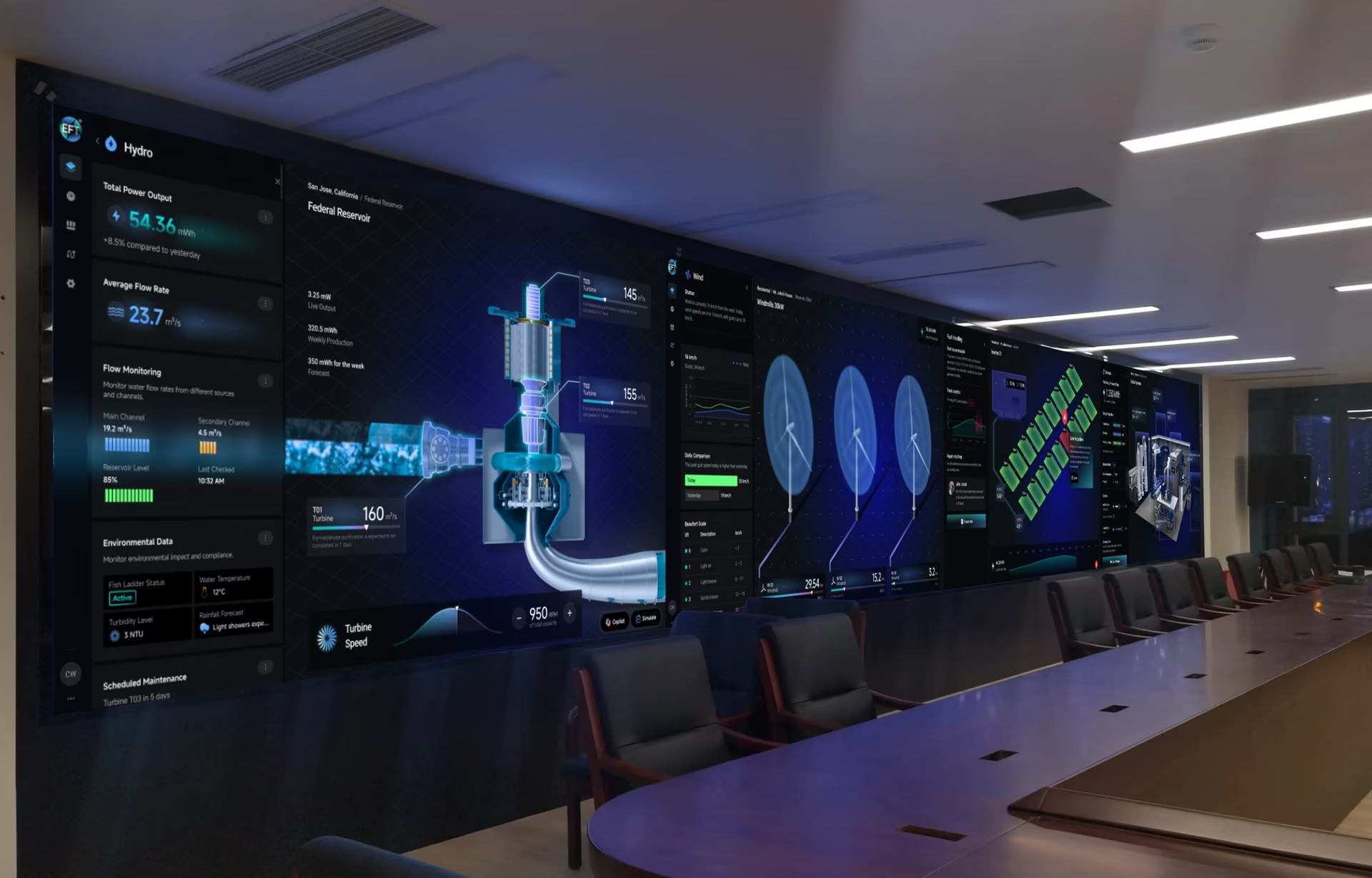
The best UX design agencies for B2B SaaS specialize in subscription software sold to other businesses, where the design challenge is not acquisition but the full adoption cycle: multi-role workflow complexity, onboarding friction, and the retention economics that decide whether an account expands or churns. A single product must serve the buyer who approved procurement, the administrator who configures it, and the end user who opens it daily, each with different permissions and definitions of success inside one interface.
What makes B2B SaaS UX different from general product design
B2B SaaS UX differs from general product design because it treats friction as sometimes structural, not always a defect. A consumer app removes every obstacle because the user can leave in one tap. In B2B software, a single workflow may require six approvers, two compliance checkpoints, and an audit trail, so removing the wrong step breaks the product rather than improving it.
An agency that misses this distinction will polish the interface while quietly breaking the product. The instinct to eliminate every confirmation, every extra screen, and every deliberate pause is correct in consumer design and dangerous in enterprise software, where those steps often encode a business rule that the subscription itself depends on.
Multi-role information architecture is the first structural requirement that separates B2B SaaS UX from nearly everything else. The same product serves a buyer, an administrator, and a daily end user, each with different data permissions and workflow priorities. Building distinct workspaces inside one coherent product takes real command of business process logic, progressive disclosure, and how permissions shape the experience at each boundary.
Nielsen Norman Group’s work on complex-application design describes how enterprise tools support nonlinear workflows and expert users in high-stakes domains, which is exactly why multi-role architecture demands different thinking from consumer or marketing design. Most agencies discover this gap only after the engagement starts, once the information architecture is already built around the wrong model.
Activation design is the second discipline that generalist agencies rarely develop. When a B2B account churns in its first year, the product has usually worked. Its users stopped before they reached the moment that justifies the subscription. Strong agencies discuss onboarding as workflow distance: how many steps separate account creation from the first action that justifies the subscription for a specific role.
AI as a native workflow layer is the biggest structural shift in SaaS design for 2026. In analytics platforms, operations tools, and workflow management software, users now evaluate AI recommendations, validate model outputs, and direct automated processes rather than executing tasks themselves. That change in the user’s role demands interaction patterns that traditional SaaS never needed and that most portfolios do not yet show.
Trust calibration is the core of NN/g’s guidance on explainable AI: users do not need to understand how a model works, but they do need to know when to rely on it and when to apply their own judgment. Fuselab applied exactly that thinking on Grid AI’s ML operations dashboard and EffiTrack’s energy analytics platform, in production rather than in prototypes.
The interaction patterns behind AI-enabled SaaS, activation, and retention build on a larger body of work. Fuselab Creative’s SaaS UI/UX design guide covers the underlying principles in depth, including how time-to-value and role-based onboarding shape the first session that decides whether a new account sticks or quietly lapses.
What to look for in a SaaS UX design agency
A strong B2B SaaS UX design agency answers four questions before any conversation about visuals: whether it has shipped at comparable scale or sector, whether it has built workflow-heavy multi-role applications, whether it documents its approach to activation and time-to-value, and whether its engagement model fits how the product team actually works. Everything else reflects preference, not capability.
Shipped products at comparable scale. When you vet a SaaS UX design company, the question that cuts fastest is whether it has shipped software with the same workflow complexity, role structure, or regulatory constraints as your product. What counts is live software with paying users, ideally across more than one stage of maturity, because the problems at product-market fit differ from those at platform scale.
Workflow-heavy, multi-role experience. SaaS workflows can span hours, days, or weeks before one business objective is complete, and an agency that has not worked in that environment cannot spot the real problems from a portfolio review. Test it directly: ask what happens when a filter applies differently to two user roles. A specialist answers from experience. A generalist changes the subject to visual treatment.
A documented approach to activation. For growth-stage products, the sharpest test is whether the agency can define the current time-to-value for a specific user role before designing anything. Agencies worth hiring at Series B open with that question, not with brand guidelines. One that leads with welcome screens and tooltips has not yet treated onboarding as a workflow-distance problem.
An engagement model that fits your team. Some products need a scoped research-through-handoff project, and others need a designer inside the sprint cadence for months. A mismatch shows within weeks: a project team with no room to iterate alongside engineering, or one embedded designer asked to restructure a whole platform. Ask who will attend your standups and who owns the design system after handoff.
Best UX design agencies for B2B SaaS in 2026
The best UX design agencies for B2B SaaS in this comparison have each shipped or materially redesigned live B2B software used by paying customers. Portfolio images on agency websites rarely separate a shipped product from a design-only exercise, a rebrand, or a landing page. Each entry was checked for shipped multi-role B2B work, named clients, Clutch-verified pricing, and a real operating location rather than a registered US address.
Entries are grouped by engagement scope rather than ranked by quality. Agencies that run full research-through-handoff projects come first, followed by those with a specialized model or a narrower constraint, such as compliance credentials or an information architecture focus. Each heading names the scenario the agency suits best, so a reader can skip straight to the situation that matches their own product.
Fuselab Creative: best suited to complex, multi-role B2B SaaS
Location: McLean, VA · Hourly rate: $100–$149/hr
Min. project: $25,000 · Clutch: ★ 5.0
Fuselab Creative is a UX design agency in McLean, Virginia, founded in 2017. It designs complex B2B SaaS: multi-role products with layered permissions, analytics and reporting tools, onboarding for technical users, and AI workflows where people act on model output. Clients include NASA, Fiserv, Uber, NIH, and DHCS, with engagements running from research to a documented design system and engineering handoff.
Strongest for: multi-role B2B SaaS, analytics and reporting, AI-enabled workflows
Less ideal for: one-off visual refreshes below its $25,000 minimum, or teams wanting one designer embedded full-time in their sprints.
Neuron: best suited to enterprise B2B software at premium scope
Location: San Francisco, CA · Hourly rate: $150–$199/hr
Min. project: $25,000 · Clutch: ★ 5.0
Neuron, founded in 2016, works on enterprise software and complex B2B products, from analytics and CRM tools to finance and HR platforms, for clients including IKEA, Palo Alto Networks, Paycom, Vendr, and HMH. Its work centers on fitting new interfaces into the workflows enterprise users already run, which matters where adoption depends on not breaking established habits.
Strongest for: enterprise B2B, workflow tools, analytics and CRM
Less ideal for: early products on a tight budget, since its hourly rate is the highest on this list.
Dreamten: best suited to growth-stage SaaS adoption work
Location: Raleigh, NC · Hourly rate: $100–$149/hr
Min. project: $25,000 · Clutch: ★ 5.0
Dreamten’s case studies are weighted toward software products rather than spread across verticals, with named clients including Invoicify, Fathom, and RepVue; the Fathom work covers a meeting app built for the Zoom Marketplace. It is strongest for companies moving from growth to retention, where improving onboarding completion and feature adoption returns more than launching further features.
Strongest for: growth-stage SaaS, onboarding completion, feature adoption
Less ideal for: products that have outgrown their original information architecture and need platform-level restructuring.
Goji Labs: best suited to teams that want design and build from one partner
Location: Los Angeles, CA · Hourly rate: $100–$149/hr
Min. project: $25,000 · Clutch: ★ 5.0
Goji Labs delivers design and development from one team, which removes handoff friction for teams building from a validated concept or rebuilding a product whose technical foundation no longer supports the roadmap. Named clients include WWF, WHO, and Mural, and the agency says it has launched more than 500 products.
Strongest for: full-stack SaaS builds, design plus engineering, growth-stage products
Less ideal for: established teams with strong internal engineering that need a design-only partner.
Cieden: best suited to redesigning complex B2B products
Location: Toronto & Lviv, Ukraine · Hourly rate: $50–$99/hr
Min. project: $10,000 · Clutch: ★ 4.9
Cieden focuses on complex B2B products where workflow efficiency outranks aesthetics, with more than 200 completed design projects and clients including Apollo.io and Blizzard. For product leaders adding AI to an established product, its relevant credential is redesigning complex tools without losing the workflow competence of existing users.
Strongest for: complex B2B SaaS, AI-enabled redesigns, EdTech
Less ideal for: teams that need design and development from one partner, or products still in early concept validation.
UITOP: best suited to vertical SaaS, ERP, and CRM platforms
Location: Kyiv, Ukraine · Hourly rate: $25–$49/hr
Min. project: $10,000 · Clutch: ★ 5.0
UITOP says it works exclusively on B2B software, pairing product design with engineering. Its portfolio centers on ERP systems, CRM tools, and industry-specific workflow products whose power users have firm habits for how their data is organized. Named clients include ResHub, TrovBase, and Costa Security, and its hourly band is the lowest on this list.
Strongest for: vertical SaaS, CRM and ERP, operational platforms
Less ideal for: multi-surface, multi-phase redesign programs that need parallel workstreams.
Qubstudio: best suited to information architecture for growing platforms
Location: Lviv, Ukraine · Hourly rate: $50–$99/hr
Min. project: $10,000 · Clutch: ★ 4.9
Qubstudio, founded in 2006, is strongest on information architecture: how a product’s structure holds up as features, roles, and data types accumulate. Named clients include Truecaller, CENTEGIX, and Workforce Velocity, a record that suits Series B or C platforms whose original navigation no longer fits what the product has become.
Strongest for: information architecture, SaaS and fintech, platform restructuring
Less ideal for: early products that need a fast first release more than structural rework.
Phenomenon Studio: best suited to HIPAA-sensitive SaaS
Location: Tallinn, Estonia · Hourly rate: $50–$99/hr
Min. project: $10,000 · Clutch: ★ 5.0
Phenomenon Studio’s clearest differentiator is its HIPAA compliance program, which the studio says was independently assessed and renewed in August 2026, alongside GDPR-aligned data handling. That removes a category of vendor risk for healthcare SaaS and fintech teams. Named work includes Isora, a governance, risk, and compliance platform built for SaltyCloud, and KlickEx, a cross-border payments platform.
Strongest for: HIPAA-sensitive SaaS, HealthTech, FinTech
Less ideal for: B2B SaaS without compliance requirements, where other agencies here hold deeper workflow and analytics portfolios.
How we evaluated B2B SaaS agencies
These B2B SaaS agencies were evaluated on evidence, not reputation. SaaS portfolio depth came first, because agencies that work with software companies repeatedly develop a sharper read on activation, feature adoption, and workflow complexity than agencies that move between verticals. AI capability, compliance credentials, and Clutch ratings followed, in that order.
SaaS portfolio depth was the primary criterion. The distinction that mattered was between agencies with genuine experience in data-rich operational software and multi-role enterprise environments, and those mostly showing marketing sites or pure brand refresh work. Live software with paying users counted. Portfolio-only concepts and landing-page redesigns did not.
We read stage fit from each agency’s published work. A studio whose case studies are mostly first releases went to Series A or B, and one whose work restructures B2B SaaS platforms with established users went to Series C or D. The Stage Fit column records where that evidence is strongest, and an agency may still take work outside it.
AI product design capability was included because designing AI features and designing AI-enabled experiences are now commercially distinct. Adding a chat interface is implementation. Designing an AI interface where the system surfaces recommendations, signals its confidence, and offers a usable override path takes interaction design maturity that fewer agencies can show with shipped examples.
Clutch ratings and design system delivery served as supporting evidence, not primary selection. Ratings can reflect account management as much as design quality, so they validated rather than ranked. Consistent handoff of documented component libraries signaled a different working method from agencies that deliver screens only. We checked location on Clutch and, where Clutch shows only a US registration address, on the agency’s own site.
We ran the evaluation in sequence rather than as a weighted score. The first question was binary: has this agency shipped live B2B software where the design challenge involved multiple roles and workflow complexity? Agencies without named examples were excluded regardless of rating. Among those that qualified, portfolio depth outranked AI capability, AI capability outranked compliance credentialing, and ratings came last.
A note on authorship: we publish this comparison of the best UX design agencies for B2B SaaS, and we list Fuselab Creative first because our work matches the article’s focus most closely: complex, multi-role B2B SaaS carried from research through engineering handoff. Every entry follows the same format, and each Clutch rating links to its public profile so readers can verify it.
Comparison table: best UX design agencies for B2B SaaS in 2026
Hourly rates across the eight best UX design agencies for B2B SaaS here run from $25 to $199, with minimum projects from $10,000 to $25,000. Pricing and ratings come from each agency’s Clutch profile as checked on September 25, 2026. The Stage Fit column shows where an agency’s published SaaS work is strongest. Filter on it first, then compare each SaaS UX design agency on price.
How to choose the right UX design agency for your B2B SaaS stage
The UX challenges inside a B2B SaaS product change substantially between Series A and Series D, and the agency that fits one stage often does not fit the next. Match the agency to the stage of the actual problem, an activation bottleneck, platform complexity, or AI workflow design, rather than to reputation or portfolio size. That is the one selection criterion that consistently returns work worth paying for.
Series A: reach the value moment. The only objective that matters is whether users hit the core value moment before they lose interest. Most Series A teams do not need a six-month redesign or a new design system. They need a targeted engagement that isolates the onboarding bottleneck and fixes it. Ask each shortlisted agency to name the value moment for your main user role before it sends a quote.
Series B: pay down UX debt. Accumulated UX debt becomes visible in the metrics here. The flow built for the first hundred users now serves ten thousand, and onboarding that relied on customer success walking through every account fails in self-serve. A structured redesign with research, a role-matrix audit, and a design system returns the most. The evidence to request is a role matrix from a shipped product.
Series C and D: platform architecture. The problem expands beyond individual screens and onboarding flows. Focused tools have grown into platforms with multiple user types, layered permissions, sprawling feature sets, and AI capabilities added faster than the information architecture could absorb them. New users stall in interfaces that veterans move through by muscle memory. The agency worth hiring can show a live platform it restructured without retraining existing users.
AI-native workflows are a challenge at any stage. When AI sits inside the core workflow, one question drives dozens of downstream decisions. When the model is uncertain, how does the product show it so the user decides faster rather than worse? Agencies that have shipped AI-enabled SaaS know which decisions belong in the design file and which become engineering specs. Ask which uncertainty states they specified.
Conclusion
The best B2B SaaS UX engagement comes from matching the agency to the specific stage of the problem. An activation bottleneck at Series A, platform complexity at Series C, and AI workflow design at any stage each need a different partner. Name the one you are solving before the first call, and ask every shortlisted agency the same stage question.
Frequently asked questions
What is B2B SaaS UX design?
B2B SaaS UX design covers subscription software sold to businesses, where the objective is the full adoption cycle rather than one-time acquisition. It centers on multi-role information architecture, activation and time-to-value, and retention, because a single product must serve buyers, administrators, and end users at once. Increasingly it also covers AI-enabled workflows where users evaluate and direct model output.
What does time-to-value mean in B2B SaaS product design?
Time-to-value in B2B SaaS product design is the number of steps, or the elapsed time, between account creation and the first action that justifies the subscription for a specific user role. Growth-stage agencies define it before designing anything, because it shows exactly which steps stand between each role and the reason the account pays. It is measured per role, since an administrator and an end user reach value differently.
How does B2B SaaS UX design differ from consumer UX?
B2B SaaS UX design keeps some friction on purpose, because enterprise workflows encode approvals, compliance steps, and audit trails that consumer apps never carry. Consumer UX optimizes for a single user who can leave in one tap, while B2B SaaS must serve buyers, administrators, and daily end users inside one interface. The result is a discipline built around multi-role architecture, not friction removal.
What is the difference between a B2B SaaS UX agency and an enterprise UX agency?
B2B SaaS UX agencies specialize in subscription software where activation, feature adoption, and retention drive the design, usually for products sold self-serve or through sales-assisted motions. Enterprise UX agencies focus on large-scale internal systems and complex organizational workflows, often with heavier compliance and integration constraints. The overlap is multi-role architecture, and the difference is whether the product is sold as a subscription or deployed inside one organization.
How much does a B2B SaaS UX design engagement cost?
Pricing for a B2B SaaS UX design engagement with the agencies on this list starts at a minimum of $10,000 to $25,000. Clutch-listed hourly rates run from $25 to $49 at a Kyiv-based studio up to $150 to $199 in San Francisco. The spread reflects location and engagement model, since a targeted onboarding fix at an Eastern European studio costs far less than a US research-through-handoff redesign with a design system.
How long does a B2B SaaS UX project take?
A B2B SaaS UX project focused on onboarding or activation usually takes six to sixteen weeks, because it redesigns one workflow for defined roles. A full redesign of a focused application with one or two user roles runs three to six months. An enterprise platform with three or more roles, complex data integrations, and compliance requirements typically needs eight to twelve months.
How do I evaluate whether a UX design agency has real B2B SaaS experience?
Evaluating a UX design agency’s B2B SaaS experience starts with live software that has several user roles and a named client you can contact. Ask for the role map or permission matrix from one of those products, because an agency that designed the roles will have one and an agency that only styled the screens will not. Check client work and location on Clutch as well as on the agency’s own site.