UX design agency vs in-house UX team in 2026
Choosing between a UX design agency and an in-house UX team is a capability-gap decision: an agency delivers specialist expertise within weeks without a hiring cycle, while an in-house team builds the accumulated product context that makes every design decision faster and better informed over 18 to 24 months. The choice is not permanent: most organizations use external agencies to create or accelerate design capability, then build an internal team once the product iterates fast enough to justify a full-time hire.
Quick answer
A UX design agency is the right choice when speed, specialist expertise, or a project-defined scope is the primary constraint. An in-house team becomes a stronger investment once the product is in continuous iteration and design decisions need to be made daily inside the engineering sprint rhythm. Most organizations use both in sequence: agencies to create or accelerate design capability, internal teams to own it long-term.
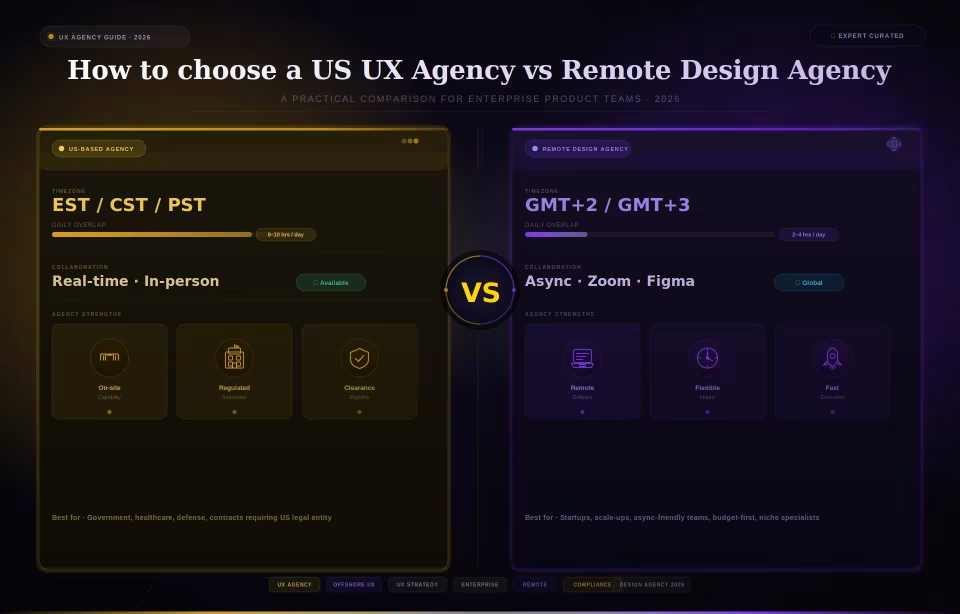
This article addresses whether to hire externally at all. If that question is settled and you are evaluating US-based specialists against offshore options, that comparison is covered in depth in this US UX agency vs remote design agency guide.
The UX capability lifecycle: start with the gap, not the staffing model
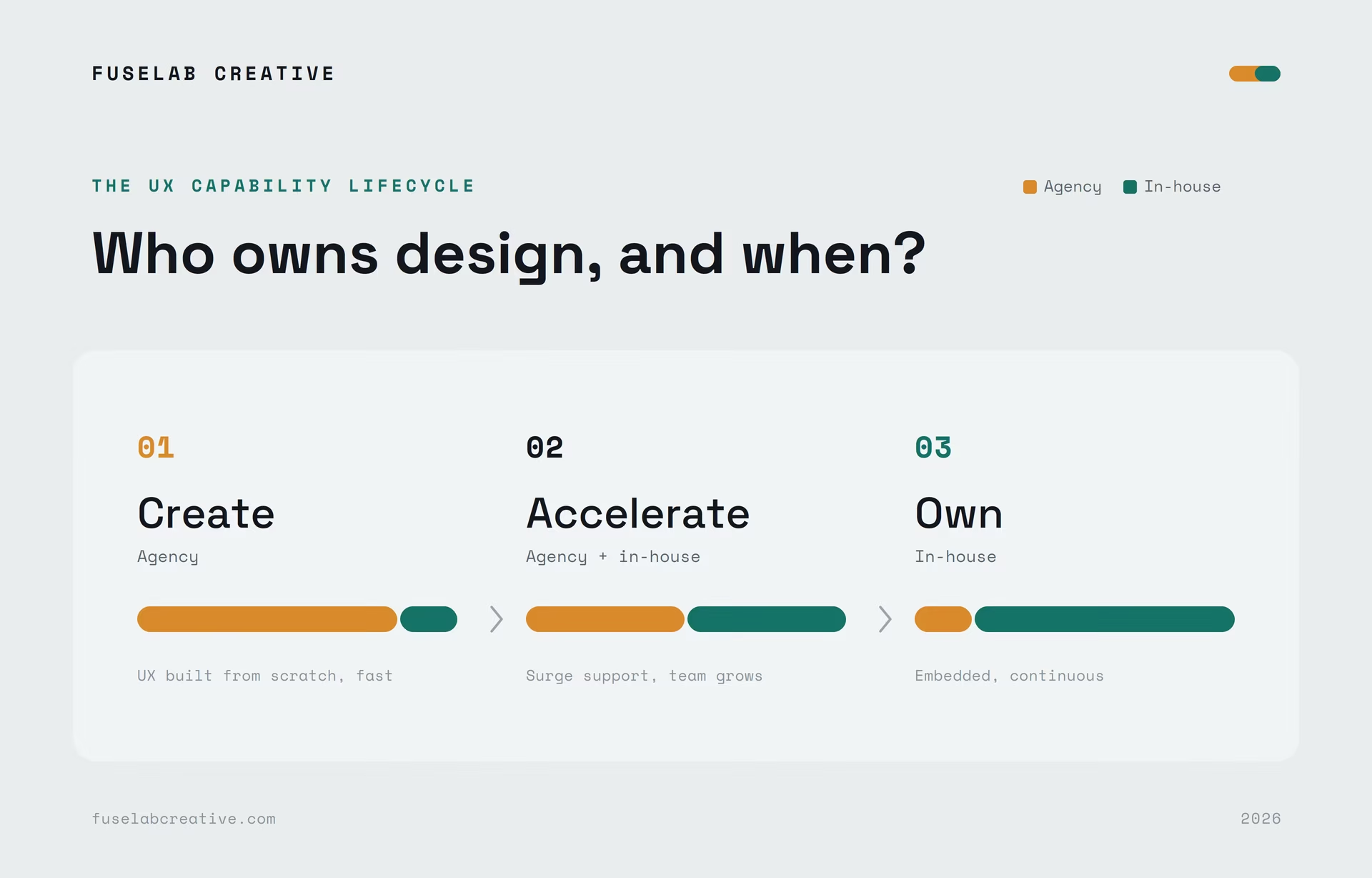
The UX design agency vs in-house decision changes meaning depending on where an organization is in its product lifecycle and its UX maturity stage. Most organizations move through three stages that form a UX capability lifecycle: creating design capability, accelerating it, and owning it. Let us break this down for you. Identifying which stage applies determines the right model before any cost comparison begins, because each stage answers the agency-or-hire question differently.
The capability creation stage applies to companies that have grown past informal design decisions but have not yet hired anyone dedicated to UX. An external agency can establish a research process, build a design system, and ship production-ready output in less time than it takes to secure headcount approval and write a job description. The organizational cost of waiting for a new hire to onboard often exceeds the agency fee at this stage.
The capability acceleration stage is where the agency vs in-house question is most genuinely ambiguous. An existing UX team cannot absorb a platform migration, a new AI product line, or a compliance-driven redesign without dropping everything else. This is a surge problem, not a model choice. The answer is almost always external support with a defined scope and handoff milestones while the internal team retains strategy. Treating it as binary ends in either a burned-out team or an agency dependency that outlasts its purpose.
The capability ownership stage arrives when the product is in continuous iteration, design operations and design systems governance have become as important as raw output, and competitive advantage comes from how well the experience works over time. In-house teams are the right primary resource at this stage because the context accumulated through two years of sprint reviews, architectural debates, and daily engineering conversations is knowledge that no external engagement replicates. Agencies remain valuable for specific initiatives where independent perspective matters, but they should not own the core design function at this stage.
When to hire a UX design agency
A UX design agency is an external firm that supplies UX research, design, and delivery under a project or retainer contract, and it is the right choice when the cost of waiting for an in-house capability to arrive outweighs the cost of an engagement. Whether the constraint is a hire that takes three months to onboard, a specialist skill that takes years to develop internally, or a product timeline that closes before either is possible, the argument for external support is almost always about time, not budget.
The argument that gets discounted most consistently is specialist depth: the actual skill gap that makes an external engagement necessary, not just convenient. A fintech practitioner who understands compliance requirements, an EHR designer with real clinical workflow experience, or a specialist who has shipped production AI interfaces is genuinely hard to hire because the talent pool is narrow and the best practitioners are already employed. An agency that has built this specialization across multiple client engagements provides access under one contract to expertise that would require three or four separate hires to replicate internally.
In our work with Grid AI on their machine learning platform, the design problem was confidence signaling: how users should interact with recommendations they cannot verify, and where the interface should make the model’s uncertainty visible without eroding trust in its outputs. That kind of AI interface specificity develops through repeated project exposure. Most engineering-led organizations cannot hire for it on a six-month timeline.
Multidisciplinary coverage is the third factor. A product that simultaneously needs a UX researcher, an information architect, an interaction designer, and a visual designer requires either a generalist who covers all four at moderate depth or four separate hires with extended recruiting cycles. Most internal teams run lean, with one or two designers covering everything, so an initiative that needs all four disciplines at once hits a capacity wall that has nothing to do with individual skill. An agency staffs those roles from an existing bench under a single contract, which is the practical reason the coverage gap closes faster externally than through hiring.
A team that has worked inside the same product for two or three years develops assumptions it can no longer see. This is a big reason why many product leaders bring in a UX consultancy for independent evaluation, separate from any execution engagement.
When to build an in-house UX team
An in-house UX team is a permanent design function embedded inside the product organization, and it consistently outperforms an external agency once a designer’s accumulated product context becomes the primary input to design decisions. That threshold arrives when the product is in continuous delivery, design input is needed inside daily sprint conversations rather than in formal project briefs, and the quality of product decisions depends on knowledge that no external team builds through a project cycle.
Products in continuous delivery operate at a pace that the structured communication rhythm of an agency relationship consistently fails to match. A feature decision raised at Tuesday sprint planning may need design input before Thursday’s demo. An embedded in-house designer gives it. An agency, even a responsive one, is a Slack thread, a version-control handoff, and a weekly status call away from the same answer. The gap here is structural, not a question of agency quality: the engagement model itself cannot accumulate the daily product context an embedded designer absorbs by default, so a better agency does not close it. Embedded designers also build product management alignment through daily sprint collaboration, a working relationship agencies maintain through structured project briefs rather than informal daily conversation.
Design as competitive advantage is the category where an in-house product design team creates durable, compounding value. Consumer products, clinical workflow tools, and SaaS platforms in mature markets all sit here. The user experience in these products is the product, not the wrapper around it. McKinsey’s Business Value of Design study, which tracked 300 companies over five years, found top-quartile design performers outpaced industry peers by 32 percentage points in revenue growth; those companies consistently embedded design in strategic decisions from the start rather than treating it as a late-stage delivery function.
The single variable most predictive of in-house UX success is UX leadership: whether a design manager or head of product design exists who can develop talent, set quality standards, and independently evaluate design decisions. If that leadership does not exist and cannot be built in the near term, the honest answer is to extend the external model until it is in place.
Cost comparison: agency rates vs the true cost of an in-house team
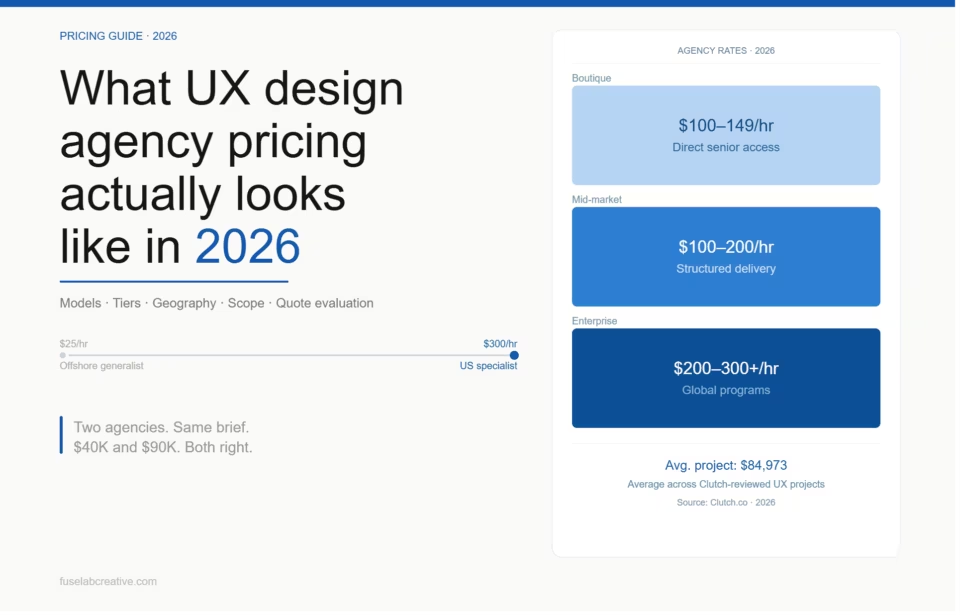
Whether structured as an outsourced UX team on retainer or a defined project engagement, the cost comparison depends entirely on the scope being compared. For project-bounded work of a few hours a week, an agency usually costs less than a full-time hire once benefits, recruiting fees, and onboarding ramp are counted against the salary. For continuous full-time coverage, the same inputs reverse the result and an in-house hire becomes the cheaper option. The deeper mistake is comparing hourly rates at all without holding utilization equal: a $175 agency rate and a $98,000 salary describe different things until you fix how many hours each one covers, and once utilization is equal the cheaper option flips with scope rather than with the rate card.
BLS’s 2024 Occupational Employment and Wage Statistics classifies UX designers under web and digital interface designers (SOC 15-1255), with a national median annual salary of $98,090. BLS Employer Costs for Employee Compensation data puts benefits at roughly 30% of total private-industry compensation, and the model below applies a conservative 30% benefits load to base salary. Placement fees from a recruiting firm typically run 15 to 20% of first-year salary, and a new hire will not reach full productive output for 60 to 90 days in most complex product environments.
*$175/hr mid-market baseline. Verify current agency rates on Clutch before publishing.
When the need is continuous full-time coverage, the comparison reverses:
Agency: 40 hrs/week at $175/hr over 26 weeks. In-house: $98,090 median salary plus a 30% benefits load, a one-time placement fee, and a 2–3 month onboarding ramp, same as the project-scope scenario above.
The trigger is concrete on the cost side. Once an organization is paying an agency for something close to full-time hours for two or three consecutive months, and the work is continuous rather than project-shaped, the comparison has already flipped: the continuous scenario above runs roughly $30,000 a month against about $14,000 for a loaded in-house hire.
On the capability side the shift arrives later, around months 18 to 24, once an in-house designer has accumulated enough product context to make decisions without briefing overhead. A full breakdown of agency rates, retainers, and project pricing sits in the UI/UX design cost guide, but the decision rule is simpler than the rate card: plan for the agency-to-in-house transition rather than treating the choice as a static cost question.
UX design agency vs in-house: capability comparison
A specialist UX design agency or broader product design agency brings cross-industry exposure, specialist depth, and objectivity that internal teams rarely sustain. In-house teams build product history, engineering relationships, and contextual judgment that compound in value as the product matures.
Time-to-impact: where the models differ
Speed of delivery is the factor buyers most often discount in the UX design agency vs in-house decision. The gap is not marginal: agencies typically begin delivering work within two to four weeks of a signed contract, while a new in-house hire needs two to three months before reaching productive output. The table below shows where the delay accumulates.
In-house timelines assume a new hire with no prior product context. An established in-house designer does not face the onboarding gap in the research-through-handoff phases.
There are two crossover points, and conflating them is what muddies the decision. The productivity crossover arrives around the six-month mark for mid-level hires in well-managed product organizations, when the new designer stops being slower than the agency and starts making better day-to-day trade-off decisions because they know the architecture, the constraints, and the roadmap. The larger context advantage compounds later, over the 18 to 24 months it takes to absorb the product’s full history. The most important variable is not billing rate but time horizon.
IP ownership and knowledge retention
Design files, research data, and working assets transfer to the client at the end of a UX agency engagement on full payment. The actual IP question worth investigating is not file ownership. It is whether the reasoning behind design decisions transfers with the deliverables: why a specific navigation structure was chosen, which alternatives were rejected, and what the user research said about edge-case workflows. That knowledge lives in the people who built it, not in the deliverables.
Before signing, confirm what the full deliverable transfer actually covers. Does it include working Figma files with all components and prototypes, raw research data and synthesis documents, decision logs and annotated design rationale, and any component libraries built during the engagement? Some agencies retain IP on proprietary frameworks or system components they introduced to the project. That is a point of negotiation, not a standard term. Any agency that cannot specify before contract signature what transfers at the end of the engagement is protecting its own reuse.
Knowledge loss at the end of an in-house designer’s tenure is equally real and consistently underestimated. Most organizations document final decisions but not the alternatives considered, the research findings that never made it into a deliverable, or the product history that explains why certain patterns exist. Structured research repositories, annotated design specs, and documented decision rationale reduce that loss regardless of model.
Common hybrid models
Many product organizations use agencies and in-house teams simultaneously, with defined ownership boundaries between the two. The typical division is an agency or UX partner handling a specific initiative or a capacity surge while the internal team owns strategy, product direction, and the long-term roadmap. This model works when the ownership boundary is explicit from day one. Where hybrids fail, they fail at the governance layer, not the capacity layer: the work gets delivered, but no one agreed in advance who decides when internal direction and external execution conflict, and the unresolved authority question stalls the engagement.
One established hybrid pattern brings an agency in for a bounded initiative, then transitions ownership to the internal team at a defined milestone. In our work with DHCS on the Medi-Cal digital products, Fuselab served as the external specialist on specific workflow modules while the DHCS internal product team retained ownership of cross-agency coordination, roadmap sequencing, and relationships with regulatory and legislative counterparts. The agency handled design execution velocity. The internal team handled the contextual and political work that requires institutional tenure. That division of responsibility is what made the handoff work rather than creating ongoing dependency.
A second pattern uses an agency to maintain continuity during a recruiting gap, a leave period, or a funding-to-team transition. This works when the transition plan defines the hire timeline, handoff deliverables, and documentation the agency produces before closing. Without those terms, bridge engagements extend past their intended purpose.
A practical decision framework
The UX design agency vs in-house decision is not permanent. Most organizations move through the three stages of the UX capability lifecycle: creating design capability externally, accelerating it through a hybrid model, then owning it internally as the product matures. The organizations that treat the transition between stages as a planned handoff rather than an open-ended arrangement get more value from both models.
Use the framework below to surface the capability question before the procurement conversation begins. The decision becomes clearer when run against specific project constraints rather than general preferences. Organizations with strong answers in both columns are typically at the acceleration stage and benefit from a hybrid model.
A few rules make the call faster. If meaningful output is needed inside twelve weeks, the timeline alone favors an agency, because a new hire will not clear onboarding in that window. Work that lives inside daily sprint decisions rather than a defined brief points to in-house ownership regardless of hourly rate, because briefing overhead erodes the agency’s speed advantage. In other words, slows everything down.
When the scope is still undefined, a fixed in-house hire is the wrong first move, and a scoped agency engagement converts the ambiguity into a defined problem before headcount is committed. Once a product has passed product-market fit and design has become a competitive variable, the capability lifecycle has reached its ownership stage, and the primary investment should be internal.
Conclusion
The UX design agency vs in-house decision simplifies when it is approached as a capability question rather than a cost one. Organizations that use both models in the right sequence avoid the stagnation of running an agency indefinitely and the insularity of an in-house team whose assumptions have never been challenged from the outside. Organizations at the capability creation or acceleration stage that have identified a specific gap are exactly the projects Fuselab takes on. Start a discovery conversation to define scope, timeline, and handoff before any engagement begins.
Frequently asked questions
What does a capability gap mean in UX design?
A capability gap in UX design is the difference between the design capabilities an organization currently has and those it needs to execute its product roadmap. The gap takes three forms at different stages: a creation gap, where no UX function exists; an acceleration gap, where the existing team cannot absorb a major initiative; and an ownership gap, where the organization is focused on compounding quality in a mature product rather than establishing baseline design capacity.
When should a company choose a UX design agency vs in-house design?
Choosing a UX design agency over an in-house hire makes sense when the need is time-bounded, requires specialist expertise the organization does not currently have, or must produce results faster than a hiring cycle allows. Product launches, compliance-driven redesigns, new AI interface development, and EHR integrations are project-shaped problems with defined scope that suit the deliverable-oriented structure of a design agency engagement better than a continuous in-house design function.
How does working with a UX design agency differ from working with an in-house designer?
A UX design agency operates on an engagement model with defined deliverables, project timelines, and formal handoff points. An in-house designer operates inside the product organization’s daily rhythm, in sprint planning, design reviews, and the informal decisions that carry no attached deliverable. Agencies deliver output faster in the first months; an in-house designer begins making better product decisions after six months because they know the context, the constraints, and the roadmap well enough to push back before a direction becomes costly.
What is a hybrid UX design model?
A hybrid UX design model pairs an external agency with an internal team under an explicit ownership boundary between them. The agency usually handles a bounded initiative or a capacity surge while the in-house team keeps strategy, product direction, and the long-term roadmap. The model works when that boundary is defined from day one and fails when the two sides hold overlapping authority with no agreed way to resolve conflicts.
How much does a UX design agency engagement typically cost?
US-based UX design agencies typically charge $100 to $250 per hour, with monthly retainers ranging from $10,000 to $25,000 depending on team size and scope. Project-based engagements start at approximately $25,000 for a focused scope and scale with deliverable volume, with full enterprise engagements reaching $250,000 or more.
Who owns the design files and research at the end of a UX agency contract?
Design files, research data, annotated assets, and working prototypes transfer to the client at the end of a UX agency engagement on full payment, which is standard in well-drafted contracts. Before signing, confirm the transfer explicitly includes Figma working files, raw research data, synthesis documents, and component libraries built for the project. Some agencies retain IP on proprietary methodology components they introduced, which is a negotiation point worth clarifying before signing.
When is the right time to bring UX in-house after starting with an agency?
Bringing UX in-house makes sense when three conditions appear together: the product is iterating faster than the agency’s communication rhythm can absorb, a design manager exists who can evaluate quality and give meaningful feedback, and the internal briefing overhead required to keep the agency effective has started to exceed the value of the outside perspective it provides. Until all three are present, extending the external or hybrid model is usually the better call.