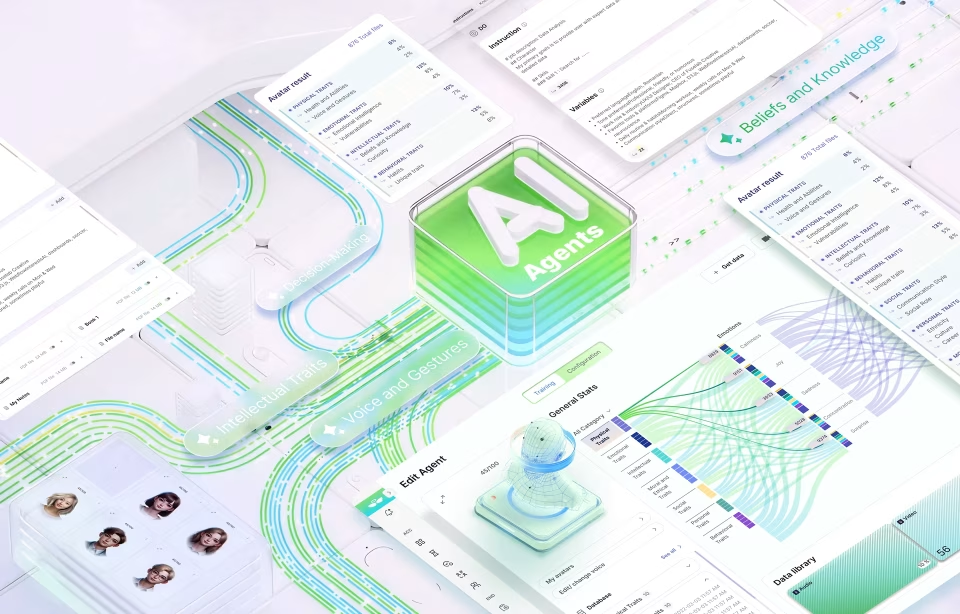
What is AI/ML? Understanding AI and ML meaning and applications
AI/ML is the pairing of artificial intelligence, the broad field of building systems that perform tasks associated with human reasoning, and machine learning, the subset of AI where systems learn patterns from data instead of following rules written by a programmer. Where these products live or die is rarely the algorithm; it is the data feeding the model and whether anyone trusts the interface in front of it. In fact, trust, in our opinion, will continue to be the most critical factor for all AI products for years to come.
What is AI/ML? Meaning and definition
Artificial intelligence and machine learning are two closely related technologies, often abbreviated as AI/ML. AI is the wider goal of building software that performs tasks once thought to need human intelligence, and machine learning is the method that gets us there by finding patterns in large datasets. Every machine learning model is AI, but not every AI system learns from data.
Artificial intelligence is a broad label, and that breadth is why the word gets stretched to cover almost anything. It spans natural language processing, computer vision, and machine learning, held together by one goal: getting software to interpret, decide, or generate where a person used to. A spam filter and a chatbot are both AI. They share almost no engineering.
Machine learning is the subset doing most of the commercial work today. Instead of a developer writing explicit rules, an ML model is trained on examples until it can classify, predict, or recommend. The real test is how it performs on data it never saw during training, because a model that only works on its own examples has, in a way, memorized rather than learned.
Why AI/ML matters for businesses
AI/ML matters to businesses because it turns accumulated data into decisions that once relied on manual analysis or guesswork. Trained on a company’s own history, models forecast demand, flag fraud, route support tickets, and personalize what each user sees, at a speed and scale a team cannot match by hand.
The honest version is narrower than the hype. Support teams use models to answer routine questions and flag the ones a human should see. Marketing teams predict which accounts are worth chasing. Operations teams see a stockout coming. None of that is a general intelligence upgrade. Each is a single prediction wired into an existing workflow.
Plenty of models that work never get used, and that’s where most of the value quietly disappears. A churn score is worthless if no one acts on it. An accurate forecast changes nothing if it lands after the decision it was meant to inform. The output has to reach a real decision, made by a real person, in time to matter.
How machine learning actually works
Machine learning works by training a model on data instead of programming it with rules. The model adjusts itself over many passes to reduce its errors, then applies what it learned to new inputs. Most systems use one of three approaches: supervised, unsupervised, or reinforcement learning, chosen by the kind of problem and the data available.
The three approaches are not interchangeable. Supervised learning trains on labeled examples and covers most business cases: spam detection, credit scoring, demand forecasting. Unsupervised learning finds structure in unlabeled data, which is how customer segments emerge without anyone defining them first. Reinforcement learning is the outlier, learning by trial and error against a reward. It sits behind robotics and game-playing systems, and most businesses will never need it.
Training the model is the easy half. It still has to prove itself on data it never saw, survive a live product, and hold up as real-world inputs drift from the training set. And they always drift. Exactly when a model will fall off is hard to call in advance, which is why retraining and monitoring are running costs, not a line item you close out.
AI vs ML: What is the difference
The difference between AI and ML is scope. AI is the field of building intelligent behavior into software, while ML is one method within that field in which systems learn from data rather than from hand-written rules. All machine learning is AI; a rules-based expert system is AI, but is not machine learning, because nothing about it learns.
That confusion is worth clearing up because it changes what you should ask a vendor. IBM’s explainer on AI versus machine learning notes that the most basic AI is just explicit if-then rules, with no learning at all. So when a product claims to use AI, the useful question is whether it learns from your data or applies fixed logic dressed up with the label.
Deep learning is the third term people stack on: a subset of machine learning that uses layered neural networks, and what powers most generative AI. Why those deep networks generalize as well as they do is, honestly, still a partly open research question. For a buyer, the signal that matters is which layer a vendor uses, because it indicates the data and computing power the product will require.
Where AI/ML shows up in product design and UX
In product design, AI/ML changes the interface as much as the backend. A system that predicts or generates must show how confident it is, where it can be wrong, and how to correct it, or people stop trusting it. A slightly worse model behind a clear, correctable interface beats a better one behind an opaque interface, almost every time.
Most of that work is design, not modeling. Nielsen Norman Group’s research on the relationship between AI and user experience describes AI as something users supervise: they watch it, judge it, and correct it. The patterns that make that possible, confidence signals, clear correction paths and sensible defaults, are a discipline of their own, one we break down in designing for personalization with machine learning.
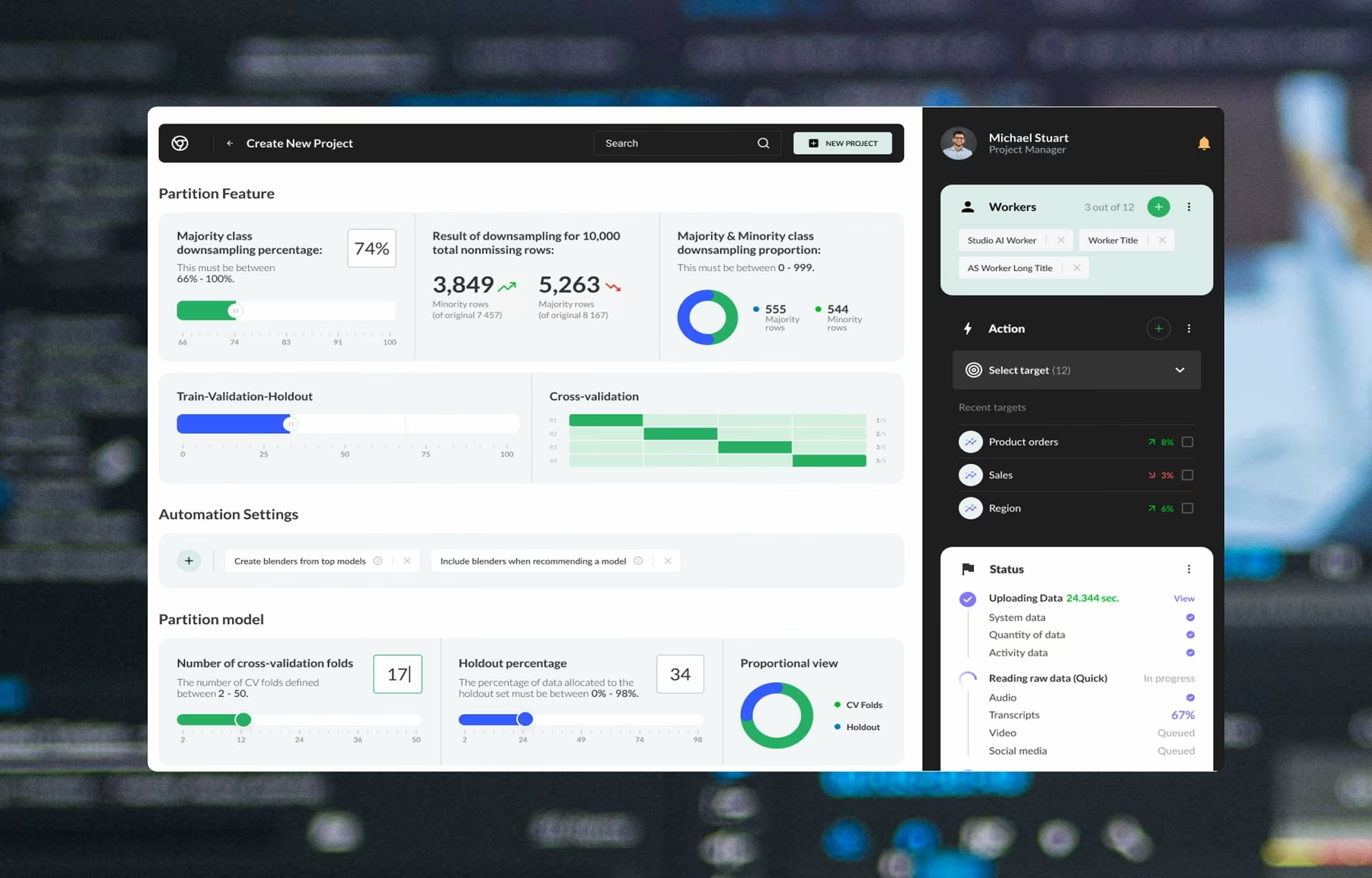
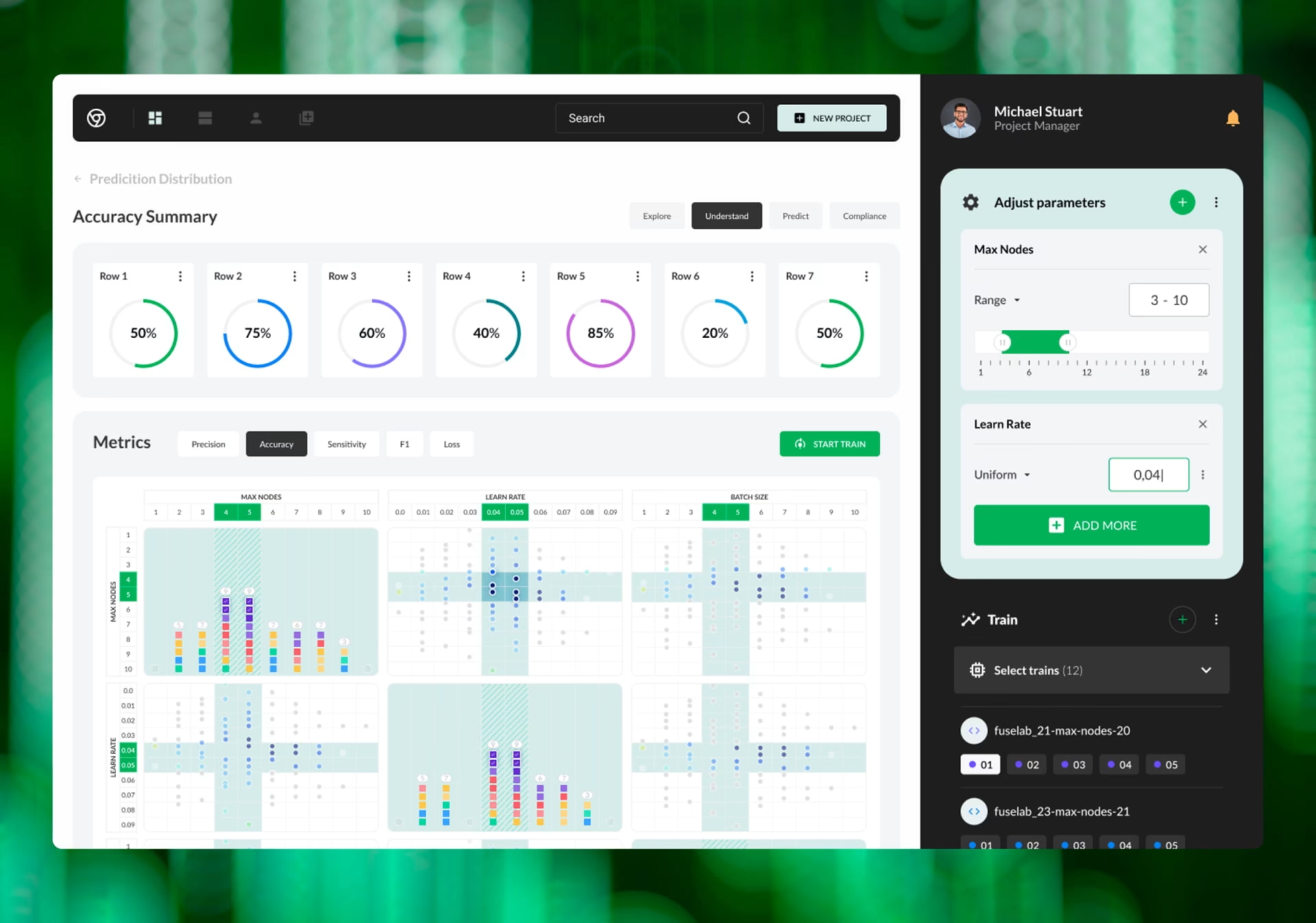
That principle shaped our work on Studio/ML, a platform for scheduling, running, and monitoring machine learning experiments. The problem it set out to solve was overhead: data scientists were losing time configuring machines, wiring up dependencies, and hunting down artifacts from earlier model runs. The design challenge was to make the state of every experiment, live or finished, legible without adding more complexity to already complex work, to say the very least!
The solution paired a single project’s dashboard with an interactive sidebar. Each experiment displayed its live status via color-coded progress meters, and drill-downs revealed the accuracy and loss curves beneath. The result was an interface that a data scientist could scan to see what was running and where to step in, rather than hunting through scattered runs to reconstruct what happened.
Common mistakes businesses make with AI/ML
The most common AI/ML mistakes are organizational rather than technical. In the projects we have seen fail, the model was rarely the problem. Teams underestimate how much work goes into data preparation, treat a promising pilot as production-ready, and reach for machine learning when fixed rules would be cheaper and more predictable. Each is avoidable before a model is ever trained.
Underestimating the data work. Data preparation is the first and most expensive place teams go wrong, because they budget for model development and forget that collecting, cleaning, and labeling data is where most of the effort goes. Feed a model biased or sloppy data, and it reproduces those flaws at scale, with the false authority of a machine, which is far harder to catch than a human error.
Treating a strong pilot as finished. A model that scores well on historical data in a controlled test often behaves differently when it encounters messy, real-world inputs and users who game it. Proof of concept and production reliability are separated by months of edge-case handling, monitoring, and retraining that rarely make it into the original budget.
Reaching for ML where rules would do. The most sophisticated option is often the wrong one, as the saying goes. If a problem has clear, stable logic, a rules-based system is cheaper to build, easier to explain, and less likely to drift. Machine learning is cost-effective only when the patterns are too complex or too changeable to write down by hand. Reaching for it by default adds risk and rarely adds much.
Conclusion
AI and ML stopped being frontier technology a while ago. The companies getting real value from them treat data quality and interface design as seriously as the model, and the next edge will go to the teams that make these systems legible to the people who have to trust them. That is the actual work of AI/ML design and development.
Frequently asked questions
What does AI/ML mean?
AI/ML means artificial intelligence and machine learning used together, where AI is the broad goal of building software that performs tasks associated with human intelligence and ML is the subset that gets there by learning from data. In most products described as AI today, the working part is a machine learning model trained on examples.
What is machine learning in simple terms?
Machine learning is a way of building software that learns patterns from data instead of following rules a developer wrote by hand. You train a model on many examples until it can make predictions or classifications on new data it has not seen. The quality of those predictions depends on the quality of the training data.
What is the difference between AI and ML?
The difference between AI and ML is one of scope. AI is the entire field of making software behave intelligently, while ML is a single method inside it where systems learn from data rather than from fixed rules. Every machine learning system is AI, but a rules-based system can be AI without doing any learning.
Is deep learning the same as machine learning?
Deep learning is a subset of machine learning, not a separate field. It uses layered neural networks to learn from very large datasets, and it powers most of what is currently marketed as generative AI. All deep learning is machine learning, but plenty of machine learning uses simpler methods that are not deep learning.
How do businesses use AI/ML?
Businesses use AI/ML for narrow, measurable tasks such as forecasting demand, detecting fraud, routing support requests, and personalizing what each customer sees. The strongest results come from projects tied to one specific question with clean, relevant data behind it, rather than broad mandates to add AI across a product.
How long does it take to build an AI/ML feature?
Building a first production-ready model commonly takes three to six months once usable data is available, and longer when the data still has to be collected and cleaned. Timelines depend far more on data readiness than on the modeling itself. A proof of concept can be built in weeks, but production reliability is what takes time.
How do you know if your business needs AI/ML?
Businesses need AI/ML when a decision depends on patterns in data that are too complex or too frequent to handle with fixed rules, and when enough clean, relevant data exists to train on. If the logic is stable and simple, or the data is thin, rules-based automation is usually the better first step. Start from the decision you want to improve, not from the technology.