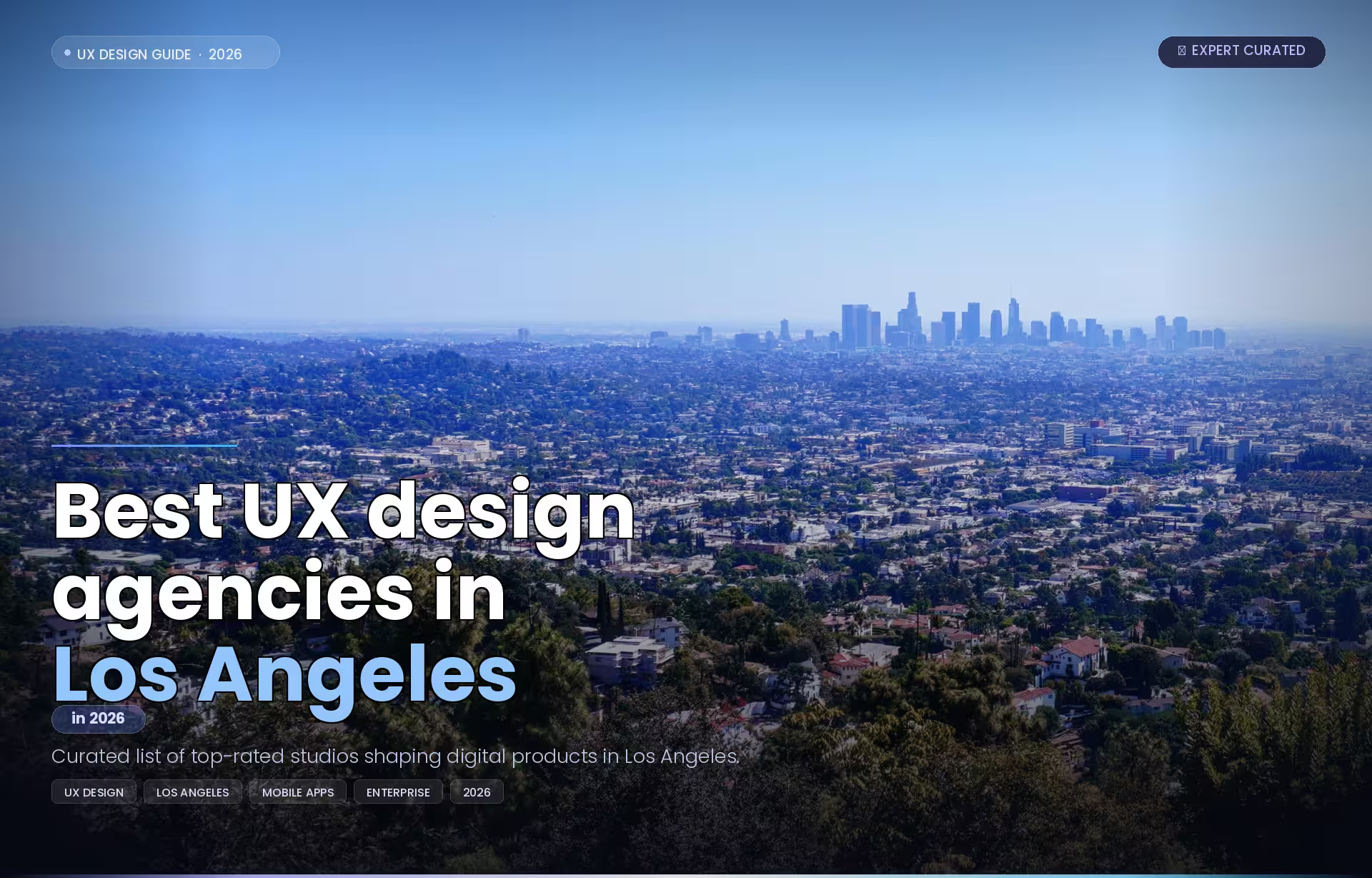
Best UX design agencies in Los Angeles in 2026
A UX design agency in Los Angeles delivers user experience research, interface design, UI/UX strategy, and product design for companies in the region’s three distinct markets: entertainment and venture-backed brands in downtown LA, enterprise B2B and AI UX work in Century City and Silicon Beach, and civic design for museums, universities, and public agencies in LA County. The 2026 market rewards vertical specialization, and AI interface design is now a core capability for enterprise agencies rather than an emerging add-on.
What to look for in a UX design agency in Los Angeles
A qualified UX design agency in Los Angeles demonstrates a verified Clutch.co profile with a sustained client review history, a named client portfolio tied to public case studies, transparent pricing, and genuine vertical specialization backed by shipped products. Agencies without public client references or unverifiable LA offices at coworking addresses warrant closer scrutiny before you begin creating your own shortlist.
A market split three ways. The Los Angeles UX agency market in 2026 can be broken down into three tiers rather than a single ranked list. Entertainment and consumer-brand work concentrates in downtown LA and the Arts District among boutiques with entertainment-industry access. Enterprise B2B, AI UX, and research-led work operate from Century City, the Beach Cities, and Silicon Beach. Regulated-industry work in healthcare, fintech, AI compliance, and government increasingly goes to specialist agencies outside LA.
Rates up, reviews slowing. Two market shifts define Q1 2026 specifically. Hourly rates at LA agencies with AI UX specialization have moved into the $150 to $300 range, a clear premium over generalist UX pricing, which held steady around $100 to $150 through 2024. Clutch review cadence has also slowed at several premium LA agencies, as referral-driven agencies have deprioritized soliciting public reviews and instead have been seeking LinkedIn and investor-network introductions. And who can blame them? The latter are free after all, and getting prime placement on Clutch is only getting more expensive.
Read the portfolio, not the pitch. What separates a strong LA agency from a mediocre one is almost always visible in the portfolio. Named clients with specific shipped products, rather than vague references to “leading brands.” Published Clutch pricing beats “contact for quote” on the agency’s own site. An agency that cannot explain its discovery process, its design system handoff, and its post-launch support model in the first meeting has not done this work at volume before.
When proximity matters, and when it does not. Proximity matters when a project requires in-person user testing with LA-based participants, direct access to the entertainment industry, or regular workshops with a locally concentrated leadership team. Proximity matters less for healthcare, fintech, federal contracts, and complex enterprise dashboard work, where vertical expertise, compliance literacy, and specialist research methods decide outcomes more than geography. This distinction drives the vertical matrix below.
How the eight cluster geographically. The map below shows how the eight agencies evaluated in this guide cluster geographically across the LA market. The pattern reinforces the three-way split: entertainment and startup work concentrates in DTLA and the Arts District, enterprise and research-led work operates from Century City and the Beach Cities, and mobile-first shops occupy the Fashion District and adjacent neighborhoods. Out-of-market specialists serve LA clients remotely for regulated-industry work.
The best UX design agencies in Los Angeles for 2026
The eight agencies below are organized by vertical rather than ranked from 1 to 10. Each entry names the specific type of LA project it is strongest for, with verified Clutch pricing and verified location as of July 2026. One honest disclosure appears inside the Fuselab entry to help readers pick the right agency for LA entertainment-industry work, where Fuselab is not the right fit.
1. Fuselab Creative
Strongest for: Regulated industries, healthcare & government, AI interface UX, enterprise UX.
Fuselab Creative has led design projects for NASA, Fiserv, Uber, NIH, Grid AI, and the California Department of Health Care Services. The DHCS Medi-Cal member interface that Fuselab designed serves 15 million Californians, including every Medi-Cal enrollee in LA County.
Founded in 2017, Fuselab serves regulated-industry clients in healthcare, government, fintech, and AI interface work, and is a GSA contract holder. Read more about Fuselab’s dashboard design services.
Less ideal for: LA entertainment-industry brand launches, VC-backed consumer product storytelling, or culturally resonant microsites, where Funkhaus is the genuinely better pick.
McLean, VA (DC area) · $100 to $150/hr, from $25,000 · Clutch 4.9
2. Funkhaus
Strongest for: Entertainment, culture, VC-backed launches, premium creative.
Founded in 2011 in the DTLA Arts District, Funkhaus pairs small senior teams with genuine entertainment-industry access, producing work for Nike, Kleiner Perkins, Adidas Originals, Paramount Pictures, Imagine Entertainment, CAA, and the Tyler, the Creator Sony album launch.
Its review base reflects a referral-driven business rather than a directory-SEO operation. Actual engagements typically land in the $31,000 to $60,000 range, and the studio operates from a dedicated downtown Los Angeles office.
Los Angeles, CA (DTLA) · $200 to $300/hr, from $10,000 · Clutch 5.0
3. Goji Labs
Strongest for: Startup MVPs, full-stack delivery, mobile, early-stage products.
Goji Labs is among the highest-trust MVP shops in LA. Named clients include American Kennel Club, Council on Foreign Relations, Cleantech Group, NextGen Prosperity Foundation, and Ghosson Consulting.
Goji Labs was founded in 2014 and handles UX, mobile, and full-stack delivery with 50 to 249 staff. Typical engagements range from $50,000 to $199,000, and the team operates from 800 Wilshire Blvd in Downtown LA.
Less ideal for: IP-sensitive work. Their default engagement hosts code and infrastructure in Goji’s environment, so clarify IP ownership terms before signing.
Los Angeles, CA (Downtown) · $100 to $149/hr, from $25,000 · Clutch 5.0
4. Neuron
Strongest for: Enterprise B2B, complex SaaS, DesignOps, design systems.
Neuron has shipped design work for Hootsuite, Vendr, Palo Alto Networks, Vivint, Paycom, Uniphore, Jobble, Flo, and IKEA Kreativ (via Geomagical Labs). The agency holds Clutch Premier Verified status.
Neuron’s LA presence is a WeWork coworking space in Century City rather than a full office, with the core team operating from San Francisco. Founded in 2016, it is headquartered at 650 California Street in San Francisco.
Less ideal for: buyers who need LA-local in-person workshops. This is remote-first in practice.
San Francisco (LA WeWork) · $150 to $199/hr, from $25,000 · Clutch 5.0
5. WANDR
Strongest for: Research-heavy strategy, AI UX, discovery-first.
WANDR‘s named clients include the U.S. Air Force (via a 2020 Phase II SBIR contract), Samsung, IBM, Tracer Labs, Caraleya, sticky.io, and PetPartners. The agency markets a proprietary SignalUX framework built specifically for AI-native product design.
WANDR was founded in 2016, operated by founder Jinny Oh, and the studio is based at 1150 S Olive Street in Downtown LA.
Less ideal for: teams needing current proof points. Review cadence has slowed since early 2025, so ask for recent case studies during evaluation.
Los Angeles, CA (Downtown) · $150 to $199/hr, from $25,000 · Clutch 5.0
6. AppMakers USA
Strongest for: Mobile-first, consumer apps, accessible pricing.
AppMakers USA brings 12 years of experience in iOS, Android, React Native, and Flutter, in the LA mobile specialist tier. Named clients include NFL running back Austin Ekeler, Los Angeles Apparel, Century 21, and CVS.
Founded in 2014 and led by Daniel Haiem, AppMakers employs approximately 30 people. Recent engagements include AI and LLM integration work, and the team operates from 1250 S Los Angeles Street in the Fashion District.
Less ideal for: fintech-specialist work. The shipped portfolio skews toward consumer and mobile-first.
Los Angeles, CA (Fashion Dist.) · $50 to $99/hr, from $10,000 · Clutch 5.0
7. Isadora Agency
Strongest for: Enterprise web, CRO design systems, Fortune 1000.
Isadora Agency‘s client roster includes News Corp, Belkin, Steve Madden, MassMutual, Kelley Blue Book, Gartner, Razor USA, Logitech, Sunbit, and LiveNation. The agency delivers capabilities in WordPress, Drupal, SEO, 3D motion, and design systems under one engagement.
Isadora was founded in 2009 by Isadora Marlow-Morgan and is a female-owned, 50 percent minority-led firm, with a 2023 Clutch Global Award and multiple Webby nominations. Operations are based in Manhattan Beach in the Greater LA Beach Cities.
Manhattan Beach, CA · $150 to $199/hr, from $75,000 · Clutch 5.0
8. Urban Insight
Strongest for: Civic & cultural, accessibility, museums & universities.
Urban Insight has served LACMA, The Broad Museum, the National WWI Museum and Memorial, the American Library Association, USC, UCLA, the City of Los Angeles, the U.S. Department of Energy, and Stay Housed LA. The agency operates a formal accessibility practice that matters for ADA-sensitive buyers.
Urban Insight was founded in 2000, giving it the longest operational tenure of any agency on this list. Project ranges run from $15,000 to $1,000,000, with maintenance retainers around $4,000 per month, and offices based in Los Angeles.
Less ideal for: fixed-scope MVP work. Their engagement model leans toward long-term partnership.
Los Angeles, CA · $150 to $199/hr, from $15,000 · Clutch 5.0
How we evaluated these agencies
Every agency on this list passed four editorial checks before inclusion:
- A verified Clutch.co profile with transparent pricing disclosed in the right sidebar, not hidden behind a contact form.
- Verified client reviews spanning multiple years with recent activity.
- At least one named client is tied to a publicly documented project.
- A physical operating presence in or adjacent to Los Angeles.
How physical presence was checked. Physical presence was checked against building records, LinkedIn, public California business filings, and the agency’s own contact page. When an LA address resolves to a WeWork coworking space or to an address occupied by unrelated businesses, that detail was explicitly noted in the agency’s entry rather than omitted. Editorial transparency is what separates a genuine evaluation from a directory listing.
Five agencies that failed verification. Of the ten agencies commonly listed in competing 2026 “best LA UX agency” articles, five failed physical-presence verification:
- Phenomenon Studio’s reported Alameda Street LA address is occupied by unrelated textile importers and does not appear on the agency’s own contact page, which lists entities in Poland, Ukraine, and Estonia.
- Herbert Digital operates from Sydney, Australia, with no verified LA office.
- Mission Control is a zero-review San Francisco firm founded in 2025 with no published client work.
- 925Studios is remote-first with no disclosed LA address and actively promotes its own LA-focused listicle content as ranking bait.
- Swovo (Flatirons Development LLC) is based in Boulder, Colorado, with programmatic LA landing pages but no California presence.
None of these five agencies met the physical-presence check.
A second pattern: hidden pricing. A second pattern emerged from the pricing review. Of the eight agencies that passed verification, only four publish hourly rates and minimum project sizes openly on their Clutch.co sidebar without requiring a contact form. The remaining four require buyers to request a quote before receiving any pricing guidance, thereby extending sales cycles and creating information asymmetry that benefits the agency rather than the buyer.
Cross-reference independent research. Beyond these checks, buyers can cross-reference agency capability claims against independent UX research published by Nielsen Norman Group and Baymard Institute. NNGroup’s UX maturity model gives senior buyers a reference framework for calibrating what “good” looks like across different agency engagements before signing any contract.
Comparison table
The table above answers the first filtering question: who works in what price band, and who actually operates in Los Angeles rather than routing through a Delaware registered agent. Pricing reflects Clutch profiles verified this month, not agency marketing copy, so the $50 to $300 hourly spread is the real range across the eight firms.
When a Los Angeles location matters, and when it does not
LA proximity matters most when a project requires in-person user research with local participants, direct access to the entertainment industry, or regular workshops with a leadership team concentrated in Southern California. For consumer brand launches, cultural-institution work, and media-industry engagements, the agencies with DTLA or Beach Cities offices genuinely benefit from their geography.
Where proximity matters less. LA proximity matters far less for three distinct categories of product work. Healthcare and life sciences UX demands regulatory literacy, clinical workflow understanding, and experience with healthcare data standards and clinician-facing interfaces. These qualifications are concentrated in specialist agencies across cities, and the research methods work equally well remotely when the agency has shipped production healthcare products before.
Regulated and enterprise work. Federal and state-regulated work requires formal compliance credentials, security clearances, and processes that are not tied to LA addresses. Complex enterprise dashboards with multi-source data architectures depend on specialist research and engineering depth, not on participant recruitment in Westwood or Santa Monica. When the work is genuinely regulated, out-of-market specialists typically deliver better outcomes than LA generalists.
A California project delivered from Virginia. Fuselab’s work for the California Department of Health Care Services is focused on building internal data visualization tools and dashboard design and development for the 15 million Californians on Medi-Cal, and was delivered from McLean, Virginia, with no Fuselab staff physically present in California. The regulatory context, accessibility requirements, and multi-role clinician interface experience were the decisive factors.
What 2026 will change. Looking ahead through 2026, three trends will further reshape the LA market. AI UX capability will continue to command a pricing premium, as enterprise buyers require compliance-literate AI interface design rather than design-aesthetic-only AI work. Mid-market LA boutiques without AI specialization will face margin compression. Specialist out-of-market agencies with regulated-industry credentials will take share from LA generalists on healthcare, fintech, and federal engagements, regardless of geographic proximity.
How to choose the right UX design agency for your Los Angeles project
Match the agency to the vertical of the work, not to the zip code of the office. If the project is an entertainment or venture-backed consumer brand launch, start with Funkhaus. If it is a startup MVP that needs UX, product design and development, Goji Labs is a full-service pick. For B2B SaaS with multi-role complexity, Neuron or WANDR, depending on whether the emphasis is on DesignOps or research depth.
The rest of the shortlist by vertical:
- For mobile-first products at accessible rates, AppMakers USA.
- For enterprise web with a CRO and design system focus on the Fortune 1000 tier, Isadora Agency.
- For civic, cultural, or accessibility-critical institutional work, Urban Insight.
- For healthcare, fintech, or federally regulated industry UX that serves the LA market, an out-of-market specialist like Fuselab Creative, where compliance literacy and federal contracting credentials outweigh geographic proximity.
Ask how they handle a wrong assumption. A useful pitch-evaluation signal comes from how agencies respond when a client’s assumption about user needs turns out to be wrong. This happens more often than most buyers expect, and the agency’s reflex in that moment separates research-led partners from production-led vendors. As Marc Caposino has observed across 15 years of enterprise UX engagements:
Ask how the agency handles a client’s wrong assumption about users. An agency that says ‘we educate the client’ is telling you it wins the argument. An agency that says ‘we test the assumption with real users’ is telling you it wins the outcome. The difference matters more than portfolio aesthetics when the project depends on research.
Why this question works. This signal is particularly useful when evaluating agencies with polished presentations, long client rosters, and confident thesis statements during the pitch. The answer to this single question separates production-led design shops that deliver what the client already believes from research-led partners willing to challenge assumptions when the user evidence points in a different direction. Ask it explicitly.
Before signing any contract, verify three things directly on Clutch.co:
- Confirm the hourly rate and project minimum match what the agency stated in the pitch.
- Confirm the review volume and recency, because an agency with no reviews in the past 12 months is coasting on older work that may not reflect current team capability.
- Confirm the named clients referenced in the pitch deck actually appear in published case studies or review text on the Clutch profile itself.
Agencies sometimes list client names in marketing material without corresponding case studies, which is a soft signal that the relationship was smaller than implied. The Clutch LA UX directory is the primary verification source for all three of these checks.
Final thoughts
Eight agencies, eight distinct verticals, one rule: match the UX design agency to your work in Los Angeles before you match it to the zip code. Funkhaus for entertainment, Goji Labs for startup MVPs, and out-of-market specialists for regulated-industry UX. Verify pricing and location on Clutch.co before shortlisting, and explore our healthcare UX design practice.
Frequently asked questions
What is the best UX design agency in Los Angeles in 2026?
No single agency is best across all LA project types in 2026. Goji Labs leads for startup MVPs with a perfect 5.0 Clutch rating, Funkhaus leads for entertainment and consumer-brand work, and WANDR leads for research-heavy enterprise product strategy. The right pick depends on the vertical of the work rather than a universal ranking of all available options.
How much does a UX design agency in Los Angeles cost?
UX design agencies in Los Angeles charge between $50 and $300 per hour in 2026, with AppMakers USA at the accessible end, Goji Labs and WANDR in the mid-tier at $100 to $199, and Funkhaus and Isadora Agency at the premium end. Minimum project sizes range from $10,000 for mobile-first shops to $75,000 for enterprise-tier agencies. Full MVP engagements typically range from $50,000 to $199,000.
What is the difference between a UX design agency in Los Angeles and a remote UX agency?
A Los Angeles UX design agency provides physical proximity to in-person user research, access to the entertainment industry, and on-site workshops with local leadership teams. A remote specialist UX agency brings deeper vertical expertise in regulated industries like healthcare, fintech, and government. Neither is categorically better; the project type determines which option fits best.
How long does a UX design project in Los Angeles take?
Most full UX design projects in Los Angeles take between 8 and 20 weeks from discovery to design handoff in 2026. Startup MVPs, including research, wireframes, and final UI, typically run 10 to 14 weeks. Enterprise engagements with design systems and multi-role dashboards run 16 to 24 weeks. Research-only discovery engagements from agencies like WANDR can be completed in 4 to 8 weeks.
What should I look for in a UI/UX design agency's portfolio?
Look for named clients with specific shipped products, case studies that document the problem and the measured outcome rather than just showcase the final UI design, and evidence of work in the same vertical as your project. A portfolio of finished apps without process documentation signals a production shop rather than a research-led UI/UX design agency. Agencies without a named client in your industry are generalists claiming to be specialized.
Do Los Angeles UX design agencies work with startups?
Yes. Goji Labs and AppMakers USA explicitly build their businesses around startup clients at accessible price points, starting at $10,000 and $25,000, respectively. Premium LA boutiques like Funkhaus and Isadora Agency typically require minimums of $50,000 to $75,000 and work best with Series A and later companies. WANDR occupies the middle, serving both funded startups and enterprise clients.
Should I hire a UX design agency with a physical Los Angeles office?
Hire a physically LA-based agency if your project needs local user research recruitment, direct entertainment-industry relationships, or regular in-person stakeholder workshops. For healthcare, fintech, federal, or complex enterprise work, vertical specialist agencies outside LA often deliver better outcomes because they bring compliance literacy and research depth that LA generalists lack.