Best UX design agencies in San Francisco in 2026
The best UX design agencies in San Francisco in 2026 are defined less by their zip code than by shipped work: verified client reviews, named shipped products, and documented results in the industries they serve. This guide compares eight established firms serving the San Francisco market, with pricing, minimum project sizes, and locations verified against public Clutch data, including two specialists that serve Bay Area clients from headquarters outside the city.
This verification standard matters because San Francisco is where agency marketing is at its most polished. This is the market that produced many of the most influential technology companies of the last two decades; every firm serving it has learned to present beautifully, and ambition is the local baseline. Public data cuts through the polish, and buyers comparing three to five shortlisted agencies deserve numbers they can check.
What to look for in a UX design agency in San Francisco
A qualified UX design agency in San Francisco shows verified client reviews, at least one named product in your industry, and pricing that it will state before a sales call. Portfolio polish is the baseline here, not the differentiator. The useful signals are domain depth, a documented research process, and honesty about where the work actually gets done.
San Francisco’s agency market splits along two lines: firms staffed by alumni of hyperscale consumer platforms and specialist studios built around a single class of problems. The first group thinks in systems that serve millions of users, which suits growth-stage companies and large organizations. The second wins when the problem is narrow and unforgiving, such as clinical workflows or multi-role dashboards.
Domain expertise matters more than geography. A San Francisco address is helpful when a project requires in-person research or weekly workshops with a local leadership team. It matters far less in healthcare, fintech, and government work, where familiarity with HIPAA constraints, accessibility standards, and specialized user workflows decides outcomes. An agency’s shipped work in your industry is the strongest single predictor of fit.
Strategic product thinking separates a design vendor from a product partner. The strongest agencies define product direction, run research that changes decisions, and build design systems that survive their own departure. The discipline covers far more than screens, as the Interaction Design Foundation’s UX design literature outlines, and buyers should expect an agency to connect every design decision to a business outcome.
The best UX design agencies in San Francisco in 2026
The eight agencies in this guide are Fuselab Creative, Punchcut, Impekable, Clay, Neuron, Ramotion, Delve, and Savas Labs. Entries run the same length for every firm, use only Clutch-verified pricing and locations, and state plainly where a firm has no reviews or no Bay Area headquarters. A disclosure about Fuselab’s position sits inside its entry.
1. Fuselab
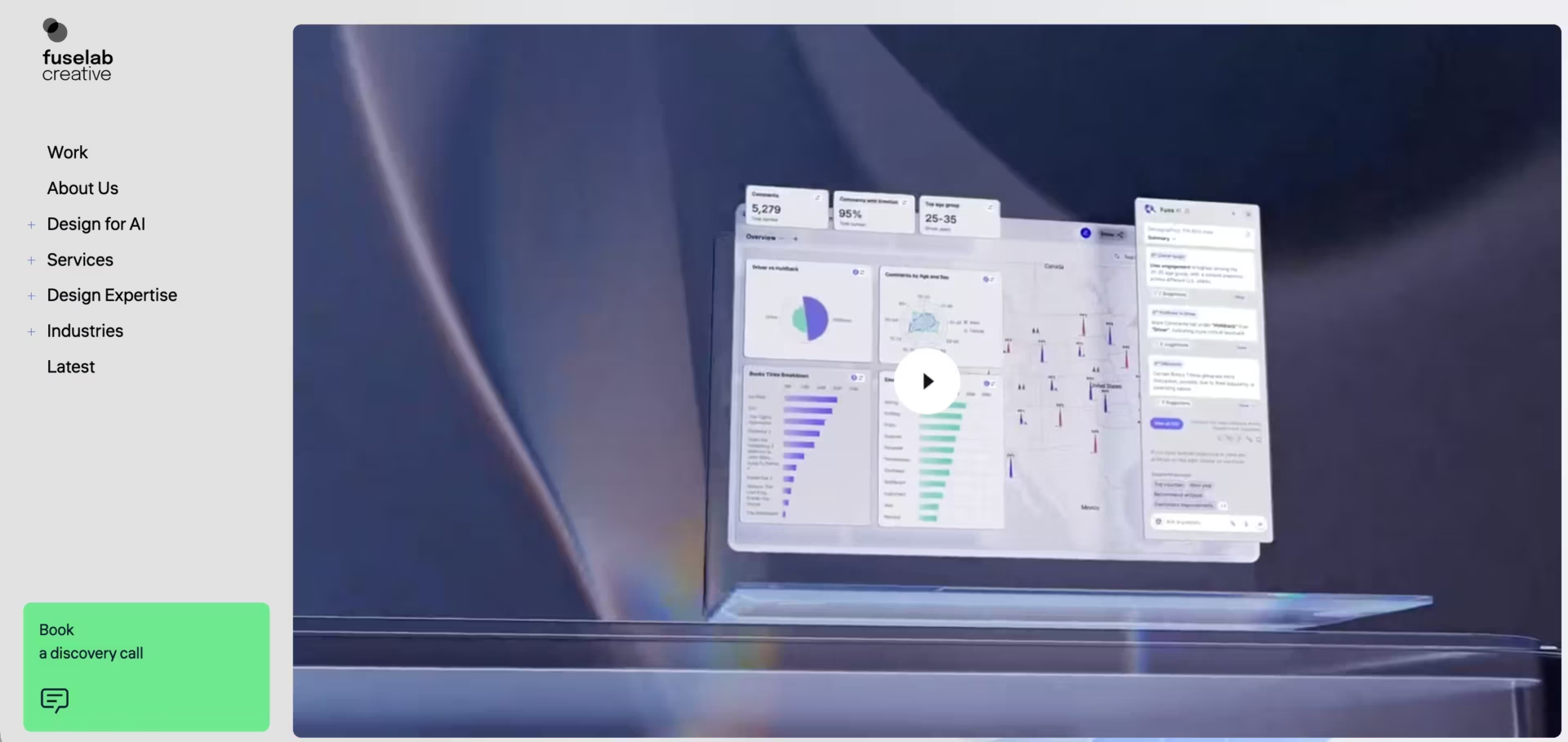
Strongest for: Data-heavy software for healthcare, government, and AI, where regulatory depth matters more than proximity.
Fuselab wrote this guide and holds the first position, so read this entry against the same standard as the rest. Founded in 2017 and headquartered in McLean, Virginia, the firm designs enterprise software interfaces for NASA, Fiserv, Uber, NIH, and California’s DHCS, and holds a GSA contract that lets government buyers engage without open bid. It has no Bay Area office and serves San Francisco clients remotely.
Why we included them: a GSA vehicle plus shipped state and federal health products is a combination no other firm here offers, and the disclosure above lets you discount the placement yourself.
McLean, VA (DC area) · $100 to $149/hr, from $25,000 · Clutch 5.0
2. Punchcut
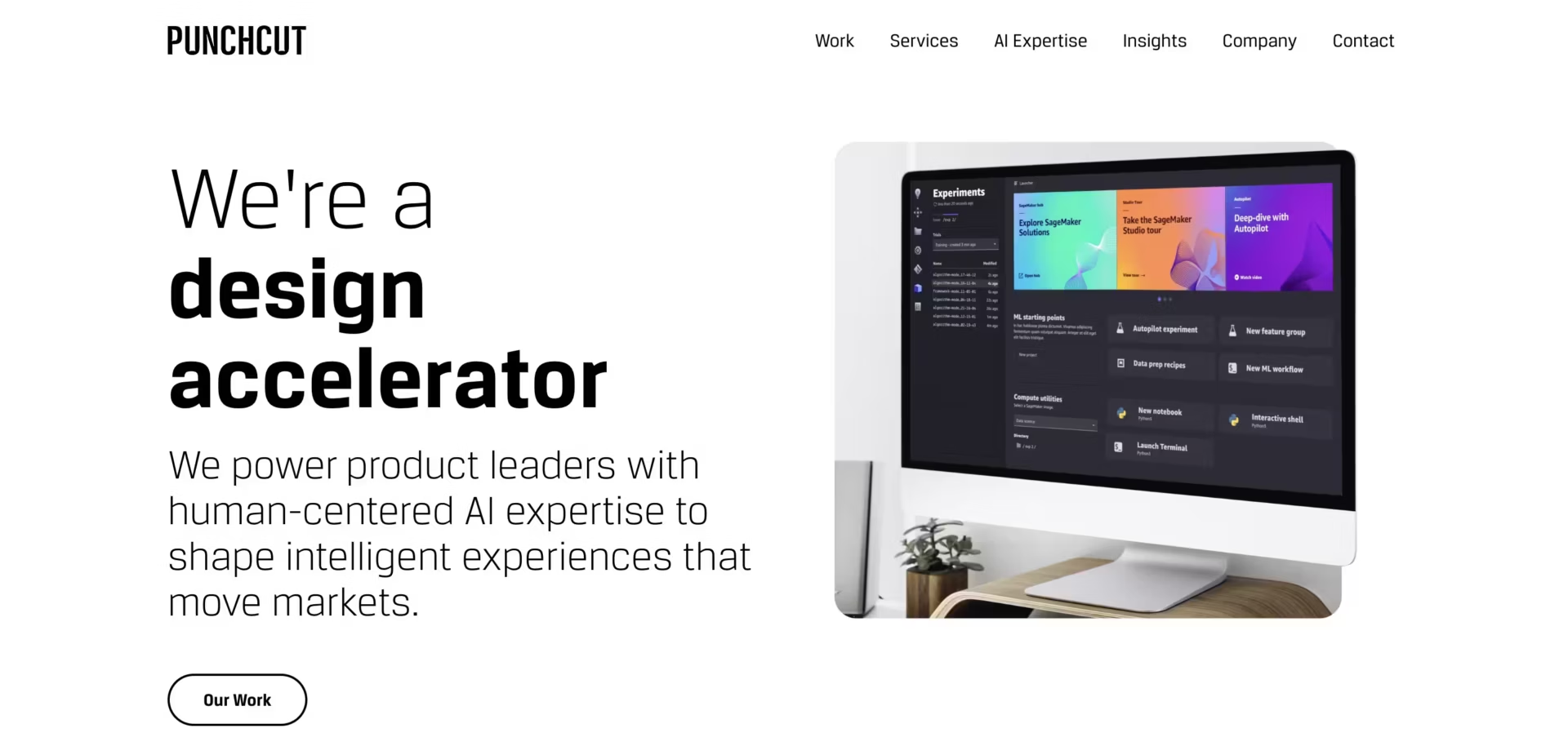
Strongest for: Product strategy and emerging-technology interfaces, from AI experiences to connected devices.
Punchcut has designed multi-device and future-facing products from San Francisco since 2002, with named work for Google, Microsoft, Samsung, LG, Disney, and Nissan. It operates at the strategy and research end of the market rather than production UI, which suits organizations exploring new product categories rather than teams shipping an MVP. Its Clutch profile carries no client reviews as of October 2026, so diligence runs through case studies and references.
Why we included them: two decades of shipped emerging-technology work for named global brands outweighed the empty Clutch profile, which we flagged rather than hid.
San Francisco, CA · Custom pricing, contact for quote · No Clutch reviews
3. Impekable
Strongest for: End-to-end delivery where one team carries a product from UX design through engineering.
Impekable combines product strategy, design, and software engineering in a single engagement, which removes the handoff loss that separate design and development vendors create. Named clients include Google, Twilio, HP, Toyota, and Netgear. The $50,000 minimum and $200-plus hourly rate position the firm for funded, large-scale work rather than early-stage projects.
Why we included them: one accountable team from research through deployed code removes the design-to-development handoff, the stage where most projects quietly leak quality.
San Francisco, CA · $200 to $300/hr, from $50,000 · Clutch 4.8
4. Clay
Strongest for: Premium product experiences where brand perception influences the enterprise sales cycle.
Clay pairs interface design with brand identity in one team, a combination most product studios do not carry, and has refined it since 2009. Named clients include Meta, Google, Slack, Coinbase, Amazon, and Stripe. The positioning suits growth-stage companies and established brands, while early-stage teams will find the pricing harder to justify against leaner studios.
Why we included them: brand and product design at this level rarely live in one team, and seventeen years of named work proves Clay carries both.
San Francisco, CA (HQ), plus New York and Austin · $150 to $199/hr, from $50,000 · Clutch 4.8
5. Neuron

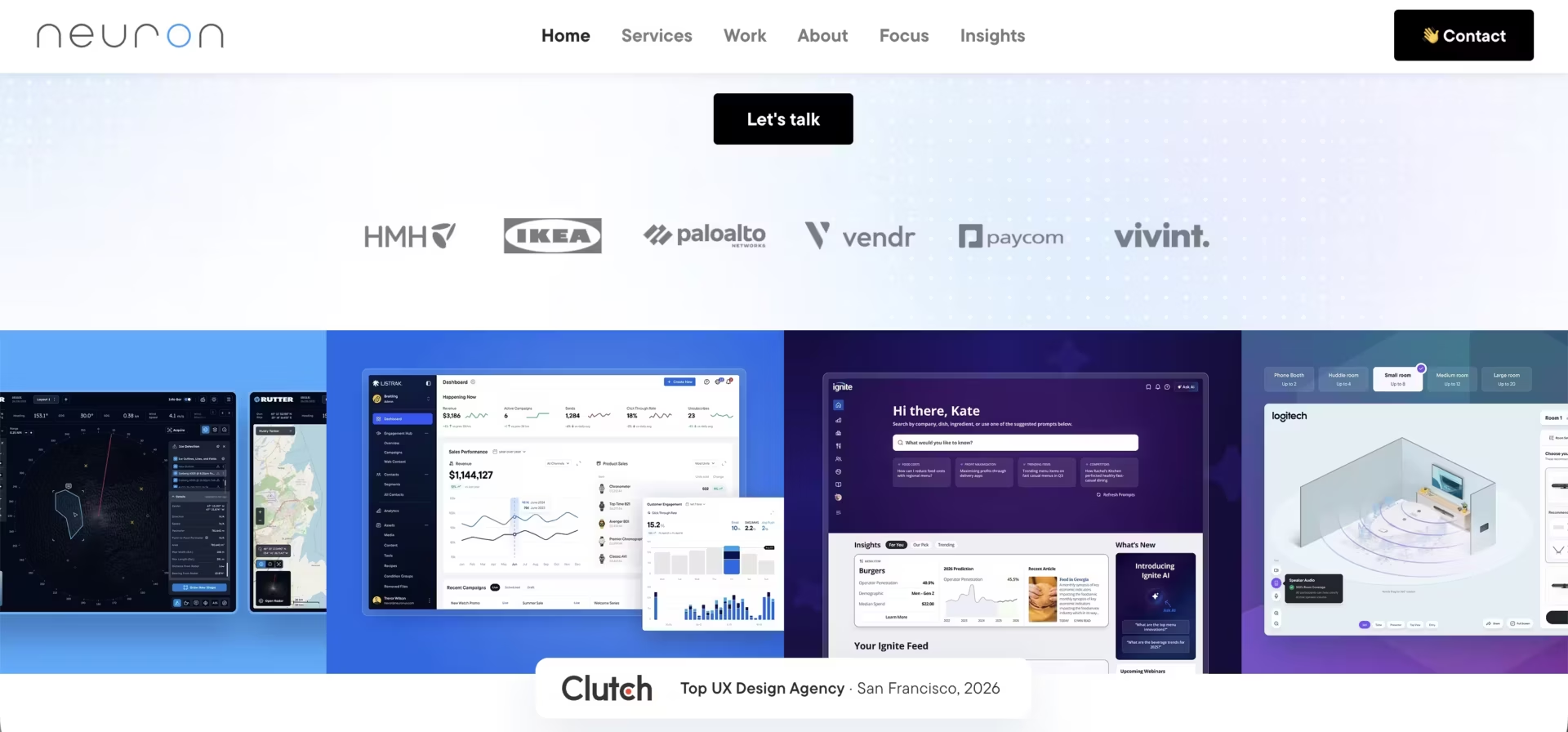
Strongest for: Enterprise B2B SaaS products with dense workflows, role-based permissions, and adoption problems.
Neuron translates vague feature requests into workflows a product team can execute against, with a research-led process and direct founder involvement rather than layered account management. Named clients include Hootsuite, Vendr, Flo, Vivint, Palo Alto Networks, and Uniphore. It also publishes some of the most useful B2B product design writing in this market, which is a fair signal of how the team thinks.
Why we included them: few firms commit this completely to complex B2B workflows, and depth of focus is exactly what that problem class rewards.
San Francisco, CA (HQ), plus Los Angeles and Boston · $150 to $199/hr, from $25,000 · Clutch 4.9
6. Ramotion
Strongest for: SaaS and consumer-tech companies that need product design and brand identity as one system.
Ramotion fuses brand work with interface systems and front-end development, with named work including the Firefox rebrand for Mozilla alongside Salesforce, Netflix, Adobe, Xero, and Opera. The studio is particularly strong on design systems and iOS-native product work for funded startups scaling their first product past its initial audience.
Why we included them: the Firefox rebrand plus a decade of design systems for funded startups is public, verifiable, and directly relevant to products scaling past their first audience.
San Francisco, CA (HQ), plus New York, Los Angeles, and Austin · $150 to $199/hr, from $50,000 · Clutch 4.9
7. Delve
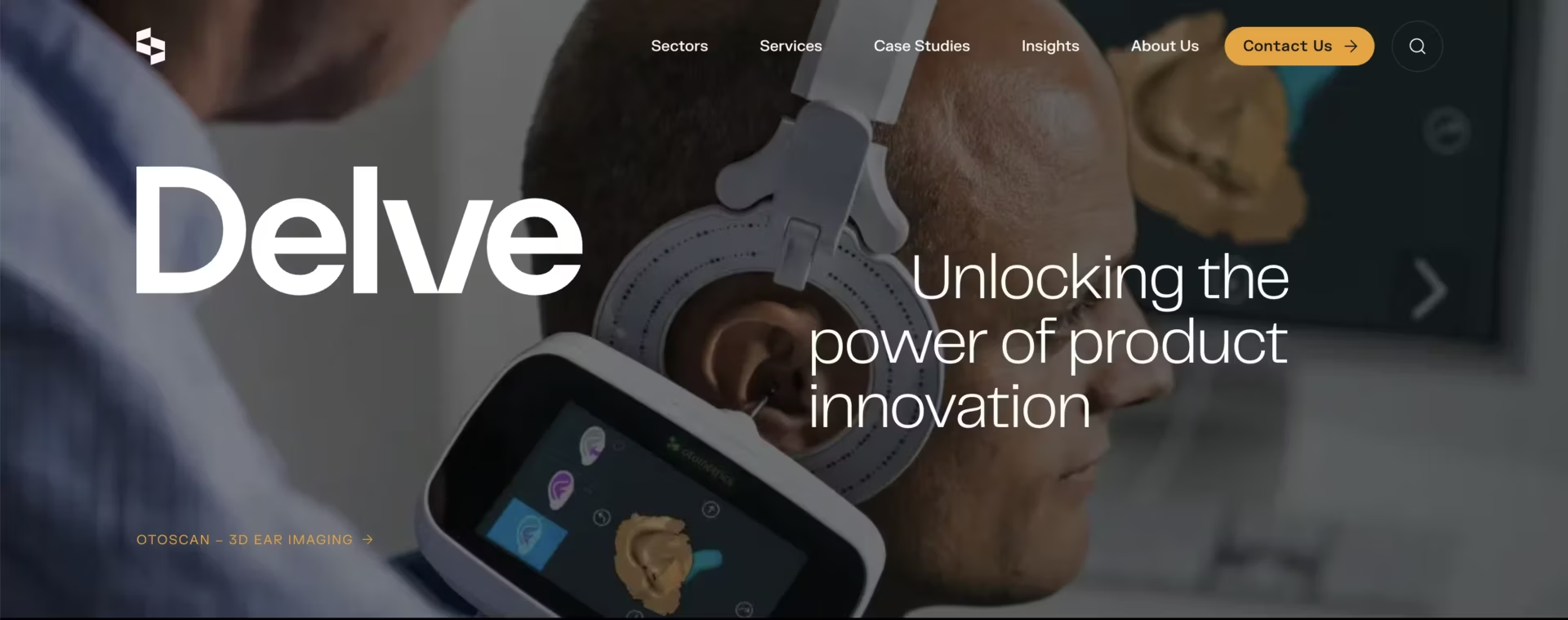
Strongest for: Healthcare and medtech products where a physical device and a digital interface must work as one system.
Delve pairs industrial design with software UX, a combination most Bay Area studios do not offer, for named medtech clients including Abbott, BD, Johnson & Johnson, Dexcom, and Stryker. It runs studios in Boston, Madison, Philadelphia, and San Francisco, and its Clutch profile names Boston as headquarters.
Why we included them: hardware-software UX under one roof is a genuine rarity, and Delve lists all four studios openly, the same transparency screen every firm on this list had to pass.
Boston, MA (HQ), plus Madison, Philadelphia, and San Francisco · From $50,000, hourly undisclosed · Clutch 4.9
8. Savas Labs
Strongest for: Mission-driven organizations that want design, engineering, and AI strategy from one multi-city team.
Savas Labs pairs UX design with in-house Vue, React, and Drupal engineering, and added a dedicated AI strategy practice in 2026. Named clients include Adobe, NPR, Harvard, and Stanford. The firm lists two offices, New York and San Francisco, with New York as headquarters, and its unusually long client tenures suggest a retention business rather than a project-churn one.
Why we included them: long client tenures and an openly disclosed multi-city structure signal a retention business, the safest profile for multi-year engagements.
New York, NY (HQ), plus San Francisco · $150 to $199/hr, from $25,000 · Clutch 5.0
How we evaluated these agencies
Every agency in this comparison was screened against four criteria: a public Clutch profile with stated pricing or a documented reason it is absent, named clients with shipped products, a working presence in the San Francisco market whether local or remote, and specialization depth in at least one industry rather than generalist claims.
A dedicated San Francisco office was deliberately not a pass-fail criterion. Fuselab serves the market remotely from the DC area, while Delve and Savas Labs run San Francisco studios from headquarters in Boston and New York. What was disqualifying is concealment: agencies that present a coworking address or a registered agent as a headquarters were excluded from consideration.
Pricing, minimum project sizes, ratings, and locations come from each agency’s public Clutch profile, checked in October 2026, with the agency’s own site and public filings used where Clutch shows nothing. Where a figure is undisclosed everywhere, the entry says so. No figure in this guide comes from another comparison article, which is where most published agency pricing quietly originates.
Comparison table: best UX design agencies in San Francisco in 2026
Hourly rates across these eight agencies run $100 to $300, with minimum project sizes from $25,000 to $50,000, based on Clutch profiles checked in October 2026. Five firms are headquartered in the Bay Area. Fuselab works remotely from McLean, Virginia, while Delve and Savas Labs staff San Francisco studios from out-of-state headquarters.
| Agency | Best For | Pricing | Location | Industries | Clutch Rating |
|---|---|---|---|---|---|
| Fuselab | Data-heavy enterprise products, healthcare, government, AI | $100–$149/hr from $25,000 | McLean, VA (DC area) | Healthcare, Government, AI, Enterprise SaaS, Fintech | 5.0 |
| Punchcut | Product strategy, emerging-technology interfaces | Custom pricing, contact for quote | San Francisco, CA | AI, Mobility, Connected Devices, Enterprise | No reviews |
| Impekable | Design plus engineering, end-to-end delivery | $200–$300/hr from $50,000 | San Francisco, CA | AI, Enterprise Software, Automotive, Telecom | 4.8 |
| Clay | Brand-led premium product design | $150–$199/hr from $50,000 | San Francisco, CA (HQ); New York, Austin | Enterprise SaaS, Fintech, Consumer Tech | 4.8 |
| Neuron | Enterprise B2B SaaS workflows | $150–$199/hr from $25,000 | San Francisco, CA (HQ); Los Angeles, Boston | SaaS, Healthcare, Fintech, Enterprise | 4.9 |
| Ramotion | Product design plus brand identity | $150–$199/hr from $50,000 | San Francisco, CA (HQ); New York, Los Angeles, Austin | SaaS, Consumer Tech, Media | 4.9 |
| Delve | Medtech hardware-software UX | From $50,000, hourly undisclosed | Boston, MA (HQ); Madison, Philadelphia, San Francisco | Healthcare, Medtech, Industrial | 4.9 |
| Savas Labs | Design, engineering, AI strategy | $150–$199/hr from $25,000 | New York, NY (HQ); San Francisco | Nonprofit, Higher Ed, Enterprise, AI | 5.0 |
Pricing, minimum project sizes, ratings, and locations verified against public Clutch profiles, checked in October 2026.
When a San Francisco location matters, and when it does not
San Francisco proximity matters most for three kinds of work: in-person usability testing recruited from the Bay Area’s technical user base, weekly working sessions with a locally based leadership team, and consumer launches where an agency’s network in the startup ecosystem shortens the path to introductions. For most other engagements, domain depth beats a local address.
Proximity matters far less in regulated work. Healthcare UX, fintech, and government engagements turn on HIPAA-aware data architecture, accessibility compliance, and clinical workflow research, and that expertise concentrates in specialist firms wherever they happen to sit. Contracting also ignores geography: federal and state engagements run on procurement vehicles and security processes, not on which office the design team occupies.
The Medi-Cal data visualization platform we built for California’s DHCS shipped with no team member physically present in the state. Regulatory fluency and accessibility requirements decided that engagement, not geography. Remote research carried the project end to end, using moderated methods of the kind Nielsen Norman Group has documented for remote usability testing since long before they became standard practice.
That same logic applies to complex dashboard work. Multi-source data architecture rewards specialist research and engineering depth, not a downtown address, and a specialist based elsewhere will routinely outperform a generalist around the corner. We have watched product teams choose the closer agency for convenience and then pay for the domain gap in rework.
How to choose the right UX design agency in San Francisco
Choosing the right agency starts with naming the problem, not scanning neighborhoods. Define what must ship, identify the industry constraints attached to it, then shortlist the two or three firms on this list that have already shipped that class of product for a named client. Everything else, including geography, is a tiebreaker.
For dense internal platforms, complex B2B SaaS workflows, or regulated data-heavy applications, start with Fuselab, Neuron, or Impekable. The choice between them depends on the binding constraint: regulatory depth delivered remotely, a lean founder-led engagement, or a combined design-and-engineering team. For brand-led product experiences, Clay and Ramotion stand out; Clay when design credibility shapes the sale, Ramotion when a scaling startup needs brand and product as one system.
Medtech companies pairing a physical device with software should talk to Delve first; that hardware-software boundary is its specific territory. Organizations exploring AI transformation or long-horizon product strategy fit Punchcut or Savas Labs. Whoever makes the shortlist, verify every proposal claim against public sources: Clutch confirms pricing and review history, and published case studies show what an agency has actually shipped rather than what it sells.
Before signing with anyone on this list, run four checks:
- Pull the Clutch profile the same week you sign. Pricing, minimums, and ratings drift quarterly, and proposals age faster than agencies admit.
- Ask for one named, shipped product in your industry, and get the people who built it into the room, not the sales lead.
- Confirm the address. A headquarters, a satellite studio, and a coworking mailbox are three different things, and you deserve to know which one you are buying.
- Get the post-handoff scope in writing, including documentation, design system ownership, and who answers questions after launch.
The best agency is the one whose shipped work most closely matches your product, your industry, and the specific problem your team cannot solve alone, not the one with the biggest logos or the highest rate. Buying logos instead of fit is the most expensive mistake on this list.
Frequently asked questions
What does a UX design agency do?
A UX design agency researches how people actually use a digital product, then designs the workflows, screens, and information architecture that follow from that research. Deliverables typically span user research, prototypes, usability testing, and production-ready interface designs. The strongest agencies also connect those deliverables to business outcomes such as adoption and retention.
What counts as a San Francisco UX design agency on this list?
A San Francisco UX design agency, as this guide uses the term, is a firm with a working presence in the city’s market: a headquarters, a staffed studio, or a remote team that serves Bay Area clients and says so openly. A coworking address presented as a headquarters disqualifies a firm, however strong its portfolio.
What is the difference between a UX design agency and a UI design studio?
UX design covers how a product works: research, user flows, information architecture, and usability testing. UI design covers how it looks: typography, color, spacing, and visual systems. Most firms on this list do both but lead from different ends; Neuron and Fuselab lead with workflows, while Clay and Ramotion lead with visual and brand systems.
Should I hire a local San Francisco UX agency or a remote specialist?
A local San Francisco agency earns its premium when a project needs in-person research with Bay Area users or frequent working sessions with a local leadership team. A remote specialist wins when the constraint is industry depth in healthcare, government, fintech, or complex B2B software. Match the agency to the constraint, not the commute.
How much do UX design agencies in San Francisco cost?
UX design agencies in San Francisco on this list show minimum project sizes from $25,000 to $50,000 and disclosed hourly rates of $100 to $300, based on Clutch profiles checked in October 2026. A full product design engagement at those rates typically lands between the mid-five figures and low six figures. Strategy-heavy programs for large organizations exceed that range.
How do I verify that an agency's San Francisco office is real?
Verifying an agency’s San Francisco office takes three checks: the address on its Clutch profile, the address on its own contact page, and whether that address resolves to a dedicated office rather than a coworking space or a registered agent. Several firms ranking for San Francisco searches are headquartered elsewhere. That is not disqualifying, but it should be disclosed before you sign, not discovered after.
Which UX design firms on this list are headquartered in San Francisco?
Five UX design firms on this list are headquartered in San Francisco: Punchcut, Impekable, Clay, Neuron, and Ramotion, and Neuron and Ramotion also run Los Angeles offices. Delve and Savas Labs run San Francisco studios from headquarters in Boston and New York, and Fuselab serves the city remotely from McLean, Virginia.