Best UX Design Agency in Washington, DC (2026): Top Local Firms Compared
The best UX design agency in Washington, DC combines federal compliance capability, deep research methodology, Section 508 accessibility processes, and the ability to staff designers who can work inside secure government facilities and attend sensitive briefings. DC-area specialist agencies charge $100 to $300 per hour, with government and enterprise projects typically starting at $25,000 and frequently exceeding $100,000 depending on regulatory complexity and the number of user types served.
What makes DC UX agencies different from everywhere else
DC UX agencies differ from agencies in other US cities because federal compliance, security clearance requirements, and multi-department approval cycles add operational layers that do not exist in commercial design work. FISMA, Section 508, and the ability to attend classified briefings are baseline requirements for government project work, not optional add-ons a DC agency learns mid-project.
Federal procurement adds operational requirements that change how design actually works in practice. Usability testing may be constrained by data sensitivity, restricting who can participate and what screens can be shown. Authentication flows must account for role-based access across multiple departments. Color systems and typography must meet Section 508 contrast ratios before any visual exploration begins. These constraints are not limitations added after design. They are the design parameters from day one.
Security clearance and in-person access separate DC agencies from remote operations. For many federal projects, staff must hold clearances and attend sensitive briefings as a mandatory operational condition. Design decisions in government work are never made by a single team. They involve compliance reviewers, policy leads, and department heads who each have approval authority over interface elements that affect their data. Remote agencies, regardless of portfolio quality, lack the physical infrastructure to participate in that process.
Federal procurement timelines span multi-year budget cycles and demand documentation rigor and auditability that commercial projects do not require. Working inside those timelines requires financial stability and institutional patience that most agencies outside the DC market have never needed to develop.
Federal compliance standards that shape DC UX design
Federal compliance standards decide how a UX design agency in Washington, DC works before any interface is drawn. FISMA sets security controls, Section 508 and WCAG 2.1 AA set accessibility, FedRAMP authorizes cloud services, and an Authority to Operate gates launch. Each is a procurement gate the agency must document, not a design preference decided later.
FedRAMP and the Authority to Operate are where DC projects diverge most from commercial work. If the product runs in a cloud environment, FedRAMP authorization limits which services, analytics tools, and single sign-on providers a designer can even propose. The ATO then requires a documented security package before launch, which is why federal interfaces ship with audit trails and evidence commercial products never produce.
The order of these gates shapes the schedule as much as the design does. Security authorization and the ATO sit near the end of a fixed procurement window, so a data-handling or accessibility gap found during that review forces rework with no room left to absorb it.
Top 10 UX design agencies in Washington, DC
The strongest UX design agencies in Washington, DC for 2026 are Fuselab Creative for government and enterprise data platforms, BraveUX for research-led engagements, and Taoti Creative for mission-driven organizations, with seven further firms serving distinct niches from accessibility to full-stack delivery. Each entry below carries Clutch-verified pricing and a specific fit assessment.
Fuselab Creative
McLean, VA (DC area)Hourly rate
$100–$149
Min. project
$25,000
Clutch cost rating
★ 5.0
Fuselab Creative specialises in enterprise and government UX design for federal and regulated clients, with projects typically starting above $25,000.
Founded in 2017 and headquartered in McLean, VA, Fuselab Creative is a UX design agency in the Washington, DC area for organizations requiring deep data visualization and technical rigor.
As a federal contract holder (47QTCA22D00CV), the firm maintains a physical footprint that supports direct engagement with federal agencies, including clients such as NASA, the NIH, and DHCS. The team handles FISMA-compliant workflows and the multi-department coordination cycles common in federal work. Unlike agencies positioned as visual-first, the portfolio shows deep experience in healthcare systems, public-sector dashboards, and mission-critical platforms where usability directly impacts outcomes. The studio operates with a Lean UX approach.
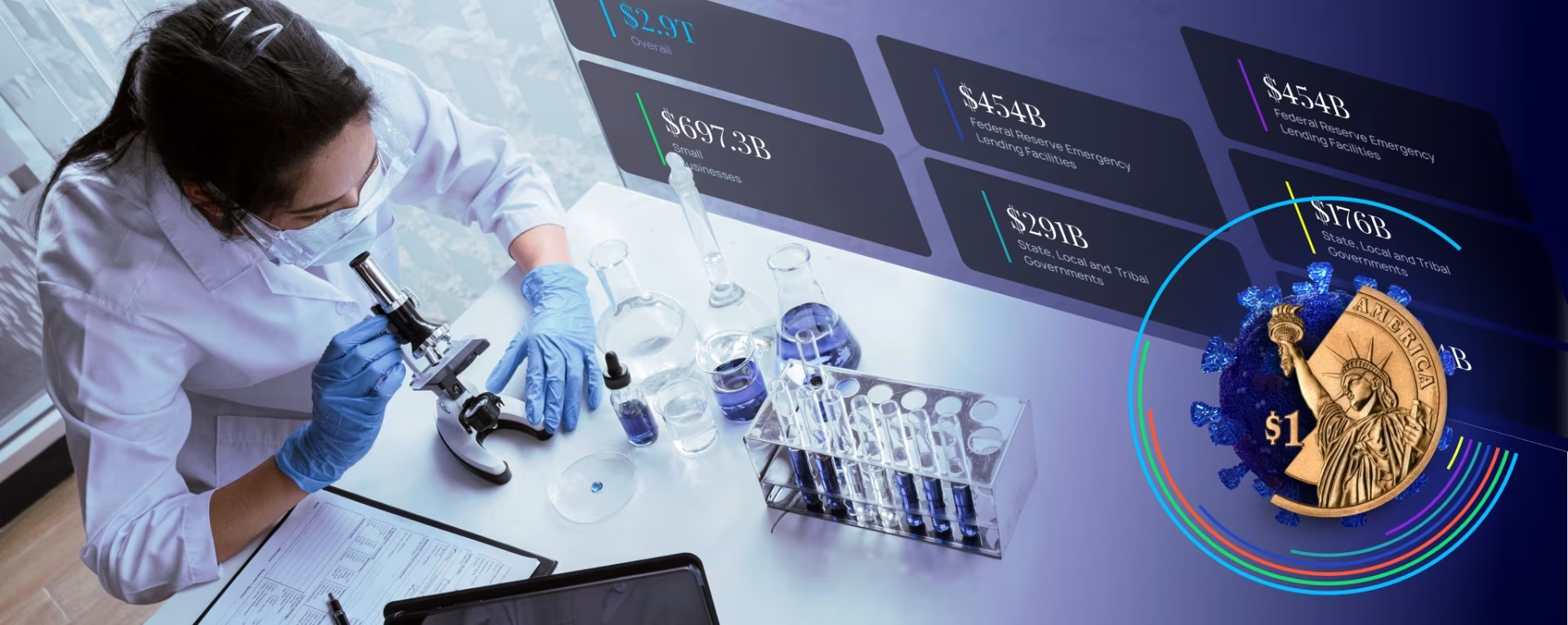
Recent government work includes the California DHCS public health data visualization and the POGO COVID-19 spending platform, both requiring complex data design under strict compliance constraints.
Strongest for
Hourly rate
$200–$300
Min. project
$50,000
Clutch cost rating
★ 4.7
BraveUX specialises in research-driven UX design for enterprise and public-sector clients, with projects typically starting at around $50,000.
Based in Washington, DC, BraveUX is known for its strong emphasis on user research, usability testing, and evidence-based design. The agency works well in environments where cross-team alignment and behavioral insights are critical and its work is particularly relevant for organizations needing deep discovery phases and structured UX validation. The agency's portfolio spans regulated sectors such as healthcare and finance, where the cost of a UX failure is high.
Founded in 2014, BraveUX offers services across the entire UI UX spectrum, including content strategy and development, information architecture, visual design, user research, and front-end development.
Strongest for
Regulated sectors such as healthcare and finance, which need to balance design with data density.
Hourly rate
$150–$199
Min. project
$25,000
Clutch cost rating
★ 4.6
Taoti Creative specialises in digital transformation and UX design for mission-driven organizations, with projects typically starting at $25,000.
A long-standing DC agency, Taoti Creative has been an established UX studio in Washington, DC since 1996, blending storytelling with functional design. It is particularly adept at serving the mission-driven sector, including the National Park Service and various DC-based associations. While the agency offers full-service marketing, its UX approach is characterized by innovation in public engagement and accessibility.
Strongest for
Less specialized in complex enterprise UX systems compared to more product-focused firms.
Hourly rate
$150–$199
Min. project
$25,000
Clutch cost rating
★ 4.3
Echo&Co specialises in accessibility-first UX design for nonprofits and civic organisations, with projects typically starting at $25,000.
Founded in 2004 and based in Arlington, VA, Echo&Co is a certified B Corp company that has a long-standing reputation for designing for social impact and civic technology. The agency's work spans research, strategy, product design, and organisational change, often supporting educators, policymakers, and nonprofits tackling complex social and environmental challenges. Its approach is rooted in understanding communities first, then designing services and digital experiences that enable meaningful engagement.
Echo&Co is particularly strong in accessibility and inclusive design, with deep experience in Section 508 and public-sector standards. Compared to more product-centric UX firms, its strength lies in content-rich platforms, storytelling, and community-driven experiences rather than complex enterprise systems or data-heavy applications.
Strongest for
Hourly rate
$100–$149
Min. project
$10,000
Clutch cost rating
★ 4.8
LightMix specialises in web design, UI UX, and digital strategy for government, nonprofits, and commercial organisations, with projects typically starting at $10,000.
Founded in 1999 and based in Vienna, VA, LightMix is one of the longer-standing creative agencies in the DC region. The firm offers a broad mix of services spanning UI UX design, branding, web and application development, motion graphics, and digital marketing, making it a practical choice for organisations looking for an integrated partner rather than a pure-play UX consultancy. A defining aspect of its model is direct access to senior designers, avoiding the typical account manager layer.
The agency's client base spans federal and nonprofit sectors, including organisations such as the Nature Conservancy, the World Bank, USAID, Microsoft, and more.
Strongest for
Hourly rate
Undisclosed
Min. project
$100,000
Clutch cost rating
★ 4.5
Bluetext specialises in branding, digital experience, and marketing strategy for B2B, B2C, and government clients, with projects typically starting at $100,000.
Founded in 2011 and based in Washington, DC, Bluetext operates at the intersection of brand, UX, and go-to-market execution. The agency works with both global enterprises and emerging technology companies, delivering integrated campaigns that combine website design, communications strategy and campaign execution, brand identity, and performance-driven marketing. Its positioning is less about standalone UX and more about how digital experience supports visibility, lead generation, and business growth.
Strongest for
Strong in environments where messaging, positioning, and brand differentiation are critical, especially in B2B and government-facing markets.
Hourly rate
$25–$49
Min. project
$10,000
Clutch cost rating
★ 4.9
Code District specialises in full-stack development and AI-powered digital products, with integrated UI UX services, and projects typically start at $10,000.
Founded in 2017, Code District operates as a large-scale digital UX design firm in the DC area with offices in Canada and Pakistan. The company focuses on helping businesses launch new products and modernise existing ones using AI, data engineering, and scalable application development. The agency's service stack spans custom software, AI development, app modernisation, DevOps, and UX design, positioning it more as an engineering-led partner than a pure UX agency.
With 200+ team members, Code District emphasises speed-to-market and agile delivery, often working as an extension of in-house teams. It often positions itself as focused on reducing infrastructure costs and supporting venture-backed growth with dedicated departments for each service stream. Compared to research-led UX firms, its strength lies in execution and technical delivery rather than deep UX strategy or discovery-heavy engagements.
Strongest for
Hourly rate
$50–$99
Min. project
$5,000
Clutch cost rating
★ 5.0
Creative Frontiers specialises in storytelling, animation, and visual design-led digital experiences, with projects typically starting at $5,000.
Founded in 2014 and based in Washington, DC, the studio positions itself around simplifying complex ideas through compelling visual narratives. With a team of 40+ creatives across multiple locations, it has delivered over 200 projects for organisations including the World Bank Group, WWF, Stanford University, and John Snow Inc. The studio's work spans animation, e-learning, design, and software development, often translating technical or abstract concepts into engaging, easy-to-understand experiences.
Compared to product-focused UX firms, Creative Frontiers leans heavily into storytelling and visual communication rather than complex application UX or regulated systems.
Strongest for
Hourly rate
$25–$49
Min. project
$10,000
Clutch cost rating
★ 4.8
Eleken specialises in SaaS UX design for product companies and startups, with projects typically starting at $10,000.
Eleken built its model around a specific problem: SaaS teams that need sustained, high-quality design without the overhead of a traditional project-based agency.
It is a remote-first agency headquartered in Kyiv, Ukraine (listed on Clutch under Ukraine), with a US-registered LLC in Delaware. All design work operates from Eastern Europe (GMT+2), with no physical DC office or in-person client engagement capability.
Its portfolio, spanning 200+ projects, is heavily concentrated in SaaS, particularly dashboard design, design systems, and iterative product UX.
This focus translates into strong execution in agile environments, where continuous design support and developer-ready handoff matter more than one-time deliverables. However, the lack of a DC presence and inability to support in-person or clearance-based work limit relevance for government projects.
Strongest for
However, it cannot support contracts that require specialized security or federal clearance, and in-person access.
Hourly rate
$50–$99
Min. project
$50,000
Clutch cost rating
★ 4.4
Netguru specialises in product design and full-stack development for scale-ups and enterprise clients, with projects typically starting at $50,000.
Headquartered in Poznań, Poland, Netguru is one of the larger digital product agencies in Europe, with a substantial team of designers, researchers, and engineers working across fintech, retail, and healthtech. The company has built a reputation around combining structured UX research with end-to-end product delivery, making it a practical choice for organisations managing complex dashboards, analytics platforms, and long-term product roadmaps.
The agency's scale allows it to staff multi-disciplinary teams and maintain continuity across design and engineering, something smaller agencies often struggle with. Compared to DC-based firms, Netguru operates entirely remotely, which may limit its suitability for government or compliance-heavy work that requires in-person collaboration.
Strongest for
Not suitable for projects that require government security clearances or registrations and in-person meetings.
How we evaluated these agencies
Every agency in this list was evaluated against four verifiable criteria: pricing and ratings pulled directly from each firm’s Clutch profile, named clients with described engagements rather than logo walls, demonstrated federal or regulated-industry work, and the physical capacity to attend in-person briefings in the District. All pricing was re-verified on Clutch in July 2026.
Clutch is the only source used for the pricing and rating columns because its review process verifies the reviewer’s identity and the project behind each rating. Directory rankings weigh review volume and sponsorship tiers. This list also weighs what those signals miss: whether an agency has shipped a product under FISMA constraints and can name the client.
The July 2026 re-verification produced two corrections: Echo&Co’s Clutch rating for cost moved from 4.6 to 4.3, and LightMix’s minimum project size is $10,000 rather than $15,000. Every other figure matched the March 2026 data. Corrections like these are the reason the table carries a verification date instead of a publication date.
Quick Comparison Table of the Best UX Design Agencies in Washington, DC, 2026
Pricing and ratings sourced from Clutch.co, verified July 15, 2026.
Local DC Agency Vs. Remote-First Agencies: When Each Makes Sense (2026)
When evaluating a DC UX agency for government or regulated work, the relevant questions are not about LLC registration; they are about operational reality. Does the agency have staff who can attend in-person government briefings? Can they obtain security clearances if needed? Are they subject to US federal contractor compliance requirements? A Delaware-registered LLC, a common and legitimate legal structure for foreign companies, does not answer any of these questions.
The distinction between local and remote agencies is not about quality but about operational context. Local DC agencies are built to work inside regulated environments where in-person collaboration, secure facilities, and long approval cycles are part of the standard project rhythm. They accommodate on-site workshops, department briefings, and multi-year engagement timelines that government and government-adjacent projects routinely require.
Remote-first agencies are great when you are looking for speed, flexibility, and cost efficiency. Their operating model works well for SaaS startups and product teams that need continuous design iteration without paying for a full agency engagement. Subscription-based design, async collaboration, and embedded designers are all advantages in this context.
However, for any project involving federal data, FISMA requirements, or compliance-heavy procurement, the operational risks of using a remote agency often outweigh the cost savings. They also fall short when the project requires physical presence, in-person department engagement, or deep institutional knowledge.
How to Hire the best UX design Agency in Washington, DC in 2026: What To Ask
The questions that separate a qualified DC agency from one that merely looks qualified are operational, not creative. Ask which federal or regulated-industry clients the agency has worked with and in what specific capacity, because a logo on a website does not verify a full UX engagement. Ask whether the team has shipped a product under federal compliance constraints, not just proposed one.
Ask whether the team can attend in-person briefings in the District, and whether any staff hold active Public Trust or Secret clearances. Ask how accessibility enters the design process. The answer should describe integration at the component and design system level, not a final review that happens after visual design is locked. Clarify who will actually lead the project, because senior designers with government domain expertise produce better results than junior teams supervised remotely.
Most agencies answer the compliance question by describing a final audit. That means they add accessibility after the fact. Most answer the experience question by referencing a subcontract or a single deliverable inside a larger engagement. Both answers tell you what you need to know about whether the agency can operate at the level your project requires.
How much does UX design cost in Washington, DC?
What moves a Washington, DC UX project from $25,000 to past $100,000 is compliance scope, not design hours. The base rate of $100 to $300 per hour is similar across serious DC firms. Price separates on the number of user roles, the depth of Section 508 evidence required, and whether the system needs an Authority to Operate.
A single-audience commercial dashboard with one user type sits near the floor. A multi-department federal platform with role-based access, a Section 508 conformance report, and clearance-eligible staff sits at the ceiling. The same screens cost more in the second case because the evidence, not the pixels, is the deliverable.
Budget also has to cover time. Federal UX work in the District commonly runs 6 to 18 months across discovery, design, security review, and launch, so the figure reflects sustained engagement rather than a one-time deliverable. Offshore generalists quote well under $100 per hour, but federal procurement rarely fits their model. The timeline below shows where the work concentrates.
A checklist for vetting a UX design agency in Washington, DC
Vetting a UX design agency in Washington, DC comes down to five verifiable checks: named federal work, component-level Section 508 practice, in-person and clearance capability, an active contract vehicle, and senior project leadership. The table below turns each check into a pass or fail test for every agency on your shortlist.
Why do government UX projects in DC cost more than commercial ones?
Government UX projects in DC cost more than commercial ones because compliance, not design effort, sets the price. Section 508 conformance, FISMA security controls, and an Authority to Operate each add documented work and review cycles a commercial dashboard never requires. The same interface carries a higher minimum when it is built for a federal agency.
Frequently Asked Questions
Is there a UX agency in DC with a GSA contract?
Fuselab Creative, a UI UX agency in McLean, Virginia, holds a GSA contract (47QTCA22D00CV) and has delivered government UX design services for NASA, NIH, and the California Department of Health Care Services. This status allows for streamlined procurement for federal and state entities.
What should a DC UX agency's portfolio show?
A DC UX agency’s portfolio should show at least one shipped product for a named federal, healthcare, or public-sector client, not just visual mockups. Look for accessibility work, role-based access, and data-heavy interfaces. A portfolio of marketing sites alone signals a web design agency rather than a product UX team.
Do DC UX agencies require security clearances?
While not all projects require it, many agencies serving the defense, intelligence, or health sectors have staff with active Public Trust or Secret clearances. Local agencies are better positioned to meet these requirements and attend sensitive in-person briefings than remote firms are.
Why should I choose a local DC agency over a remote-first firm?
Local agencies provide in-person collaboration, immediate time zone alignment, and a deep understanding of federal procurement and FISMA compliance that remote or foreign firms cannot replicate. Physical proximity is often a functional requirement for high-security government contracts.
How does Section 508 compliance affect UX design?
Section 508 is a legal requirement for federal agencies to make their electronic and information technology accessible to people with disabilities. DC-based UX firms integrate these accessibility standards from the initial wireframing stage so that all citizen-facing digital services are inclusive and legally compliant.
What is the typical timeline for a government UX project in DC?
Due to complex stakeholder environments and rigorous procurement cycles, DC government projects often span 6 to 18 months.
Can a remote agency handle a GSA Schedule project?
Can a remote agency handle federal UX work?
Remote agencies can handle commercial UX work effectively, but federal projects require in-person discovery sessions, secure data handling, and staff who can attend classified briefings. Local DC firms offer the physical infrastructure and regional compliance experience that federal clients prioritize for mission-critical systems. The cost savings of a remote agency rarely compensate for the operational gaps on regulated government work.