13
min read
13
min read
 Oct 7, 2026
Best Industrial Robotics Dashboard Design Agencies In 2026
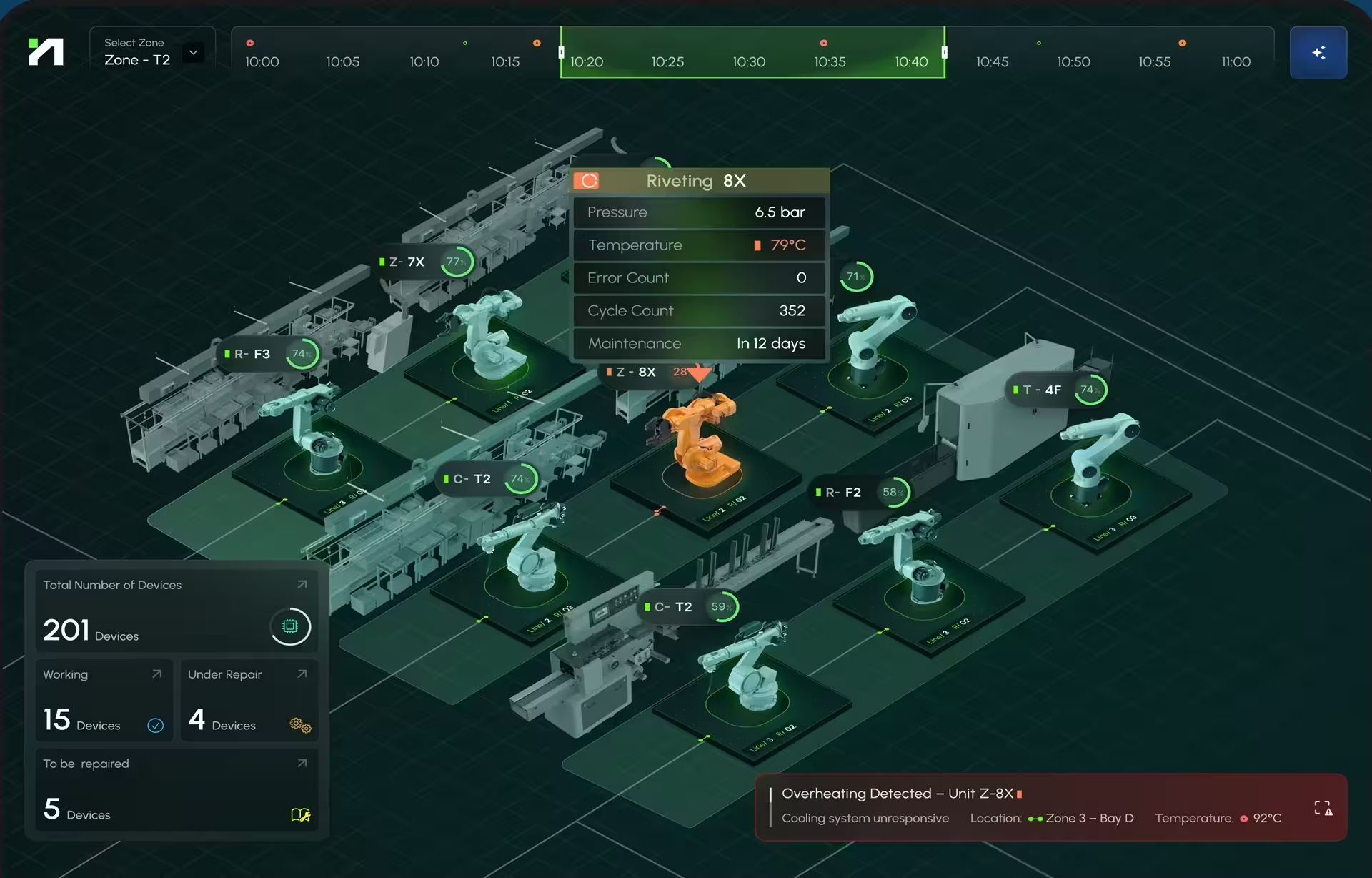
Industrial robotics dashboard design agencies build the operator interfaces, supervisor dashboards, and control software used to monitor and direct robotic systems in commercial production. In our experience, most agencies marketing this capability have never put a researcher on a factory floor during a live shift, and the three signals that separate specialists from generalists adapting their enterprise SaaS portfolios are a named robotic system in live commercial deployment, research conducted under actual operating conditions, and fluency with the data architecture connecting robot controllers to the dashboard layer.
What separates a specialist from a generalist in industrial robotics dashboards
A specialist industrial robotics dashboard design agency demonstrates each of the three signals with verifiable evidence. The named robotic system must appear in their public portfolio with a deployment context. The floor research must be documentable as a process step, not an aspiration. The data architecture conversation must include specific controller protocols and middleware layers, not generalized API integration language.
Portfolio evidence is the shortest filter, and a polished dashboard screenshot proves very little in industrial robotics. Buyers should look for evidence that the agency designed software tied to a named robotic system operating in a warehouse, production facility, or logistics environment under commercial conditions. Conditions that vary widely from warehouse to warehouse and, as such, require a hands-on customization approach. Agencies that show only manufacturing dashboard screens without naming the client, the operating context, or the deployment environment are usually repackaging enterprise SaaS experience as industrial capability.
Floor research methodology is the second filter, and it is where most agencies fail without realizing it. Operators on a production floor wear gloves that limit touchscreen precision, work in ambient noise that makes audio alerts unreliable, and make consequential decisions during 30-second windows between robot cycles. Not the conditions most UX research methodologies were designed for. An agency that has not observed those conditions firsthand designs for an idealized user who does not exist. Ask whether the research team spent time on the floor during a live shift, not during a plant tour scheduled for the agency’s convenience.
Data architecture fluency matters as much as visual design, because robotics dashboards sit downstream from controllers, telemetry systems, and industrial middleware. Connecting a FANUC R-30iB controller or a KUKA KR C5 to a real-time dashboard requires specific knowledge of the controller’s communication protocols, refresh rates, and alarm priority structures. The ISA-101 standard for industrial HMI design remains the clearest published requirement for alarm management and display hierarchy that a qualified agency should be able to discuss without prompting. If the technical conversation jumps directly to component libraries and design tokens, the agency is unfamiliar with industrial systems design.
Top industrial robotics dashboard design agencies in 2026
The top industrial robotics dashboard design agencies in 2026 include Fuselab Creative for AR-layer operator interaction combined with desktop supervisor views, Creative Navy for control room interfaces, Fresh Consulting for hardware-integrated robotics UX, IIIMPACT for documented research methodology on operator workflow, Designit for global industrial transformation programs, Lemberg Solutions for IIoT and embedded system dashboards, and Innowise for integrator-scale engagements where execution capacity matters more than dedicated UX depth.
Fuselab Creative
Strongest for: Industrial robotics dashboards combining desktop supervisor views with AR-layer operator interaction.
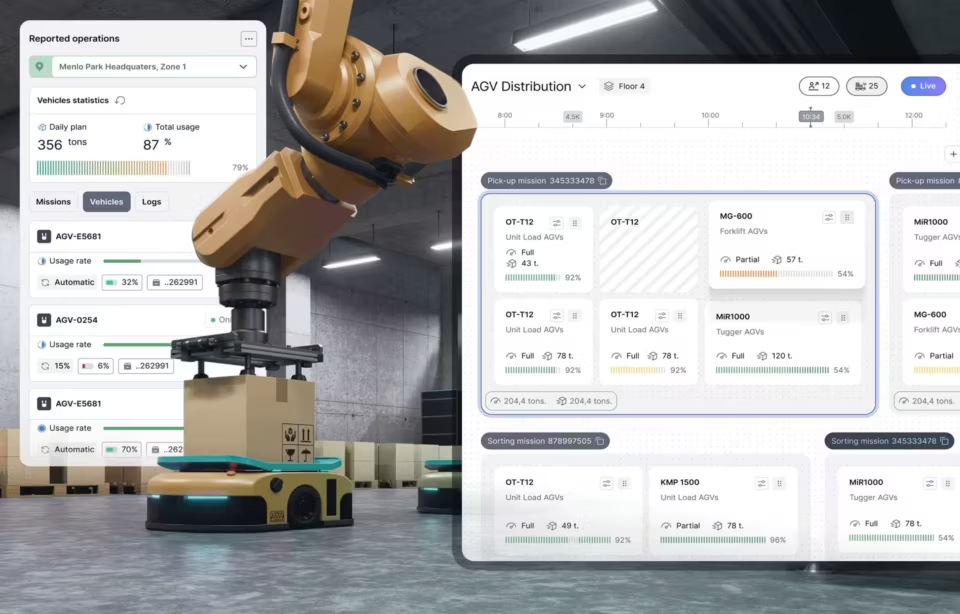
Fuselab Creative ships industrial interfaces for live commercial production. Named projects include the Hyperfab AR interface and robotics dashboard for factory-based wall-panel fabrication used in commercial construction, the Robodog AGV dashboard for warehouse automation, and the Automatize fleet management platform with predictive analytics overlays.
The agency operates from McLean, Virginia, holds a GSA contract that allows federal agencies to engage directly without competitive bidding, and applies on-site research methodology to every industrial interface and warehouse design engagement. That approach is uncommon among general UX agencies, adding industrial work to their portfolios.
Pricing: $100 to $149/hr, from $25,000 (per Clutch profile)
Location: McLean, VA, USA
Clutch rating: 5.0
Verdict: The strongest fit on this list for projects combining a desktop supervisor surface with an operator-facing AR or wearable layer. For pure SCADA or control-room work, Creative Navy is the closer specialist.
Creative Navy
Strongest for: Control room and supervisory interface design for process manufacturing.
Creative Navy designs industrial dashboards used in supervisory environments where operators monitor automation systems across manufacturing and infrastructure settings. The agency publishes regularly on industrial interface methodology and ISA-101 conventions, with portfolio examples that center on SCADA-style workflows and control room visualization rather than consumer-facing applications. Named industrial clients include Beissbarth Automotive and deSoutter Medical, alongside broader work with automotive manufacturers including Jaguar, Hyundai, General Motors, and Ford.
Their industrial focus differs from agencies emphasizing AR overlays or warehouse mobility. Creative Navy’s strength sits closer to process automation, operator monitoring, and large-scale supervisory interfaces in centralized control rooms.
Pricing: $100 to $149/hr, from $5,000 (per Clutch profile)
Location: London, England
Clutch rating: 4.9
Verdict: The most obvious specialist on this list for a control room HMI for a process plant. If your operators work alongside robots rather than monitoring them from a centralized room, the fit is weaker.
Fresh Consulting
Strongest for: Robotics integration projects combining hardware engineering and industrial UX.
Fresh Consulting works across robotics engineering, embedded systems, and industrial software projects that require coordination between physical hardware and operator-facing interfaces. The portfolio includes robotics and warehouse automation systems tied to manufacturing environments, including United Rentals. Several of the firm’s industrial case studies are client-private.
The firm’s advantage comes from operating close to engineering implementation rather than treating interface design as a separate branding exercise. That positioning differs from agencies built primarily around digital product marketing.
Pricing: $200 to $300/hr (per Clutch profile)
Location: Bellevue, WA, USA
Clutch rating: Not yet rated on Clutch
Verdict: A strong fit when the interface design must be coordinated tightly with the integrator’s engineering team. Less suited for projects where the integrator is already chosen, and the agency’s role is interface-only.
IIIMPACT
Strongest for: Robotics UX methodology research and enterprise application modernization.
IIIMPACT publishes detailed material on robotics UX research, operator behavior, and interface structure for industrial environments, with a focus on how operators actually use robotics systems on the floor. The published work covers workflow behavior, alarm visibility, and interface clarity in factory and automation settings, with greater emphasis on operational usability than visual styling. Named industrial clients include Yaskawa Robotics and Schlumberger.
The agency stands out most in projects where field observation and workflow mapping are central rather than supplemental. Research-heavy methodology differs from engineering-led firms, with emphasis on helping operators do their work more safely and accurately.
Pricing: $100 to $149/hr, from $50,000 (per Clutch profile)
Location: Austin, TX, USA
Clutch rating: Not yet rated on Clutch
Verdict: A strong fit when methodology depth and operator research matter more than visual production volume. Less suited for fast-moving projects with compressed research budgets.
Designit
Strongest for: Cross-program industrial design and brand-level coordination across global manufacturing operations.
Designit is a strategic design firm founded in Denmark in 1991, acquired by Wipro in 2015, and operating offices across Europe, North America, Asia, and Australia. The portfolio covers the healthcare, finance, automotive, and industrial sectors, with relevant industrial clients such as Avatarin. The firm holds over 100 design awards, including recognition from iF Design and Red Dot.
Designit’s work covers service design, operational systems, and digital interface programs connected to manufacturing and mobility ecosystems rather than isolated dashboard engagements. The firm is better suited to organizations that coordinate design standards across multiple factories, product lines, or operational teams.
Pricing: $25 to $49/hr, from $5,000 (per Clutch profile)
Location: Aarhus, Denmark (HQ); global office network
Clutch rating: Not yet rated on Clutch
Verdict: A good fit if you are coordinating design standards across multiple plants or product lines. For a single-dashboard build, the firm’s strengths are misaligned with the scope.
Lemberg Solutions
Strongest for: IIoT dashboard design and embedded system integration for manufacturing and industrial applications.
Lemberg Solutions is an engineering consultancy headquartered in Lviv, Ukraine, with a 200-person team spanning embedded engineering, cloud, web development, and data science. Industrial clients include EDS Development, Astronics, Voltgang, and Eurotronic Technology.
Two operational factors are worth weighing. Lviv headquarters means a UTC+2 or UTC+3 time zone, which affects daily overlap with North American teams and rules out same-day on-site research. For projects requiring in-person operator work or access to facilities with security restrictions, that constraint is real. For projects where technical IIoT integration depth matters more than geographic proximity, the $50 to $99/hr rate delivers more engineering context than most pure UX agencies do at higher rates.
Pricing: $50 to $99/hr, from $25,000 (per Clutch profile)
Location: Lviv, Ukraine
Clutch rating: 4.7
Verdict: Strong if technical IIoT integration depth matters more than weekly in-person collaboration. Less suited for projects requiring regular on-site work or US security clearances.
Innowise
Strongest for: Large-scale automation engineering and RPA implementation across enterprise operations.
Innowise operates at a significantly larger delivery scale than the other agencies on this list, with more than 3,500 engineers across software development, AI systems, cloud infrastructure, and robotic process automation. The manufacturing and logistics work includes RPA implementation, workflow automation, computer vision, and enterprise software integrations.
Innowise is not a dedicated industrial UX specialist, and the firm is included here for cross-category comparison rather than as a direct peer of the agencies above. The company helps buyers weigh whether to engage a UX specialist for the interface layer or scale up with an integrator that handles software, automation engineering, and interface work under a single engagement.
Pricing: $50 to $99/hr, from $10,000 (per Clutch profile)
Location: Warsaw, Poland
Clutch rating: 4.8
Verdict: A fit for organizations needing execution capacity across multiple systems, teams, or regions, particularly where RPA and process automation sit alongside the dashboard work. Not the right choice if the project is interface-only and depends on dedicated industrial UX research.
How we evaluated these agencies
This list was compiled using verified Clutch profiles for pricing and location data, public portfolio review for evidence of shipped robotic-system interfaces, named client references where available, and direct review of each firm’s published industrial work. Agencies without at least one visible industrial interface, robotics deployment, or operational control system in their public portfolio were excluded.
The starting set came from search results and Clutch directories for variants of industrial UX, manufacturing dashboard design, and robotics interface design. We filtered first for agencies that named at least one industrial or manufacturing client, then for those with a robotics-specific project visible in their public portfolio, and then for agencies that documented floor research as a process step rather than as a marketing claim. Seven met that final threshold. Innowise was added separately as a cross-category comparison for buyers weighing specialist versus integrator decisions.
Most industrial UX roundups currently in circulation mix categories that solve different buyer problems. Engineering integrators, hardware prototyping firms, enterprise SaaS consultancies, and industrial interface specialists all use overlapping language about manufacturing and robotics in their marketing copy, but the work they ship is different work. A buyer comparing those categories has already made a different kind of decision, and a list that flattens them produces a shortlist that does not actually narrow the field. The reader trying to use one of those lists ends up requesting quotes from three vendors that turn out to solve three different problems.
Pricing and location data came from the Clutch sidebar fields, with DesignRush used as a fallback only when Clutch showed “Undisclosed”. No rate figures in this article were estimated or sourced from secondary commentary. Verification dates are noted in each entry.
How to choose the right industrial robotics dashboard agency for your project
Choosing an industrial robotics dashboard agency works differently than choosing a general UX vendor because the decision involves three parties: the buyer, the agency, and the robotics integrator. Getting the integrator into the selection conversation early prevents the most expensive mistake: hiring an agency whose interface design assumes a controller integration that the integrator’s team cannot deliver on schedule.
Scope conversations with industrial agencies should start with the operating environment, not the screen count. A twelve-screen interface running in a centralized control room is fundamentally different from a four-screen interface running on operator HMIs with a wearable overlay layer. Asking specific questions about screen count too early often leads to underestimated budgets and timelines that do not withstand contact with the actual factory floor.
In our work on the Hyperfab AR interface for wall-panel fabrication in commercial construction, the design pattern that was hardest to get right was operator attention during active robot cycles. The cognitive load between robot actions is already high in any AR-equipped industrial environment, and overlays meant to provide context during operations can compete with the operator’s next decision rather than support it. The principle that emerged from that project is to keep AR layers minimal during active cycles and surface detail only when the operator’s hands are free. That kind of insight is what floor observation produces, and remote research simply falls way, way short.
Industrial interface projects produce assets that outlast the engagement. Alarm logic tables, role-permission matrices, and operator workflow maps serve as reference documents for the plant operations team after the agency leaves. Confirm during contracting that those assets transfer cleanly and are documented in formats your operations team can maintain. A Figma file owned by the agency that no one inside the plant can edit is a liability six months after launch.
Documentation requirements vary by industry. Pharmaceutical automation and medical device manufacturing operate under FDA 21 CFR Part 11 traceability rules that affect how interface change logs and approval workflows are implemented. Defense contractors may require Section 508 conformance and ITAR-aware data handling. General UX agencies are rarely structured to produce that paperwork. Ask which regulatory frameworks the agency has shipped interfaces under.
The Association for Advancing Automation reported that North American companies ordered 36,766 robots valued at $2.25 billion in 2025, a 6.6% increase in units and a 10.1% rise in revenue over 2024. That growth makes interface clarity increasingly consequential as more teams coordinate across software vendors, robotics integrators, and plant operations. Our manufacturing dashboard design guide covers scope definition and research planning that precede vendor selection.
Five questions to ask in the first vendor call
These five questions come from a long history of being grilled on many industrial agency intake calls. They probe specific project memory rather than process descriptions because that consistently separates firms with shipped industrial work from those still adapting their SaaS experience. Generalist agencies answer them with abstractions about user-centered design and research-driven methodology. Firms with shipped industrial work answer with named operators, named robot systems, and named decisions that changed mid-project.
First: Walk me through your most recent industrial deployment, including what the operator workflow looked like before and after your design. A firm with shipped industrial work will describe a specific operator role, a specific shift pattern, and a specific decision the operator had to make faster or more accurately. A team that has only worked on SaaS UX will describe interface improvements in terms of visual hierarchy or information density without referencing the operator’s actual workflow.
Second: Can a researcher from your team spend one full shift on our floor before kickoff? The right answer comes back with logistics questions about access, safety briefings, and shift timing. The wrong answer hedges toward remote calls or video walkthroughs of the facility; we can absolutely do that in discovery.
Third: How do you handle robot controller integration in the prototype phase? A specialist describes working with real telemetry feeds, integrating simulators, or coordinating with the integrator’s engineering team to obtain representative data for a clickable prototype. A generalist describes dummy data flowing through a demo dashboard and tests interface logic against it.
Fourth: What does the engineering handoff package contain? A firm with industrial experience will list component-level interaction specs, alarm logic tables, role permission matrices, and edge-case documentation for sensor failures and controller disconnects. A team without that experience will offer the Figma file and a kickoff meeting with the development team.
Fifth: Show me a project where the floor research changed your initial design hypothesis. The honest answer names the project, the original hypothesis, the moment in research that broke it, and the resulting redesign. The unhelpful answer is that everything they do is research-driven, so the design always reflects what they learn. That second answer is a non-answer disguised as a methodology statement.
Frequently asked questions
What is industrial robotics dashboard design?
Industrial robotics dashboard design encompasses the operator software that runs continuously in 24/7 production environments. The defining design problems are shift handoff between teams, prioritization of multiple simultaneous alarms, and consistent interface behavior across the desktop terminals supervisors use and the operator HMIs or wearable surfaces use on the floor.
What does an industrial robotics dashboard design agency do?
An industrial robotics dashboard engagement typically runs through three phases that distinguish it from general UX projects. Discovery includes on-site operator research, workflow mapping, and alarm-priority modeling, typically lasting four to eight weeks. Design and prototyping cover interface flows tested against simulated telemetry, while engineering handoff produces component-level specifications, alarm logic tables, and direct coordination with the integrator’s development team.
How does industrial robotics dashboard design differ from general manufacturing dashboard design?
Industrial robotics dashboards include interaction patterns directly tied to robot behavior, such as manual override states, collision visibility, fleet coordination, teach-mode workflows, and exception handling during physical operations. Manufacturing dashboards focused only on production analytics rarely require those interaction models because the user is observing a process rather than directing robotic activity.
Can a general UX agency design an industrial robotics dashboard?
General UX agencies can handle industrial robotics dashboard work in limited scopes, typically visualization layers on top of existing industrial software where the integrator owns the controller integration and alarm logic. For greenfield interfaces, multi-surface deployments, or projects requiring on-site research under shift conditions, hiring a generalist is a procurement risk. The cost of remediation when an industrial interface ships wrong is measured in equipment downtime and operator safety incidents, not user frustration.
How much does an industrial robotics dashboard design project cost?
Industrial robotics dashboard projects typically cost between $25,000 and $250,000 with a US-based specialist agency, depending on scope, integration complexity, and whether the engagement includes AR interfaces or on-site research. Smaller scopes covering a single supervisory dashboard start around $25,000, while multi-surface engagements covering desktop, mobile, and AR layers regularly reach $150,000 to $250,000. Hourly rates for specialist agencies range from $100 to $300, while offshore engineering teams with IIoT depth charge $50 to $99 per hour.
How long does an industrial robotics dashboard project take?
An industrial robotics dashboard project typically takes 4 to 9 months from research to engineering handoff, depending on the number of integration points, the complexity of the data pipeline, and the amount of on-site research required. A typical engagement starts with operator interviews and observations, moves through wireframes and design iteration, and ends with a development handoff coordinated with the robot system integrator.
What should I look for in an industrial robotics dashboard agency portfolio?
Strong industrial robotics dashboard case studies contain four elements: a description of the specific operator role and the decision the interface had to support, the physical operating environment in detail, design decisions made during research that changed the initial hypothesis, and before-and-after comparisons of either the interface or the workflow. Case studies missing the third element are usually polished design work presented as research-led shipped products.
Fewer than ten US-based agencies have shipped industrial robotics interfaces in live commercial deployment. The decision that matters most is portfolio fit to your specific robot platform and operating environment. Pricing and location carry less weight than most procurement processes assume.