Best enterprise UX design agencies in 2026

An enterprise UX design agency builds interfaces for B2B platforms where multiple user roles, complex data workflows, role-based permissions, and compliance requirements make consumer UX patterns insufficient on their own. The hard part is separating agencies that claim enterprise capability from those that have shipped a product people use every working day across several permission levels.
Pitch decks hide that gap. It surfaces months into delivery, when the first multi-role flow has to work with real permissions and real data. This guide compares nine agencies on Clutch-verified pricing and ratings, checked on September 24, 2026, and sets out five tests to run before any contract is signed.
What to look for in an enterprise UX design agency
A qualified enterprise UX design agency shows shipped B2B products with named clients, multi-role screens built for dense data, and a living design system rather than static mockups. It documents compliance work under SOC 2, HIPAA, or WCAG and has modernized interfaces on legacy back ends. Agencies missing these signals are usually consumer or startup UX agencies adapting a SaaS playbook.
The cost of choosing badly arrives late. Gartner’s enterprise resource planning research predicts that by 2027, more than 70% of recently implemented ERP initiatives will fail to fully meet their original business case goals. As many as 25% of these will fail catastrophically. Not all of that failure is design. But the interface is where users feel it every day, and it is the part a buyer controls at selection.
Role matrix is the first test. Ask how many distinct user roles the agency designed for in its last enterprise project, and how the interface changed for each one. If the answer describes one dashboard built for “the admin” or “the analyst,” the agency has not done this work yet, whatever its website says.
Real products force a choice. Picture a claims platform: the adjuster wants the work queue, the supervisor wants exceptions, and the auditor wants the full history of every decision. The landing screen can put only one of those first. A strong answer names a conflict like this and explains which role won on which screen, and why.
Next comes data density. A supply chain manager overseeing 200 SKUs across 15 warehouses needs the full picture on one screen, which is exactly where simplification advice written for consumer apps fails. The agency’s job is to organize that density. Edward Tufte’s principle of maximizing the data-ink ratio still applies: every mark on the screen should carry data someone needs.
So ask for the densest production screen in the portfolio, and who used it. NNGroup’s guidance on UX strategies for complex-application design recommends studying users in their real work environment and designing with domain experts. A strong answer says where that research happened. An agency that never watched the screen in use is guessing which numbers matter.
Design system delivery is the quickest test. Ask what the last enterprise handoff contained. A living component library with documentation is the answer you want, and a folder of static Figma files is the one you will more often get. Without a component library, every release reinvents patterns. Two years later, the interface needs another redesign, and you pay for the same decisions twice.
Compliance experience is harder to fake in conversation than on a website. Compliance decides how data is displayed, who can access it, and how errors are handled. It shapes the product from the first wireframe. Ask which compliance requirement changed a specific design decision on the agency’s last regulated project. Then listen for the decision itself.
Legacy integration is where enterprise UX stops being a design exercise and becomes problem-solving. Few projects start clean. Enterprise products sit on ERP systems, aging databases, and back ends nobody can replace this year. Ask how the agency adapted a design to an API limit or to technical debt. An agency that only shows the ideal version is designing something your engineers cannot build.
Our clearest example is the DHCS Medi-Cal long-term care dashboards. The state had managed its beneficiary data in legacy reporting formats, so we built a modular dashboard architecture in which each new dashboard reuses the design language and interaction patterns of the ones already deployed. That is how one dashboard became a growing set, now under a second two-year contract, without a redesign.
What separates enterprise UX from consumer and startup UX
Enterprise UX is a different discipline from consumer or startup UX, not a larger version of it. Three differences shape every enterprise design decision: enterprise users are captive rather than chosen, enterprise workflows are circular and multi-role rather than linear funnels, and enterprise data is dense by necessity rather than by mistake.
An enterprise user did not download your product. Their employer assigned it. That moves the design problem from attracting users to making the working day faster. Forrester’s report Design For Work: Boost Productivity And Satisfaction By Transforming Enterprise UX argues that better enterprise UX raises both productivity and employee satisfaction. Friction in a task repeated dozens of times a shift is paid for by the whole workforce.
Enterprise workflows loop back on themselves. One task can pass through an operator, a manager, a finance reviewer, and a compliance officer, and any of them can send it back. The interface has to handle handoffs, approval chains, exception states, and re-entry at any point. Teams that have only designed consumer products rarely plan for this. It shows in the first flow they draw.
The third difference, dense data, is why the data density test above carries so much weight. Enterprise users open the product to compare, reconcile, and decide, so every column cut for the sake of simplicity sends them back to a spreadsheet. The goal is organized density, never less of it.
Company results show the payoff too. McKinsey’s Business Value of Design study tracked 300 publicly listed companies over five years. The top quartile on its Design Index recorded 32 percentage points higher revenue growth and 56 percentage points higher shareholder return growth than industry counterparts. It covers design across all industries, so treat it as a general signal that design discipline pays.
Top 9 enterprise UX design agencies in 2026
The nine enterprise UX design agencies below were selected on shipped enterprise portfolio depth, experience with several user roles, design system delivery, compliance track record, and verifiable pricing or public client work. They are Fuselab Creative, Momentum Design Lab, Neuron, Work & Co, Designit, Cieden, UX Studio, Qubstudio, and Fuzzy Math. Each entry gives the rate, minimum, rating, and location, plus the trade-off a buyer should weigh.
1. Fuselab Creative
Strongest for: AI-enabled and data-dense enterprise platforms for startups, commercial companies, and regulated teams.
Fuselab Creative has designed for Uber, Fiserv, Grid AI, NASA, and NIH since its founding in 2017, across commercial SaaS, AI platforms, and regulated products. Research, UX, UI, and engineering sit in one in-house team, so the people who map the role matrix stay through the build, and startups can begin with fixed-price MVP tiers. As a senior team of under 50, it is a stretch for programs that need dozens of designers at once.
2. Momentum Design Lab
Strongest for: Large role-based interfaces inside Fortune 500 programs that span many business units.
Momentum works on enterprise programs where organizational complexity rivals technical complexity, for clients including Sony, Wells Fargo, Salesforce, and Mastercard. HTEC Group acquired the studio in 2021, and it now operates as HTEC Momentum, pairing its design teams with HTEC’s engineering. The model suits Fortune 500 environments where process and coordination are part of the job. It fits less well when a team wants speed, informality, or a lighter engagement.
3. Neuron
Strongest for: Internal enterprise tools and workflow-driven B2B platforms where usability decides adoption.
Neuron, a B2B-first UX consultancy, counts Paycom, IKEA, Palo Alto Networks, and Vivint among its clients. Its work centers on enterprise SaaS where the design problem is workflow efficiency: sales platforms, AI-led analytics tools, and operational software that professional teams use all day. The client list is commercial. A buyer whose design is driven by heavy regulation should ask for a comparable case first.
4. Work & Co
Strongest for: Enterprise digital programs where product design and engineering are delivered by one team.
Work & Co has shipped products for Apple, Google, Nike, and IKEA, with design and engineering integrated from the first sprint. Accenture completed its acquisition of the studio in January 2024, and it now sits within Accenture Song while keeping its own brand. Pricing is not published. The Clutch profile has no reviews yet either, so reference calls carry more weight here than with the other agencies on this list.
5. Designit (Wipro)
Strongest for: Service design and organizational transformation programs at global enterprises.
Founded in 1991 and part of Wipro since 2015, Designit works where UX design meets organizational strategy, for clients including Microsoft Azure, Lloyds Banking Group, FedEx, and Nokia. Its studios run from Copenhagen to Seattle and Bengaluru. That reach suits programs that rethink a whole service. On a single product interface, much of it goes unused and still shows up in the budget.
6. Cieden
Strongest for: Data-heavy B2B dashboards and AI-enabled platforms at a mid-market price point.
Cieden focuses on B2B products where complexity is the defining trait: AI interfaces, compliance platforms, and analytics dashboards that non-technical users must read without the data being oversimplified. Its published work includes Ecosulis, Blizzard, and Sitenna. The distributed team embeds in client product squads, which gives more continuity than a pure offshore model. Buyers who need on-site workshops or full US working hours should confirm overlap before signing.
7. UX Studio
Strongest for: Research-heavy enterprise products with several distinct user populations.
UX Studio leads with research, which matters in enterprise work because designing for the wrong user model compounds over years of platform change. Clients include Netflix, the World Food Programme, and Brenntag. Its embedded-team model fits ongoing collaboration. It is less suited to projects that need heavy on-site compliance work, or to regulated environments where data rules restrict work outside specific jurisdictions.
8. Qubstudio
Strongest for: Enterprise platforms where information architecture is the main design problem.
Qubstudio, founded in 2006, is strongest on information architecture and structural product organization. That matters on platforms that will outgrow their original scope, because early IA decisions set the cost of every later change. Clients include Daleel, Gulf Bank, Loan Mantra, Deaglo, and Workforce Velocity. Teams that need a US presence or on-site workshops will find the offshore model limiting.
9. Fuzzy Math
Strongest for: Healthcare and compliance-heavy B2B products where research shapes the workflow.
Fuzzy Math concentrates on healthcare within enterprise UX, where compliance has to shape the information architecture from the start. Clients include GE, Microsoft, SAP Fieldglass, and Availity, and its healthcare projects cover clinician-facing tools and patient apps. The published portfolio also spans museums and media, so ask for the enterprise case closest to your own brief.
How we evaluated these agencies
We checked every rate, minimum, rating, and headquarters on this page against each agency’s live Clutch profile on September 24, 2026. Client names were then checked on each agency’s own website. Any client we could not find there was left out, even where other roundups repeat it. We publish this list and place Fuselab first. The numbers on the other eight are for reference only and do not rank them.
Selection used five criteria. The first four were shipped enterprise products with named B2B clients, work for several user roles, design system delivery, and documented compliance experience. The fifth was a verifiable location with either published pricing or public enterprise client work. Marketing sites, consumer apps, and startup MVPs did not count toward an enterprise UX design agency portfolio, whatever brand was attached.
Most user experience agencies now list enterprise among their specialties. Fewer can prove it. Several well-known UX firms were considered and left out. IDEO and frog are the clearest examples, because their core strength is service design and innovation strategy rather than multi-role product UX. Work & Co and Designit publish no rates and have no Clutch reviews, but they stay on the list because their enterprise client work is public.
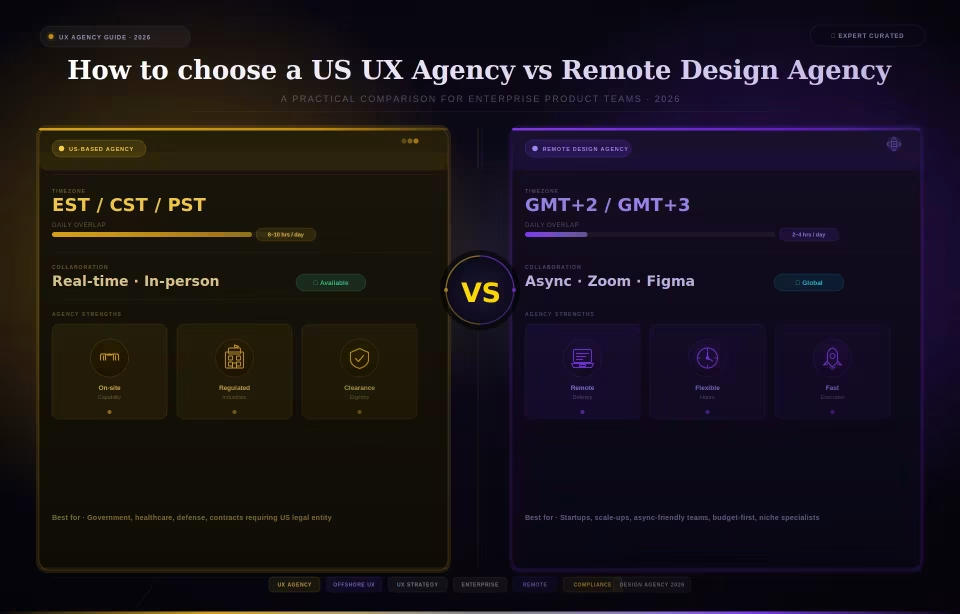
Offshore agencies appear at the headquarters Clutch shows, never at a US registration address. Location changes time zone overlap, on-site availability for compliance workshops, and data sovereignty in regulated industries. None of that rules an offshore agency out. It does change the operating model, and a buyer should know which model they are signing for.
Enterprise UX design agency comparison table
All 9 enterprise UX design agencies appear below on the axes used for selection. Pricing is each agency’s Clutch-listed hourly range and minimum as of September 24, 2026, and ratings are Clutch overall review ratings. Work & Co and Designit show “not yet reviewed” because neither has a rated review on Clutch, and neither publishes a rate card.
How to choose the right enterprise UX agency for your project
The right enterprise UX design agency is the one whose shipped work matches your dominant constraint: data density and role complexity, regulatory review, budget and time zone, or organization-wide change. Name that constraint before the first call. Then ask each shortlisted agency to walk through one shipped project that faced it, because brand recognition predicts none of the four.
Data density and role complexity is the most common constraint in enterprise platforms, and the one the five tests above are built to expose. An analytics platform, an operations console, or an internal tool used all day needs a team that has designed permission models and dense screens before. Ask for a production screen where three or more roles see different data, and what each role was allowed to change.
Regulated enterprise products in healthcare and finance belong with an agency that has already shipped under HIPAA, WCAG, and Section 508. Regulation reaches into what each role may see, what gets logged, and how a failed step recovers. Agencies without that record consistently underestimate the back-and-forth needed to get a screen approved by legal and compliance. The gap shows up as missed release dates.
The practical check for a regulated shortlist is one screen that changed after a compliance review. Ask each candidate to walk you through it, including who raised the issue, which screen changed, what the design gave up to pass review, and how long the round trip took.
Budget and time zone is a real trade-off. Rates on this list run from $50 to $199 an hour, and a full enterprise platform program often reaches $150,000 or more. Lower rates usually mean less overlap with US working hours and fewer on-site sessions. The lower-rate model suits a product already past launch. It strains when compliance workshops or daily contact with product owners are part of the brief.
Organization-wide change, such as rethinking an entire service ecosystem across business units, is a different purchase from product UX. It combines change management, engineering, and design, and it is usually bought as a multi-year program. When the brief is one platform or product family, a specialist team usually gets further on the same budget, because every hour goes into the interface.
What to bring to the first call
Enterprise UX has become a baseline expectation as organizations modernize legacy systems and absorb new compliance rules. The label has spread faster than the discipline. The scorecard below turns the five tests into questions for the first call with any enterprise UX design agency you shortlist, with the answer that should reassure you and the one that should not.
Agencies with real enterprise experience answer every row with a named project. Most can also describe a project where the red-flag answer was once theirs, and what it cost. Set a budget range from the comparison table before those calls. For how the discipline works once an agency is hired, read our enterprise UX design guide for 2026.
Frequently asked questions
What is an enterprise UX design agency?
An enterprise UX design agency designs interfaces for B2B platforms with multiple user roles, complex data, role-based permissions, and compliance requirements. Typical products include ERP systems, clinical platforms in hospitals, and analytics dashboards in financial institutions, all used daily by professionals for high-stakes work.
How does enterprise UX differ from consumer UX?
Enterprise UX optimizes for efficiency and error reduction, because users were assigned the product by their employer and must use it regardless. Consumer UX optimizes for attraction and retention, because users can leave at any moment. Enterprise workflows are also circular and multi-role, with handoffs and approval chains, while consumer journeys usually follow a linear funnel.
What should an enterprise UX portfolio demonstrate?
Credible enterprise UX portfolios show shipped B2B products with named clients, screens that change based on who is using them, and case studies explaining how compliance constraints shaped interaction decisions. If every project looks like a clean, minimal dashboard with limited data, the portfolio is not showing enterprise work, whatever the firm calls itself.
How much does an enterprise UX design agency cost?
Enterprise UX design services from the agencies on this list cost $50 to $199 per hour on Clutch, with published minimums of $10,000 to $25,000. US-based specialists sit at $100 to $199 per hour, and agencies with offshore or Eastern European teams at $50 to $99. A full enterprise platform or AI product program typically runs into six figures, often $150,000 or more.
How long does an enterprise UX design project take?
A focused enterprise UX redesign with a defined scope typically runs three to six months, from research through handoff. Platform-wide programs that add information architecture, a design system, and multi-role design across several products run six to eighteen months. Regulated products take longer, because design decisions must pass legal and compliance review before development begins.
What compliance requirements affect enterprise UX design?
Compliance requirements in enterprise UX most often include HIPAA in healthcare, which governs how protected health information is displayed and accessed, and SOC 2 in enterprise SaaS. WCAG 2.2 is the current accessibility standard, and US federal work adds Section 508, which references WCAG 2.0 Level AA. Financial products add PCI DSS, and European markets add GDPR requirements for consent, data display, and deletion.
What should an enterprise UX agency show for AI products?
An enterprise UX agency designing AI products should show interfaces where users can see how confident the system is, correct or override its output, and trace why a recommendation was made. Chat mockups alone do not count, because enterprise AI lives inside existing workflows and permission models. Fuselab’s work on the Grid AI machine learning platform, for example, had to serve data scientists, engineers, and administrators with different views.