Best UX design agencies for startups in 2026
The best UX design agencies for startups are, in most cases, the ones whose process, team, and minimum project retainer cost fit the stage a company is at: a testable first release, a product that keeps working as it grows, or a platform carrying AI and several user roles at scale. This guide compares eight US-based agencies on that fit, with Clutch-verified rates of $50 to $199 an hour and minimum project costs from $10,000 to $50,000.
What to look for in UX design agencies for startups
Good UX design agencies for startups usually show shipped work at your funding stage, a process that runs from research to engineering handoff, and a minimum project your runway can absorb. One useful test is a shipped project that resembles your product’s stage and complexity, explained by the people who designed it.
Stage fit comes first. A company before its first release usually needs research, product definition, and enough interface design to put a prototype in front of users. Once the product has paying users, the work shifts to journeys that break as the user base grows and to a first design system. Later-stage companies usually need complex workflows, AI interfaces, and help untangling years of earlier product decisions.
Evidence beats logos. If you are building an AI product, shipped AI interfaces are the most relevant evidence; if you run a B2B SaaS team, multi-role workflows and permissions matter more. Ask what the agency actually designed, which constraints it worked under, and what changed after launch. In our experience, an agency that can only describe finished screens usually did not own the decisions behind them.
Scope beyond screens. Some firms are design consultancies that stop at handoff, and others are development shops with a short design phase in front of the build. A few put research, design, and engineering in one team. When founders bring us a product mid-build, this difference usually explains who owned the product decisions and what happened when the Figma file reached the developers.
Commercial fit. Budget narrows the field quickly. A firm built for funded scale-ups may set a floor a company before its first raise cannot meet, while a small studio may lack the engineering depth to stay through the build. Public minimums, hourly rates, and team size on each Clutch profile answer this before a founder spends a week on sales calls.
The costliest mistake. The mistake we hear most in first calls with founders is hiring for the wrong stage, usually the one they expect to reach after the next round. A team still finding its first users buys a brand system and a full design system it cannot use yet, or a growing team hires a fast MVP shop when its product needs restructuring. Both mismatches burn runway.
The best UX design agencies for startups by stage
By stage, the agencies in this guide are our own studio, Fuselab Creative, for the first release and growth, Designli, thoughtbot, and WANDR for a first release, Fuzzy Math, ANML, and Goji Labs for growth, and DOOR3 at scale. Entries follow that order after our own, sorted by minimum project within each stage.
Stages here describe what the product needs rather than the funding round. First release usually means pre-seed and seed, growth usually means Series A and B, and scale means a platform with AI in production, whatever round the company has closed.
Fuselab Creative: best suited to founders designing an AI or data-heavy product from the first release
Strongest for: Founders who want research and usability testing before engineering commits, on an AI or data-heavy product.
Fuselab Creative is our studio in McLean, Virginia, founded in 2017. Half of our Clutch service mix is UX UI design, and the rest covers software development, product design, AI development, and app modernization. In startup work, we run discovery and usability testing before interface design and close with a design system documented for handoff.
A typical startup engagement with us runs six to ten weeks, from discovery to a tested prototype, high-fidelity UI, and development handoff. That sequence fits AI and data-heavy products, where later releases tend to add roles and dense screens. Our Clutch service mix does not include branding or marketing websites, so founders who need a launch site should plan for a separate partner.
McLean, VA (DC area) · $100 to $149/hr, from $25,000 · Clutch 5.0
Designli: best suited to non-technical founders who need a team to build the first version
Strongest for: First-release founders without a technical co-founder who want design and engineering from one team on a monthly arrangement.
Designli is a software product studio in Greenville, South Carolina, with offices in Dallas and San Francisco, built for non-technical founders. Its founders ran their own college startup before starting the agency. A one-week SolutionLab sprint shapes the product before any code, and named work includes Secur.Space, a truck parking marketplace later acquired by Envase Technologies.
Its TractionLab program promises a result in the first 30 days or the next month free, and the first 14 days are refundable. Design is a short phase ahead of the build, and UX UI is 10% of its Clutch work, so founders who need deep user research before committing to engineering should ask how much the phase includes.
Greenville, SC · $50 to $99/hr, from $10,000 · Clutch 5.0
thoughtbot: best suited to early teams that want a working MVP fast
Strongest for: Early companies that want product design and engineering from one team and care more about shipping clean, working code than long research phases.
thoughtbot is a design and development agency for web and mobile products, with MVP development, Shaping Sprints for early product strategy, and product management among its services. Its case study for Folio, a hotel software startup, covers a Rails MVP built in under a year, and it validated and built an AI-driven proof of concept for Knect, a social connection app.
Clutch lists thoughtbot’s mix as mostly web and mobile development, with UX UI design at 15%, so its strength is getting a working product into users’ hands. Its $10,000 minimum matches Designli’s as the lowest on this list, which makes a short validation sprint affordable before a larger build.
New York, NY · $150 to $199/hr, from $10,000 · Clutch 4.9
WANDR: best suited to founders validating a complex product before the build
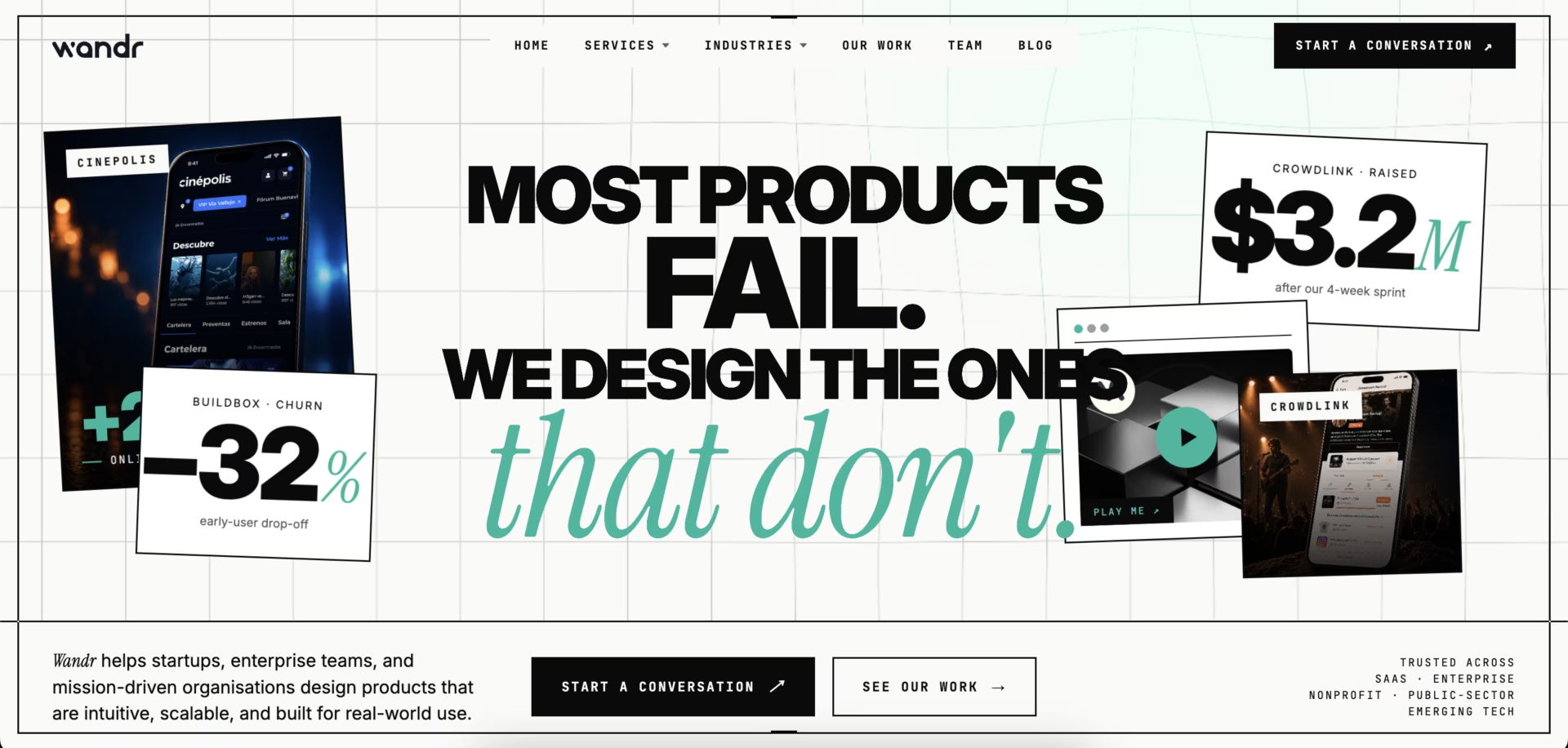
Strongest for: Early companies that need to vet a technically complex product before a larger engineering investment.
WANDR is a product design studio founded in Los Angeles in 2016, with teams in Silicon Valley, Austin, Miami, and Mexico City. It combines product strategy, user research, usability testing, and UI and design systems, and runs a dedicated MVP service built around an investor-ready prototype.
Its case study for Vectrix, a Y Combinator cloud security startup that Cloudflare later acquired, covers a nine-week engagement in which WANDR researched, redesigned, and tested the platform. That mix of research and rapid prototyping suits founders who still need to prove what to build before committing engineering budget to it.
Los Angeles, CA · $150 to $199/hr, from $25,000 · Clutch 5.0
Fuzzy Math: best suited to growing SaaS teams that need research-led UX
Strongest for: B2B and SaaS companies past their first release that need user research and interface design and already have their own engineers.
Fuzzy Math is a UX consultancy with offices in Chicago and Toronto, working since 2009 on consumer-grade design for B2B and enterprise software. UX UI design is 65% of its Clutch service mix, the highest on this list. For Clarix, a medical device startup at an early stage, it designed the product interface and first website ahead of launch.
It also designed WonScore, a new SaaS platform for Wonderlic, and runs an AI practice that assesses where AI fits a product before design starts. Most of its client roster is made up of established companies, and its projects end at handoff to development, so a startup needs its own engineers or a separate build partner.
Highland Park, IL (Chicago area) · $150 to $199/hr, from $25,000 · Clutch 4.9
ANML: best suited to growing teams building connected and emerging-tech products
Strongest for: Growing companies building connected-device, AI-powered, or spatial products that want senior designers doing the work.
Founded in San Jose in 2012, ANML is a senior-led studio that designs websites, digital products, and brands for B2B, AI, and emerging technology companies. Clients include ServiceNow, Ford, and Flock Safety. Its longest engagement shows its stage range: ANML worked with Yummly for over ten years, from startup to Yummly’s acquisition by Whirlpool.
Other work includes separate redesigns of the Whirlpool and KitchenAid appliance apps and an Apple Vision Pro version of BILT’s 3D instruction app. Web design is 40% of its Clutch work against 30% for UX UI, which makes in-app workflow samples the first thing a product team should request.
San Jose, CA · $150 to $199/hr, from $25,000 · Clutch 5.0
Goji Labs: best suited to growing companies that need design and engineering from one team
Strongest for: Funded companies that need product strategy, UX, and engineering working together as the product grows past its first release.
Goji Labs is a strategy-first product agency in Los Angeles, with a second office in New York, that puts product strategy, UX UI design, software development, and AI development in one team. Named work includes AnyMile, Mitsubishi’s drone logistics platform; a gamified app for Root Insurance; and an energy intelligence dashboard for TGS.
The integrated model matters once the product has paying users. At that point design decisions start to change the architecture underneath, and a handoff between two vendors can cost weeks. Its $50,000 minimum is twice the $25,000 most firms here ask, which fits a funded team with a roadmap longer than one release.
Los Angeles, CA · $150 to $199/hr, from $50,000 · Clutch 5.0
DOOR3: best suited to scaling companies putting AI into production products
Strongest for: Scaling companies that need design, engineering, and AI development from one firm, in fintech, insurance, legal, or similar products.
Founded in 2002 and headquartered in New York, DOOR3 is a technology consultancy with offices in Barcelona, Kyiv, and Zurich that combines UX design, software development, and AI services. For Dr.Treat, a veterinary care startup, it handled design and build from the first concept to MVP launch, and it runs a startup service for proofs of concept and scaling an MVP.
Its AI work includes agentic systems and two legal workflow agents of its own, ARIA and MIRA. Most named clients are large enterprises and delivery spans its European offices, so a startup will want the design lead and the working hours confirmed in the contract.
New York, NY · $100 to $149/hr, from $25,000 · Clutch 4.9
How we evaluated these agencies
The eight UX design agencies for startups here were checked against each agency’s own website and Clutch profile. Criteria were weighed for inclusion in this order: startup work published on the agency’s site, UX share, minimum project size and rate, and Clutch rating. UX share describes service mix and was used to place firms, not to score design quality.
Startup work was a yes-or-no check. Has the firm shipped live product work for startups, shown in case studies on its own website or in Clutch reviews a reader can open? Firms without it were left out, regardless of rating. Services, case studies, and industries come from each agency’s website, and claims we could not confirm there or on Clutch were cut.
Service mix explains the role each firm plays within its stage. Build-led firms such as thoughtbot and Designli fit a founder who needs a working product more than a research program, while Fuzzy Math’s 65% UX share fits a team that already has engineers. Our own entry spans the first release and growth because our startup engagements run from discovery to development handoff.
A note on authorship: we publish this guide to the best UX design agencies for startups, and we list Fuselab Creative first because our work is the closest match to this guide’s focus, taking a startup from a first prototype to a product that keeps working as it grows. Every entry, ours included, was checked against the same Clutch data and each agency’s own published work.
UX design agencies for startups compared
The table compares eight UX design agencies for startups on best fit, stage, pricing, UX share, location, industries, and Clutch rating. Rates run from $50 to $199 an hour with minimums of $10,000 to $50,000, and UX share, from 10% to 65%, shows whether a firm is design-led or build-led. It measures service mix, not design quality.
Pricing, location, and ratings from each agency’s Clutch profile. UX share is the part of a firm’s Clutch service mix listed as UX UI design. Industries come from each agency’s website. All data checked October 2026.
How to choose a UX agency for your startup’s stage
Choose a UX agency by matching it to the problem your stage creates: an unproven idea before the first release, a product that gets harder to use as it grows, or platform and AI complexity at scale. Then test the shortlist on who does the work, how it validates decisions, and what your company owns afterward.
First release. The risk is building too much of the wrong thing. Ask early when a real user will touch a clickable prototype and how many test sessions come before the first build decision. Nielsen Norman Group’s usability testing guide describes what a proper session looks like. Founder briefs are rarely complete, and a team that names a week and a session count is comfortable with that.
What to skip before the first release. A complete brand system, a full design system, and research across several user segments can usually wait until the product has paying users. Watch for a proposal that spends its first month on discovery documents and puts no prototype in front of a real user until month two.
Growth. The question changes from what to build to why the product is getting harder to use as it grows. Look for experience with information architecture, multi-role journeys, and a first design system. Nielsen Norman Group’s design systems guide is a useful benchmark for what that deliverable should contain. A team that treats the project as a visual refresh is likely to leave the structural problem in place.
What to skip during growth. When a growing product gets harder to use, we usually find the cause in navigation and information structure, so a full visual redesign rarely fixes it. Be wary of an agency that opens with mood boards before it has mapped the current user flows and read the support tickets behind them.
B2B SaaS companies at this stage face one more filter: role-based permissions, admin views, and onboarding for technical buyers. Our comparison of UX design agencies for B2B SaaS sorts firms by exactly that work. For consumer and hardware-connected products, shipped mobile work that survived several release cycles is usually the better signal.
Scale and AI-heavy products. By this point, one change touches several roles, an admin console, and often a mobile app, and AI adds screens where users act on recommendations or generated content. Ask the agency to show how it handled a wrong AI output in a shipped product: the confidence cue, the correction path, and what the user saw next.
What to skip at scale. A studio that only delivers screens, however polished, tends to hand back work that each product team then interprets differently. The red flag is a proposal with no plan for design system governance, accessibility, or how AI features show their confidence and let users correct the output.
Questions for the shortlist. We tell founders to ask every agency, ours included, who will lead the work day-to-day, since the senior people in a pitch are not always the ones designing. Ask how designers respond when engineering changes a design, and what research sat behind the case study you liked. Then ask whether code, design files, and research transfer to you in full after the first release.
Project, retainer, or hourly: how startups pay for UX design
Startups pay for UX design in three ways: a fixed-scope project with a set deliverable, a monthly retainer for ongoing design capacity, or hourly time and materials. A fixed project suits a defined first release, a retainer suits a product shipping every sprint, and hourly billing suits short audits or overflow work.
Fixed-scope projects. A fixed scope protects runway because the price is set before work starts, which is why prototype and MVP work is often sold this way. We sell fixed packages ourselves and still see the weak spot: when user testing shows the first idea was wrong, a fixed scope needs a change order, so ask how the agency handles a pivot before signing.
Retainers. A retainer buys a set amount of design time each month and fits a product past launch, where research, new features, and design system upkeep never stop. It works when the startup has a product owner who can feed the agency a steady backlog. Without one, retainer hours tend to drift into low-value polish.
Hourly billing. Hourly work at the $50 to $199 rates on this list suits a UX audit, a usability study, or extra hands during a crunch. It is usually the hardest model to budget for an open-ended build, so cap the hours for each phase in the contract and ask for a weekly report of hours used against that cap.
Conclusion
Start with the UX design agencies for startups in this guide that match the stage your product is in: first release, growth, or scale. Ask each agency at that stage to walk through a shipped project like yours, and get the ownership terms in writing before the first invoice. An agency that fits will answer with examples from its own work.
Frequently asked questions
How much do UX design agencies for startups cost?
UX design agencies for startups charge $50 to $199 per hour, based on the Clutch profiles of the eight firms in this guide, with minimum projects of $10,000 to $50,000. A first release usually sits near the minimum, while a multi-role platform redesign runs well above it.
Does a startup need a local UX agency?
Most startups do not need a local UX agency to get strong product work. Proximity helps with in-person workshops and early discovery sessions, but shipped work at your stage and in your product category usually matters more. A remote team with relevant AI or SaaS experience is usually a safer choice than a nearby generalist.
What UX design should a startup buy for its first release?
A startup preparing its first release usually gets the most from one validated workflow, delivered as a clickable prototype a real user can complete, plus the research that shows it works. A role matrix or multi-phase research program is premature before that workflow exists, and any design system at this stage should stay small: the handful of components the next release will reuse.
When does a startup need a different kind of UX agency?
Startups often outgrow their first design partner when onboarding stops working without a founder on the call, or when permission layers and multiple user roles appear. That usually happens as the product grows past its first users, and again at scale, when platform architecture and AI behavior become the main design problem.
How is a UX agency different from a web design agency for a startup?
A UX agency designs how the product itself works, through research, user flows, prototypes, and usability testing, while a web design agency builds the marketing site that explains and sells it. Many studios that rank as UX agencies are mostly web and brand shops, so check the service mix on a firm’s Clutch profile before hiring it for in-product work.
What should a startup own at the end of a UX engagement?
Startups are generally best protected when they own every design file, the design system and its documentation, research findings, and any code the agency wrote. Ownership belongs in the contract as a full assignment at handover, so the next designer or engineer can extend the product without going back to the agency for access.
What does stage fit mean when choosing a UX agency?
Stage fit means an agency’s process, team size, and minimum project match the problem a startup has at its current stage. In practice, a company before its first release needs fast research and a testable prototype, a growing company needs structure and a first design system, and a company at scale usually needs system-level design across roles, platforms, and AI features.