UI/UX Design for Startups: A Complete Guide for Beginners
UI/UX design for startups is not markedly different from design for other types of agencies, but if done right, they can be an magical differentiator. are known for their pace, the risks they work with, and the constraints they must make the best use of. Unlike established corporations, startups face a crunch of budgets and deadlines, not to mention the constant pressure to prove their viability and achieve rapid growth.
These challenges mean that for startups, quick iteration, efficient resource allocation, and the ability to pivot based on market feedback are must-dos. At the same time, there’s plenty of room for innovation, disruption, and building products from the ground up, without legacy systems or processes to bother about.
Add to that the vividly competitive landscape, and what startups need is a critical differentiator that can directly drive business success. The need of the hour is for startup founders and teams to get equipped with a head-to-toe success guide for UI/UX design, from its foundational principles to its practical application.
What Makes UI/UX Design for Startups an Urgent Priority?
The one precursor for startups that stand out and sustain is a brilliant product, one that is intuitive, efficient, and enjoyable to use. UI/UX design is a key enabler in this regard. It boosts user retention and conversion rates, guiding users effortlessly through key actions like sign-ups, purchases, or content consumption.
Beyond immediate metrics, a superior user experience also fosters strong brand loyalty. In no time, your brand’s casual users turn into loyal advocates championing your product and contributing to its organic growth.
But great UI/UX design for startups is no overnight wonder. It involves multiple detailed stages, beginning with the crucial initial discovery where you identify your users and their needs. It then goes on to cover strategic planning, detailed design and prototyping, rigorous testing, and finally, the vital post-launch activities of continuous improvement and scaling.
Once startups have a clear roadmap for embedding user-centric design into the brand’s DNA, they can ensure that their product not only functions well but also delights users at every touchpoint. The first step to this is sound design thinking.
Design Thinking for Startups
First things first, what is design thinking? Consider it a non-linear, iterative process that design teams use to understand users, assumptions, and problems, and come up with innovative solutions to prototype and test.
At its core, design thinking guides startups to innovate using a human-centered approach. It starts with a deep empathy for the people you’re designing for and ends with solutions tailored to their needs.
This brings us to its core principles:
- Understanding user needs (empathy)
- Generating a wide range of ideas (ideation)
- Building tangible representations of those ideas (prototyping), and
- Rigorously testing them with real users (testing).
In a way, design thinking moves beyond traditional problem-solving by focusing on the underlying human needs and desires. This makes it possible to come up with more effective and desirable products.
The Five Stages of Design Thinking Process for Startups
The design thinking process can be broken down into five stages, though these are in no way strictly sequential. Each stage often overlaps with another, or must be revisited from time to time. For startups, these stages provide a structured yet flexible framework to navigate the uncertainties of product development.
- Empathize: This involves immersing yourself in your users’ world to understand their experiences, motivations, and pain points, often through observation and interviews.
- Define: This is when you synthesize the insights from empathy to clearly articulate the core problem you’re trying to solve from the user’s perspective.
- Ideate: It involves brainstorming a wide range of creative solutions, encouraging divergent thinking without immediate judgment.
- Prototype: The stage transforms selected ideas into tangible forms, whether low-fidelity sketches or interactive mockups, allowing for hands-on interaction.
Test: This is where you put the prototypes in front of real users to gather feedback, validate assumptions, and identify areas for improvement, fueling further iterations.
Why Design Thinking is Crucial for
UI/UX design for startups requires design thinking much more than any other design methodology; it is a survival strategy. Design thinking is iterative in nature, and early user feedback plays a key role in mitigating avoidable risks when launching your product.
When you empathize with users and test prototypes early, you can validate ideas quickly and cost-effectively. This also saves your startup from the common pitfall of building something nobody wants.
Another benefit is in the form of fewer chances for costly failures down the line. The ideation phase encourages out-of-the-box thinking and ultimately, innovation. This single factor can differentiate your startup in a crowded market. It shifts the focus from simply building features to solving real user problems in a way that’s unique and appealing.
Adapting Design Thinking for Lean & Agile Environments
While design thinking provides a complete, step-by-step framework itself, startups often need to adapt it to fit their lean and agile operational models. The focus is less on extensive documentation and more on rapid experimentation and continuous learning.
Instead of separate and unnecessarily long phases, designers can integrate elements of design thinking here. For instance, “Empathize” and “Define” might become ongoing activities, “Ideate” could be a quick brainstorming session before a sprint, and “Prototype” and “Test” are integrated directly into the sprint cycle, with user feedback informing the very next iteration.
The iterative feedback loops of design thinking, coupled with the speed and flexibility of lean and agile development within a startup environment, help bring products to market quickly and efficiently. Just remember to maintain a human-centric approach through all of that.
Phase 1: Foundational Research and Discovery
While the fundamental concepts of design thinking for startups transcend to all aspects of design, it is time to bring our focus back to what makes user experience design for startups successful.
Contrary to popular view, a startup’s road to product success doesn’t begin with lines of code or beautiful interfaces. It starts with a deep, empathetic understanding of the people you want to serve.
This is the foundational phase, what we can term “Research and Discovery”. It is arguably the most critical step when embarking on UI/UX design for startups. It is here that you challenge assumptions, unearth real user problems, and define the very essence of your product’s purpose.
Here’s how:
Define Your Target Audience
The cornerstone of any successful product is a deep understanding of its users. This initial phase demands a rigorous effort to define exactly who your target audience is. Go beyond simple demographics and look into their psychographics, behaviors, motivations, and pain points.
The first building block of this process is the creation of detailed user personas. Think of these personas as semi-fictional representations of your ideal users, together with their goals, frustrations, and daily routines. Alongside personas, categorize users into distinct groups with audience segmentation. This can help tailor UI/UX design for startups and marketing efforts more effectively to address their specific needs and preferences.
Uncover User Needs and Pain Points
Once your target audience is broadly defined, the next step is to understand their specific needs, desires, and, most importantly, their pain points related to the problem your startup aims to solve.
You can use various qualitative and quantitative research techniques at this stage. In-depth user interviews provide rich, nuanced insights into individual experiences and perspectives, while surveys can gather broader quantitative data from a larger user base.
Tools like empathy maps help startups visualize and internalize what users are thinking, feeling, seeing, and doing. This proves critical in fostering a deeper sense of empathy that will inform every subsequent design decision.
Learn and Differentiate from Competitors
While focusing on your users is paramount, it is equally important to understand the existing solutions and landscape. Competitor analysis involves thoroughly examining direct and indirect competitors to identify their strengths, weaknesses, and the user experiences they offer.
Keep in mind that this process is not about imitation. Rather, it’s about learning what works, what doesn’t, and identifying unmet needs or gaps in the market that your startup can uniquely fill. Say, when looking for landing page design tips for startups, local competitor research can prove handy.
Taking the time to understand the competitive environment can place your offering strategically ahead, highlight your unique value proposition, and avoid common pitfalls that others encounter along the way.
Article The Problem and Value Proposition
It is also important for startups to have clarity on the problem it is solving and the unique value they bring to the table before diving into solutions. Start by concisely articulating the core problem statement. The key is ensuring that everyone on the team understands the fundamental challenge users face.
Hand-in-hand with this, you must define your value proposition, a clear statement of the benefits your product will deliver to users. Explain why they should choose your solution over alternatives. This foundational clarity serves as a guiding star throughout the entire design and development process, ensuring all efforts are aligned with solving a real problem effectively.
Set Measurable Design Goals and KPIs
Establishing measurable design goals and Key Performance Indicators (KPIs) from the outset goes a long way in ensuring that your UI/UX design for startups efforts are impactful and aligned with business objectives.
The goals of custom UI/UX design for startups should be specific, achievable, and directly tied to improving the user experience. Think “reduce user onboarding time by 20%” or “increase feature adoption by 15%.”
Then, track progress and objectively assess the success of your design interventions using corresponding KPIs. Examples include task completion rates, bounce rates, conversion rates, or time on task. With this data-driven approach, startups can ensure that design decisions are not based on assumptions but on tangible evidence of user behavior and business impact.
Phase 2: Strategy and Information Architecture
Now that you have a clear understanding of your users and their needs from the discovery phase, the next step is to translate those insights into a coherent and intuitive product structure. “Strategy and Information Architecture” is where the blueprint for your user experience takes shape.
This phase is about organizing content, mapping out user journeys, and making critical decisions about what core features will form your Minimum Viable Product (MVP). Think of it as the bridge between raw user data and actionable design. Such a strategy is critical for ensuring that your product has a robust, user-friendly, and aligned underlying structure.
This is how it rolls out:
Map User Journeys and Flows
With a solid understanding of your users and their pain points as your base, move on to visualizing their entire interaction with your product and brand. User journey mapping involves charting the complete path a user takes, from their initial awareness of your product through their first interaction, repeated use, and potentially, becoming an advocate.
Try to identify every touchpoint, action, emotion, and potential roadblock users might encounter, say, when making a creative website design for startups. Map these journeys and detailed user flows (specific paths for completing tasks), to be able to pinpoint opportunities, optimize the experience, remove friction, and ensure a smooth, intuitive progression towards your goals.
Structure Content for Intuitive Navigation Design
Effective information architecture (IA) is the backbone of a user-friendly product. This involves thoughtfully organizing and labeling your product’s content and features in a logical and intuitive manner.
A well-structured IA ensures that users can easily find what they’re looking for, understand where they are within the product, and anticipate where they need to go next. This directly impacts navigation design, which should be clear, consistent, and easy to use.
You may use menus, search functions, or contextual links for structure. For startups, a strong IA prevents user frustration, reduces cognitive load, and enables efficient task completion, all of which are must-haves for early adoption and retention.
Prioritize Features from a UX Perspective
Startups often face the challenge of having many ideas but limited resources. This is where the need to prioritize features and define the Minimum Viable Product (MVP) from a user experience perspective comes into play.
Imagine you are building a design for SaaS startups. An MVP in this case isn’t just about the bare minimum functionality. Instead, it helps you deliver the core value proposition with the best possible initial user experience. Begin by prioritizing features that directly address the most critical user pain points and deliver strong value. Defer the less critical features for future iterations.
By focusing on a well-designed MVP, you will be able to launch quickly, gather real-world user feedback, and iterate based on actual usage. There would be no need to spend excessive time and resources on features that may not resonate with the market.
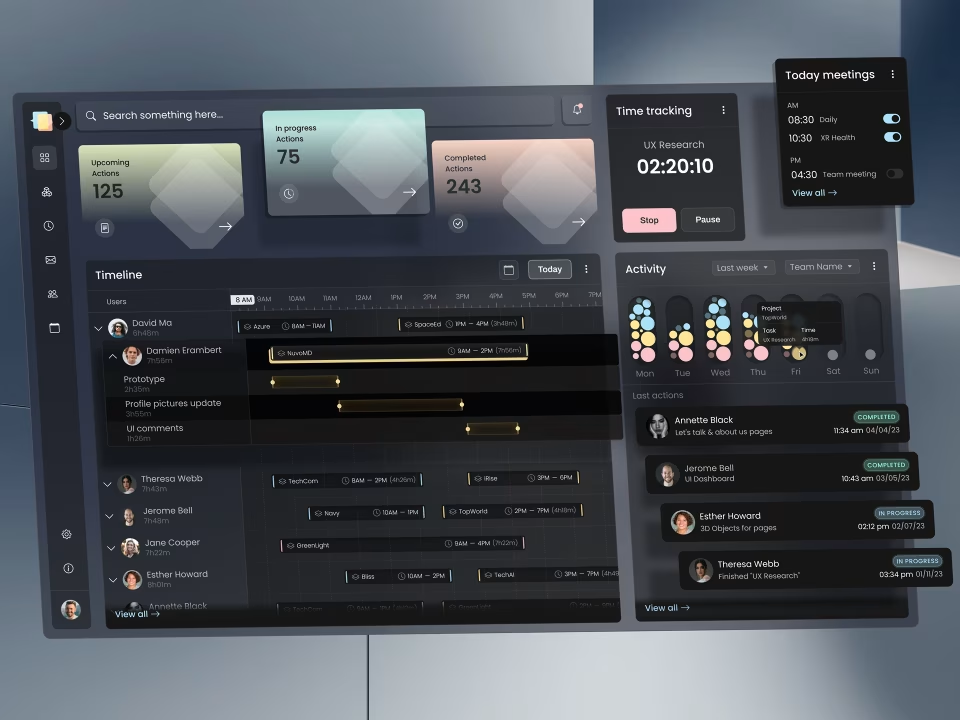
Phase 3: UI/UX Design for Startups and Prototyping
Once the strategic groundwork is laid, the “Design and Prototyping” phase brings your product vision to life. This is where you move from abstract ideas to tangible, interactive experiences.
Focus on blending creativity with functionality at this stage, refining the visual and interactive elements of your product. Here’s the flow: rough sketches and wireframes to define basic layouts, moving on to interactive mid-fidelity mockups simulating user flows, and finally to polished high-fidelity interfaces.
Each step helps visualize and refine the user’s interaction.
Low-Fidelity Product Design for Startups
Once the strategy is in place, the design process begins with low-fidelity methods. The focus here is on speed and concept validation over visual polish.
This stage typically involves sketching on paper or using digital tools for wireframing. Wireframes are schematic representations of a product’s interface, focusing solely on layout, content structure, and basic functionality, without any visual styling.
The goal here is to quickly visualize different ideas for screen layouts and user flows, test basic navigational concepts, and gather early feedback on the fundamental structure before investing time in detailed visual design. It is an iterative approach that makes room for rapid testing and refinement of core concepts.
Mid-Fidelity Prototyping
Building upon low-fidelity designs, mid-fidelity prototyping introduces a greater level of detail and interactivity. These prototypes are interactive mockups that accurately represent the user interface elements, content, and navigational paths, allowing users to click through and experience the product’s flow. Say, a mock mobile app design for startups.
While still not fully polished visually, mid-fidelity prototypes enable more realistic usability testing. You can identify issues with interaction patterns, navigation logic, and overall user flow. It is also critical for validating the user experience before committing to high-fidelity visual design and development, saving you much time and resources by catching potential problems early.
High-Fidelity UI Design
High-fidelity UI design is where the product comes to life visually. It is here that you apply all the aesthetic elements that define your brand and create a polished, engaging user interface.
Designers focus on typography, color palettes, iconography, imagery, and overall visual style, ensuring consistency with the startup’s brand identity. Every pixel is considered to create an appealing and professional look that instills trust and delight in users.
The detailed visual design in this stage transforms the functional prototype into a near-final product, ready for development. You have basically readied a cohesive and attractive experience that stands out in the market.
Develop a Lean Design System
For startups, maintaining design consistency and efficiency as the product evolves is paramount. Developing a lean design system addresses this need by creating a centralized library of reusable UI components, patterns, and guidelines.
This system includes elements like buttons, input fields, navigation bars, and typography rules, all documented with their intended use cases. A design system ensures that all team members, from designers to developers, are working with a consistent set of building blocks.
With a lean design system, it is not just the design and development process that takes off. It also ensures a cohesive user experience across all product touchpoints, making it easier to scale and onboard new team members.
Ensure Accessibility and Inclusivity
Designing for accessibility and inclusivity means creating products that can be used effectively by the widest possible range of people, including those with disabilities.
The benefits of deploying expert startup UI/UX design strategies with accessibility and inclusivity are essential. You are not just ticking off regulatory requirements, but designing with a moral imperative while broadening your potential user base.
From day one, startups should integrate accessibility considerations into their design process, think about sufficient color contrast, alternative text for images, keyboard-navigable interactive elements, and clear, readable content. By prioritizing inclusivity, you are essentially building a more robust, user-friendly, and socially responsible product that serves everyone.
Phase 4: Testing, Feedback, and Iteration
No matter how well-researched or thoughtfully designed a product may be, its true effectiveness can only be validated by real users. The “Testing, Feedback, and Iteration” phase is where designs are put to the ultimate test.
Think of it as a continuous cycle where you observe how users interact with your prototypes or product, actively gather their insights, and then use this invaluable feedback to refine your designs. The iterative approach is among the design essentials for startups, relying on empirical evidence instead of assumptions. They can quickly identify and rectify usability issues, validate design decisions, and continuously improve the user experience.
Here’s what this phase involves:
Usability Testing
Even the most well-researched and thoughtfully designed product can have unforeseen usability issues. This is where usability testing becomes invaluable.
It involves observing real users as they attempt to complete tasks using your prototype or product. There are two methods you can use:
- Moderated in-person sessions, where you guide users and ask questions
- Unmoderated remote tests, where users complete tasks independently.
The goal is to identify pain points, confusion, and areas where the design falls short of user expectations. For startups, conducting usability testing early and often, even with low-fidelity prototypes, can help catch critical flaws before investing significant development resources.
Gather and Prioritize Feedback
Usability testing is one form of feedback, but a comprehensive approach involves collecting insights through various qualitative and quantitative channels.
- Qualitative feedback comes from direct user interactions, interviews, open-ended survey questions, and observations, providing rich context and “why” behind user behaviors.
- Quantitative feedback, on the other hand, comes from analytics, surveys with rating scales, and A/B tests, providing measurable data on “what” users are doing.
Tech startups can then proceed to prioritize the gathered feedback based on its impact on user experience, business goals, and feasibility of implementation. Not all feedback can be acted upon immediately, so a systematic approach to prioritization ensures resources are allocated effectively.
Iterative Design
Design is never truly “finished”. It is a continuous, cyclical process. The insights gained from testing and feedback fuel the next round of design iterations.
Think of it as a loop of refining existing designs based on new information, re-testing those refinements with users, and then further improving the product. This agile approach is particularly suited to startups, as they can adapt quickly to user needs, market changes, and emerging technologies.
Besides, the cycle of refinement, re-testing, and improvement helps startups continuously improve their product’s usability, desirability, and overall effectiveness, so it evolves alongside its user base.
Phase 5: Implementation and Post-Launch UX
All the rigorous research, strategic planning, and iterative design you have put in so far ultimately lead to the “Implementation and Post-Launch UX” phase.
This is where your designs transition into a live, functional product, and the real-world user journey truly begins. And yet, we do not consider it an endpoint. Instead, think of it as a new beginning, bringing the product to market and the critical activities that follow its launch are no small feat, after all.
From ensuring accurate design handoffs to developers to continuously monitoring user behavior and performance, design experts can ensure your product thrives and evolves in the user’s hands.
Seamless Collaboration with Developers
The transition from design to development is a critical juncture. It is also prone to miscommunication that can lead to delays and discrepancies between the intended design and the final product.
Seamless collaboration between UI/UX designers and developers is thus paramount. Clear design handoffs are a must, where all assets, specifications, interaction details, and responsive behaviors are meticulously documented.
Best practices include using shared tools (like design-to-code platforms), maintaining open communication channels, conducting regular sync-up meetings, and ensuring designers are available to answer developer questions throughout the implementation phase. Effective teamwork at this stage ensures that the user experience envisioned by the design team is accurately translated into functional, high-quality code.
Post-Launch Monitoring
Post-launch monitoring involves continuously collecting and analyzing data on how users interact with the live product.
Web and app analytics tools provide quantitative insights into user flows, popular features, drop-off points, and conversion funnels. A/B testing allows startups to experiment with different design variations to see which performs better in terms of user engagement and business metrics.
Besides, user behavior tracking through workflows, heatmaps, session recordings, and event tracking offers deeper qualitative insights into how users navigate and interact with specific elements. Consider this data-driven approach as crucial for identifying real-world performance issues and opportunities for optimization.
Continuous Improvement and Scaling UX for Growth
As a startup grows, its user base expands, and its product evolves, the UX must also scale and adapt. Continuous improvement is an ongoing commitment to refining the user experience based on the insights gathered from post-launch monitoring and evolving user needs.
This might involve introducing new features, optimizing existing flows, or redesigning sections of the product. UI/UX design for startup’s growth also means ensuring that the product design system remains robust, that new features are integrated cohesively, and that the user experience remains consistent and delightful even as the product becomes more complex.
For startups, this forward-looking approach ensures that UX remains a competitive advantage, supporting sustained growth and user satisfaction.
Beyond the Launch: Continuous UX Optimization
Launching your product is a significant milestone, but it’s also the start of an ongoing journey. You must ensure that your product remains relevant, performs optimally, and continues to delight users long after its initial release.
Let’s see how.
Deep-Dive into UX Metrics
While Key Performance Indicators (KPIs) provide a high-level view of product success, a truly effective post-launch strategy requires a deeper dive into specific UX metrics.
Beyond conversion rates and retention, startups should actively track qualitative metrics that shed light on the why behind user behavior. This includes user satisfaction scores (CSAT), Net Promoter Score (NPS) to gauge loyalty, and System Usability Scale (SUS) to measure perceived ease of use.
You may also use behavioral analytics tools for insights into user flows, click paths, and time spent on specific features. Combine these quantitative and qualitative data points for a nuanced understanding of your product’s branding performance and pinpoint exact areas for improvement that basic KPIs might overlook.
Leveraging User Feedback Loops for Iteration
After your product’s launch, continuous improvement hinges on establishing robust user feedback loops. This is why startups should implement systematic ways to collect, analyze, and act on ongoing feedback from their live users.
In-app feedback widgets are a great option. You may also use targeted surveys at key moments in the user journey, direct outreach to users who experience issues, and closely monitor customer support tickets for recurring pain points.
The goal is to create a constant stream of insights that can directly inform the product roadmap and design iterations. You will find that actively listening to users and showing them how their feedback is valued and acted upon helps build stronger, loyal communities. Our data visualization project POGO, is a great example of strong user connect.
A/B Testing & Experimentation
Continuous UX optimization, A/B testing, and other forms of experimentation are indispensable tools post-launch.
In this stage, you create two or more versions of a design element (e.g., a button color, headline, or entire page layout) and show them to different segments of your user base. The aim is to determine which performs better against a defined metric.
With this data-driven approach, you can remove guesswork from design decisions, validate what resonates most with their users, and drive desired behaviors at the same time.
Beyond simple A/B tests, multivariate testing and other experimental designs can help optimize complex interactions. Every design change is backed by empirical evidence of its positive impact on the user experience and business outcomes.
UI/UX Design for Startups Strategies: Some Unique Considerations
Now that we have discussed the core principles of UI/UX design, which apply universally, we must acknowledge the distinct set of challenges and opportunities before startups that call for a tailored approach.
Long story short, adapting traditional UX methodologies to a fast-paced, resource-constrained environment is key. Startups must master building impact and user experiences despite their many limitations, turning constraints into catalysts. Here’s how:
Embracing Lean UX and Agile Methodologies
Startups operate in an environment where speed and efficiency are paramount. Traditional, lengthy UX processes can often be too slow and resource-intensive for their rapid development cycles.
This is where Lean UX and Agile methodologies step in.
Lean UX focuses on creating just enough design documentation to move forward. The focus is on rapid experimentation, continuous feedback loops, and close collaboration with development teams. Integrating UX activities directly into agile sprints helps startups ensure a quick design process, frequent testing, and continuous iterations. This helps them adapt to market demands and user feedback with agility.
Budgeting for UI/UX
One of the most significant constraints for startups is often a limited budget. When it comes to UI/UX design for startups, this means smart allocation of funds is crucial to maximize impact.
Instead of investing heavily in every possible design tool or extensive user research from day one, startups should prioritize essential tools that offer the best value, leverage free or low-cost research methods (like guerrilla testing or online surveys), and focus on iterative improvements rather than a single, large-scale design overhaul.
Strategic budgeting for UI/UX involves understanding where the most significant user experience gains can be made with the available resources, ensuring that every dollar spent contributes directly to a better product and stronger user engagement.
Building vs Hiring vs Outsourcing
Acquiring the right UI/UX talent is a critical decision for any startup. There are generally three main approaches: building an internal team, hiring individual designers, or outsourcing design work to agencies or freelancers.
Building an internal team offers deep product knowledge and seamless collaboration, but requires significant investment in salaries and infrastructure. Hiring individual designers allows for flexibility and integration, but it can be challenging to find the right fit.
On the other hand, outsourcing a UI/UX design agency for startups can provide specialized expertise and scalability without the overhead of full-time employees. All you need is careful management to ensure alignment with the startup’s vision. Ultimately, the best choice depends on the startup’s stage, budget, and specific design needs.
The Founder’s Role in Championing UI/UX
While a dedicated design team is vital, the ultimate success of UI/UX design for startups often hinges on the founder’s commitment and advocacy. Founders must understand that UI/UX is not merely about aesthetics. It is a strategic business function that directly impacts user acquisition, retention, and brand perception.
Founders who champion good design from the top foster a user-centric culture throughout the organization, ensuring that design considerations are integrated into every decision-making process, from product strategy to marketing. Their active involvement and belief in the power of great design can inspire the entire team to prioritize the user experience, making it a core competitive advantage.
Fostering a UX-Centric Culture in Your Startup
The most impactful UI/UX design for startups doesn’t solely reside within the design team; it permeates the entire organization. Embedding empathy and a user-first mindset across every department is paramount because the user experience is everyone’s responsibility.
Cultivating a collective commitment to the user within your startup is what can ensure that every decision, from product development to marketing, ultimately contributes to a superior and cohesive user experience. Let’s see how.
Making UX Everyone’s Responsibility
While dedicated UI/UX designers are crucial, true user-centricity in a startup thrives when it becomes a shared responsibility across all teams. This means fostering an environment where product managers, engineers, marketers, sales teams, and even customer support view themselves as advocates for the user experience.
Cross-functional collaboration is key: designers should work hand-in-hand with developers from the earliest stages, marketing should understand user pain points to craft relevant messaging, and sales teams can provide invaluable insights from direct customer interactions. When every department understands and contributes to the user experience, the product becomes more cohesive, effective, and truly user-focused.
Advocating for the User
In a startup, UI/UX design trends are not all about making things look pretty or easy to use. They also help ensure that user needs are at the very core of product strategy.
UX professionals, or founders with a strong UX mindset, must actively advocate for the user in strategic discussions, challenging assumptions, and bringing user research to the forefront of decision-making. They must drive what features are built, how they are prioritized, and even what problems the startup chooses to solve.
Ensuring that user insights drive strategic choices can help startups avoid building features that no one needs and instead focus on creating solutions that genuinely resonate with their target market. This paves the way for greater product-market fit. Our project Bearn Expertise is a great example, coming from a place of strong UX design thinking.
Building Empathy Across Teams
For a user-centric culture to flourish, helping non-designers build empathy for the end-user is of utmost importance. This can be achieved through various practical methods that expose team members to real user experiences.
Conducting empathy workshops is one such method, where teams collaboratively create user personas or empathy maps. Alternatively, you may invite team members from all departments to observe usability testing sessions or listen to recorded user interviews provides direct exposure to user frustrations and delights.
Even simple activities like sharing user feedback snippets in team meetings or creating “user of the week” profiles can significantly increase empathy across the organization. They ensure that every team member understands the human impact of their work.
Future-Proofing Your Startup’s UI/UX
With the fundamentals in place, we must also acknowledge that the digital landscape we live and work in is rapidly accelerating. In this scenario, a startup’s longevity and success depend not just on current relevance but on its ability to anticipate and adapt to future changes.
This calls for startups to design for tomorrow’s challenges and opportunities. And how do they do this? By understanding emerging technological trends, building scalable design systems that can grow with the product, and maintaining a proactive approach to evolving user needs.
Only strategic planning for the future can guarantee that the startup’s user experience remains cutting-edge, resilient, and continuously aligned with the ever-changing expectations of its audience. Here’s what this involves:
Anticipating Trends
The digital landscape is constantly evolving, and for a startup’s UX to remain relevant, it must be future-proofed by anticipating emerging trends and technologies.
Personalization, for instance, is no longer a luxury but an expectation. Designs must adapt to individual user preferences and behaviors. The rise of Artificial Intelligence (AI) and Machine Learning (ML) is also increasingly impacting UX, from intelligent chatbots and predictive interfaces to data-driven content recommendations.
Startups should keep an eye on these and other emerging technologies (like AR/VR, voice interfaces, or blockchain) to understand how they might shape future user interactions. Proactively integrating them where they offer genuine value will ensure that your product remains cutting-edge and competitive.
Designing for Scalability
As the startup grows, your product will inevitably become more complex, and the user base will expand. This is what makes designing for scalability so important from the outset, you can prevent the UX from becoming unwieldy or inconsistent.
Here’s what this involves:
- Building modular design systems to create and maintain UI components effectively
- Adopting adaptable frameworks and architectural patterns, so new features can be integrated without disrupting the existing user experience.
A scalable UX approach means that the design can gracefully accommodate increased data, more complex user flows, and a larger variety of user needs. This allows the product to grow without requiring a complete overhaul down the line.
Evolving User Needs
User needs are not static. They evolve with changing technologies, societal shifts, and new market offerings. For a startup to maintain its product-market fit and long-term relevance, its UX strategy must account for this dynamic nature.
This requires a commitment to continuous user research, not just at the initial discovery phase, but throughout the product’s lifecycle. Regularly re-evaluate user personas, conduct market trend analysis, and stay attuned to competitor innovations. Proactively assess how user expectations are shifting and adapt the product’s UX accordingly.
This is the only way to ensure that your startup continues to provide value, your product remains desirable, and you stay ahead of the curve in an ever-changing digital landscape.
Conclusion on UI/UX For Startups
Expert UI/UX design for startups is now an essential service area, and is no longer just an option but a non-negotiable imperative for startups aiming for sustainable growth. Right from the foundational research that defines your users and their needs, through the strategic planning of information architecture, and into the iterative process of design and prototyping, UX/UX for startups is a multi-faceted, multidisciplinary, and complex process.
Not to mention the crucial phases of testing, feedback, and continuous improvement, which help implement and optimize post-launch. If we had to summarize in a nutshell, user-centricity is absolutely critical from day one, building upon continuous iteration driven by real user insights.
And still, at the end of the day, the startup ecosystem is unfairly crowded today, with ideas abundant but execution often faulty. In this scenario, exceptional UI/UX can give your brand a much-needed competitive advantage. Think of it as the silent force that converts casual browsers into loyal users, reduces customer support inquiries, and amplifies word-of-mouth referrals.
Investing thoughtfully in design with a partner like Fuselab Creative would mean that you need not bother about the iterative process on your own. Our UX team can do all the background work to help and truly understand your users, so you end up building much more than just a product, an experience that resonates deeply, solves real problems, and fosters lasting connections. Connect with us today and learn how UI/UX design for startups can be the cornerstone of your success.