11
min read
11
min read
 May 2, 2025
AI Dashboard Future-proofing Business Analytics: Design, Applications, and Latest Trends
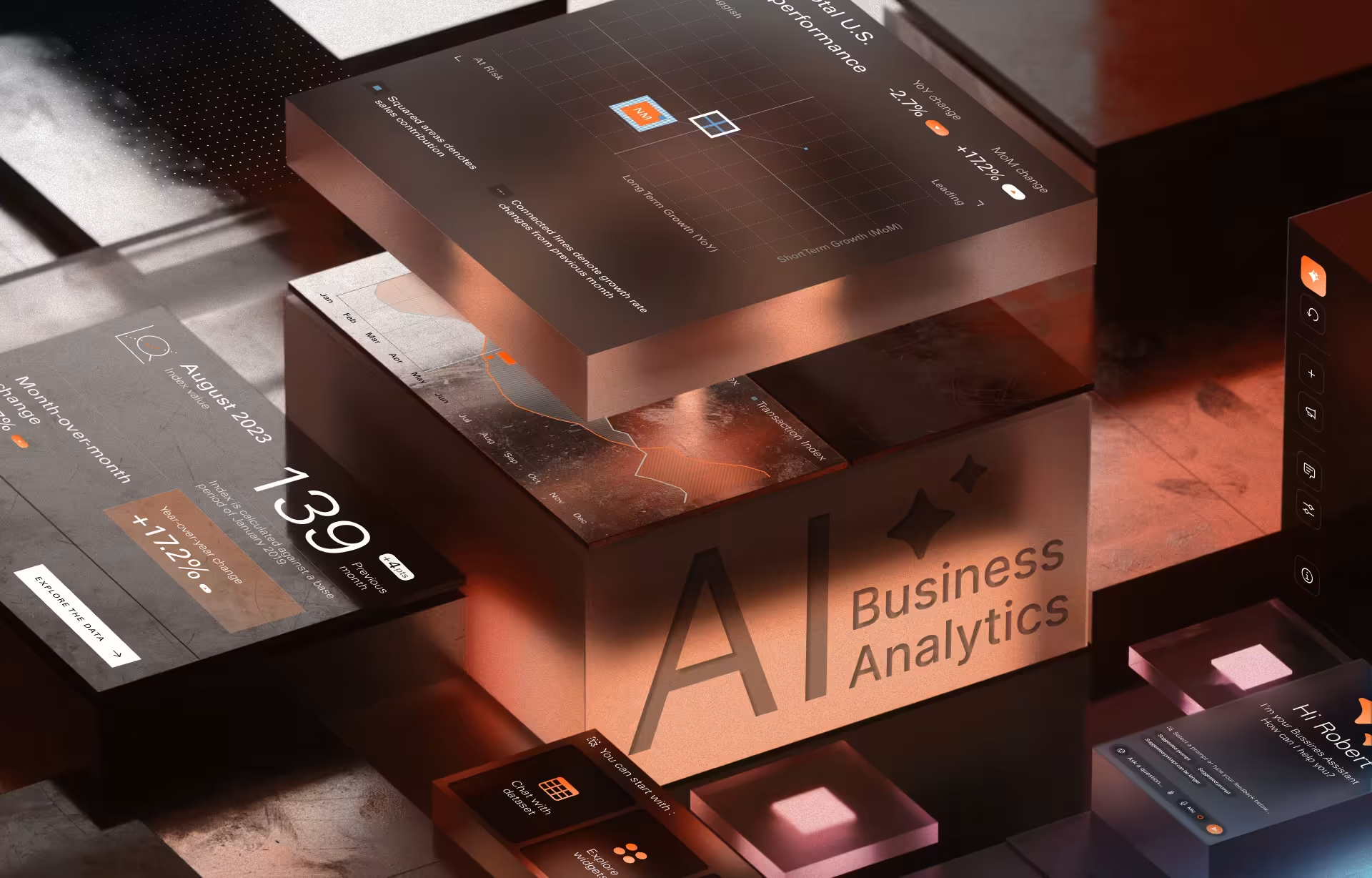
It’s 2025, and business analytics dashboards are creating a huge following. The business landscape is awash with data. The challenge lies in being able to extract meaningful insights from this deluge of information and media splashed in front of our eyes every second of every day. This is where a business analytics dashboard comes to the rescue. Studies suggest that over 42% of companies worldwide are investing in AI to improve product/service quality. The stark figure underscores just how dependent businesses have become on AI when it comes to critical decisions.
In this light, the AI dashboard emerges as a pivotal tool that goes beyond simple data visualization to analyzing, interpreting, and presenting information in a user-friendly format that is immediately informative and equally actionable. Think of it as an intelligent interface that does it all – real-time data monitoring, predictive analytics, automated report generation, and your most trusted colleague when it comes to decision-making support.
AI dashboards have been nothing short of transformational in almost any industry you can think of. From static charts to dynamic interactive tools, their increasing sophistication is helping uncover hidden patterns and trends like never before. Businesses, therefore, must understand and incorporate the offerings they offer at the earliest.

The Power of AI in Dashboard Design
Traditional dashboards get a much-needed facelift with AI, thanks to components like intelligence and automation. While conventional dashboards present static data, the AI data dashboard actively breaks down information for you and includes actionable insights and predictions. There’s so much this powerful and nimble tool has to offer.
For one, data interpretation has received a next-level boost. These systems can automatically identify patterns, anomalies, and correlations that human analysts might have missed. Second, with automated insights and real-time predictions in place, users can anticipate future trends for proactive decision-making.
Personalization of user experiences is another massive benefit and among the top UX/UI design trends. AI can tailor dashboards to individual roles and preferences. AI-driven automation also helps streamline data analysis, making it faster, more efficient, and more accurate.
Key Components and Features of an AI Dashboard
The true power of an AI dashboard lies in the components that make data comprehension so much better. Let’s look at what these are:
#1 Analytics
At the core of the business analytics dashboard is the analytics engine, including predictive analytics and forecasting. Using machine learning (ML) to anticipate future outcomes, the AI analytics dashboard enables anomaly detection and alerts for potential issues and opportunities in real-time. Its Natural Language Query (NLQ) feature allows users to ask questions in plain language, so there’s no need for complex, code-based queries.
The advent of Explainable AI (XAI) is another key trend. XAI offers transparent insights into how AI models end up with specific answers/outcomes. This means that users have both raw data and actionable intelligence at hand, which boosts decision-making to the next level.
#2 Data Visualization
Complementing AI’s analytical power is the data visualization layer. Put simply, this layer helps present all the amazing intel in a format that’s both visually appealing and easy to understand. Think AI-powered chart recommendations so you can choose which data to present how considering clarity and impact. Or consider dynamic and interactive visualizations that can be used to explore data from multiple perspectives.
Real-time data streaming is another interesting feature, especially in business. Data is no longer a table or a graph idling away in a folder. Instead, it can be presented in a clear, understandable way with a responsive view. For instance, Grid AI uses an intuitive interface for users to track their experiments, deal with data issues, and determine success – all from the same dashboard.
#3 Automation and Personalization
What makes a dashboard with AI truly indispensable is the automation-personalization component. Teams can now automate report generation for routine tasks, so they have much more time for strategic jobs. Dashboards can also be customized per user roles and preferences, which means each user gets only the most relevant information instead of the complete set.
This also includes smart alerts and notifications that can be set up for prompt action. All these features come together for a truly personalized and efficient experience with three-fold benefits – fast, effective, and informed business decisions.
UX/UI Considerations for AI Business Analytics Dashboard Design
While all these features are great, they only come together with great UX/UI design. The idea is to minimize cognitive load, so users can focus on analysis instead of struggling with navigation or interpretation.
Here are a few important considerations:
- Display information in a clear, simple manner, and let go of any unnecessary clutter.
- Use visual hierarchy effectively to guide the user’s eye, highlighting the most critical data points for quick comprehension.
- Incorporate responsive design so the dashboard looks and feels consistent across various screen sizes.
- Make sure users with disabilities can fully interact with and understand the data.
Effitrack, as a good example from our portfolio, unlocks hidden patterns and opportunities for energy savings with a seamless data dashboard using the same principles.
How to Create a Dashboard Using AI
A structured approach is key to building an effective AI dashboard. Here’s a step-by-step guide:
Step 1: Integrating and Preparing Data
Consolidate, clean, and transform data from all available sources into a format suitable for AI analysis. A few key principles to focus on at this stage are data consistency, handling missing values, and data structuring for efficiency.
Step 2: Selecting the Right AI Algorithms
The choice of algorithms depends on the specific business analytics dashboard goals you have in mind – Predictive modeling, anomaly detection, or natural language processing. Let’s take an example here – time-series forecasting calls for recurrent neural networks while anomaly detection may use clustering algorithms, and so on.
Step 3: Designing Dashboard Layout and Visualizations
Once the data and algorithms are in place, the next stop is AI dashboard design. The focus should be on creating intuitive interfaces that can communicate data insights effectively. Use clear and concise charts, visual hierarchy, and responsive design for the best outcomes.
Step 4: Implementing AI Functionalities
This is the core of the AI dashboard. Integrate features like Natural Language Query (NLQ) to enable conversational data exploration – this way, users can use the platform with simple commands. Predictive analytics is another important feature for forecasting future trends. This step calls for meticulous coding and configuration for accurate, seamless results.
Take a look at our Robodog AGV project for instance, which is an application that is revolutionizing warehouse automation with real-time AI insights and intuitive controls.
Step 5: Testing and Iteration
Finally, dashboard effectiveness only comes from testing and iteration. User feedback is invaluable, and there are several tools and platforms to this end. Cloud-based AO services, for instance, offer pre-built algorithms and development environments. Such resources are key to optimizing the dashboard for usability and performance.
Using AI Business Analytics Dashboards: Applications, Benefits, and More
The primary benefit of an AI dashboard is its versatility – hence the vast number and types of applications that stem from it. Let’s see some core and expanded applications.
Core Solutions of an AI-Based Business Analytics Dashboard
Data-driven insights from artificial intelligence business analytics dashboards drive the operational success of SaaS platforms. SaaS business models rely heavily on recurring subscriptions and user engagement, which makes it important to analyze and predict customer behavior on the go. AI SaaS dashboards do just that and much more.
First, they facilitate customer behavior analysis by predicting churn and identifying engagement patterns. Businesses can thus proactively address potential issues and tailor services as per customer needs.
Next, they streamline subscription management by forecasting renewals and optimizing pricing strategies. This helps the SaaS provider monitor key performance indicators like user adoption and feature usage, imperative to continuous improvement.
Expanding the Scope
Building upon the customer-centric fundamentals of an AI SaaS dashboard, the application can be extended to the broader business intelligence (BI) context. Here are some examples:
- Market and sales analysis: The analytical principles in SaaS environments can be scaled up to predict campaign effectiveness, identify target demographics, and optimize market strategies.
- Financial performance monitoring: AI-based dashboards can help forecast revenue and detect financial anomalies for financial stability.
- Supply chain management: Dashboards can optimize logistics and predict demand fluctuations, thus streamlining operations.
Specialized Applications
While these were all general business applications, dashboard AI has also stepped up the game in sectors with unique and critical needs.
Healthcare is the biggest example. The core dashboard principles of predictive analysis and real-time monitoring transform into improved patient care and resource management. predictive risk assessments and tailored treatment plans can significantly enhance patient monitoring and diagnostics. Resource management gets an uplift with patient influx predictions and efficient allocation of hospital beds.
Manufacturing is another example, where predictive maintenance and quality control helps ensure product excellence. Similarly, AI-based dashboards enable fraud detection and algorithmic trading in the finance sector, maximizing returns. In education, they support student performance prediction and resource allocation so institutes can function better overall.
AI Business Analytics Dashboard Design Trends
At the end of the day, AI-generated business analytics dashboard design is a dynamic, evolving field. Emerging technologies and shifting user expectations are constantly shaping and reshaping the what and how of these intelligent interfaces. It, therefore, becomes important to keep a tab on the latest dashboard advancements; here are some highlights:
- The integration of Augmented Reality (AR) and Virtual Reality (VR) is transforming data visualization as we know it, bringing immersive and interactive experiences into the picture.
- Edge AI and real-time processing are gaining traction, with business analytics dashboards processing and analyzing data locally, reducing latency and enabling immediate insights.
- Enhanced Natural Language Processing (NLP) is making data more accessible than ever before, so even non-technical users can interact with dashboards.
Apart from these technological developments, several AI dashboard design trends are gaining prominence. Let’s take a look at a few:
- There’s a growing emphasis on personalized and adaptive interfaces – dashboards dynamically adjust to individual user preferences and roles.
- Data storytelling and narrative are taking center stage, transforming raw data into compelling narratives.
- Integrating ethical AI and responsible data practices is paramount for AI algorithms to be transparent, fair, and accountable.
To sum up, there’s a clear and strong current towards user-centered, ethical, and engaging AI dashboards.
Conclusion
AI dashboards are indispensable today if businesses wish to make sense of the data-rich landscape and gain an advantage over others in their marketplace. There’s so much to play with – machine learning algorithms, AI dashboard UI design, AR/VR capabilities, and heaps of raw data. The list of benefits is constantly growing, from improved data interpretation and automated insights to personalized user experiences and increased operational efficiency.
Artificial intelligence dashboards are proving their mettle across diverse industries as well. This includes SaaS, business intelligence, healthcare, and beyond. From customer behavior analysis to streamlined subscription management, enhanced sales and marketing strategies to optimized healthcare resource allocation, these platforms are driving innovation across domains.
The AI dashboard is making data more accessible, easier to decode, and much, much simpler to work with. All you need is a reliable partner to bring your vision to life. Fuselab is here to make this decision easy for you. We are grounded by time-tested principles and are in constant pursuit of the latest technology trends in order to provide our clients with the most sophisticated and effective consulting and design possible. Our skilled team is great at designing dashboards that gel in superbly with your business needs while being easy to scale and adapt. Wondering how to grow your business in a short period through effective data usage? Connect with us right away and let’s get the conversation started.
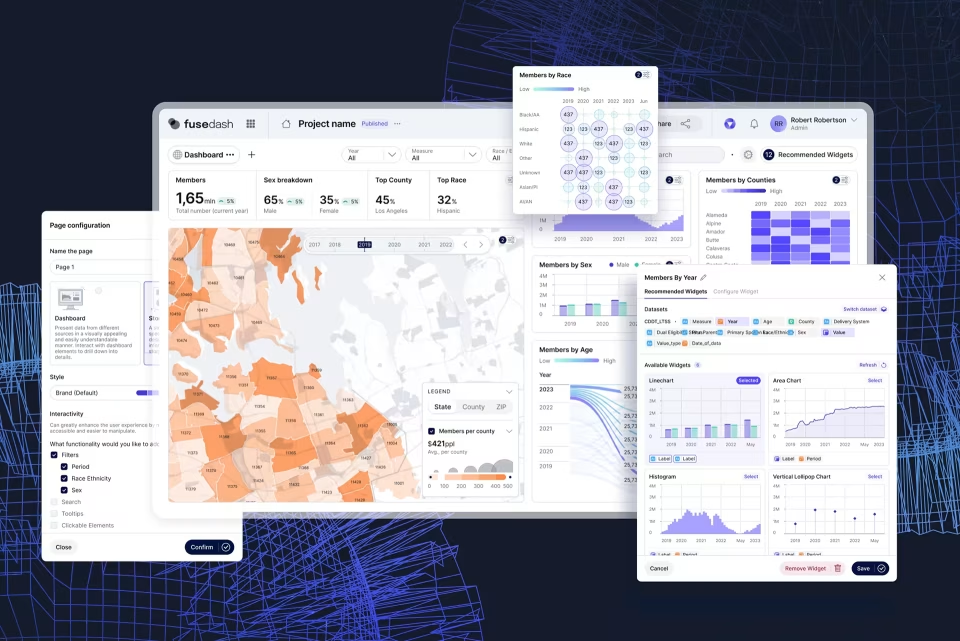
AI Dashboard Interface
Supercharge Your Growth with an AI-Powered Business Dashboard