Best AI design agencies in the Washington DC area in 2026
Almost every design agency around Washington now says it designs for AI startups and platforms. Far fewer can show you a screen where a real person had to act on a model’s answer and decide whether to trust it, and that screen is the whole job. Designing for AI is its own craft, about how people use a model rather than how the model gets built, and the two get confused constantly. A real AI design agency in the Washington DC area lives on the design side of that line, working for some of the most demanding clients in the country, federal agencies, hospitals, banks, and the list goes on. Since April 2025, every federal agency has also had to name a Chief AI Officer and publish a public list of where it uses AI, which sets the bar for what these interfaces have to do.
What an AI design agency in the Washington DC area does
The work behind the label is concrete. An AI design agency decides how a model’s answer reaches the person using it. In other words, it’s about where what you are looking for shows up and how it’s communicated. This process also involves how the screen admits when it might be wrong, and how someone overrides it, or digs deeper into why. Training the model is a different job entirely. One team builds the system. The agency decides what the person sees and what they can do with it
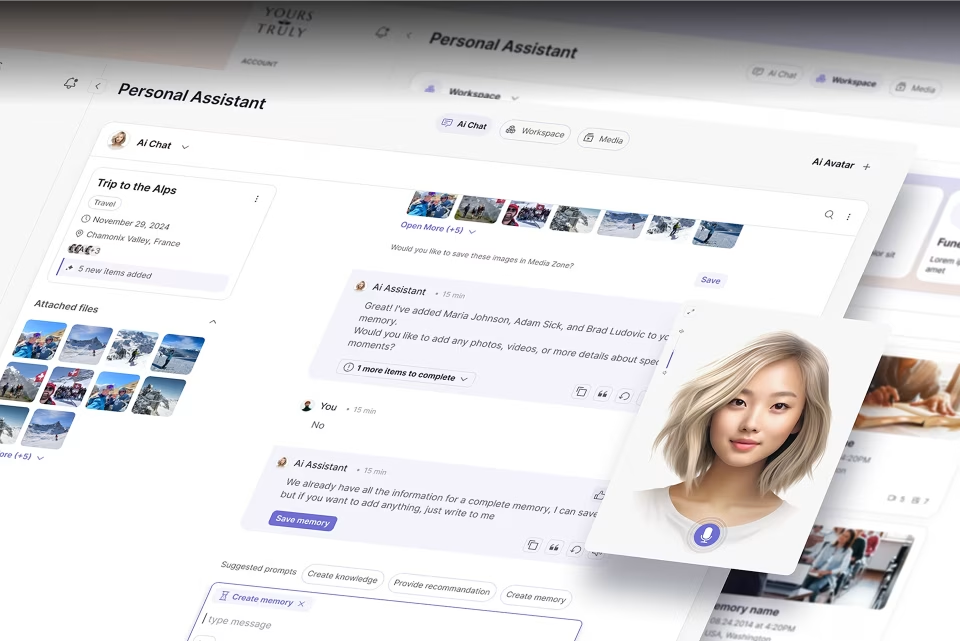
In practice, our work typically involves designing for three different types of projects. Most often, it is a chatbot or some conversational tool, where the hard part is not the chat bubble; it is what the thing does when it cannot answer. Sometimes it is an agent that takes action across systems, and then the screen has to show every step and provide a way to pull the plug. And sometimes it is a dashboard where the model’s output sits right next to a person’s own read on the situation.
These are design problems because AI breaks differently than ordinary software. A form takes your input, or it does not. A model hands you something that looks right and sometimes is not, and the screen is the only place the person finds out how far to trust it. How you show confidence, whether you cite a source, how easy you make it to disagree: those calls decide whether anyone is going to continue using the tool after it gets something wrong, and it will get something wrong. None of this is new thinking. Nielsen Norman Group has argued the same about explainable AI for years: people trust a system when they can see the basis for what it tells them.
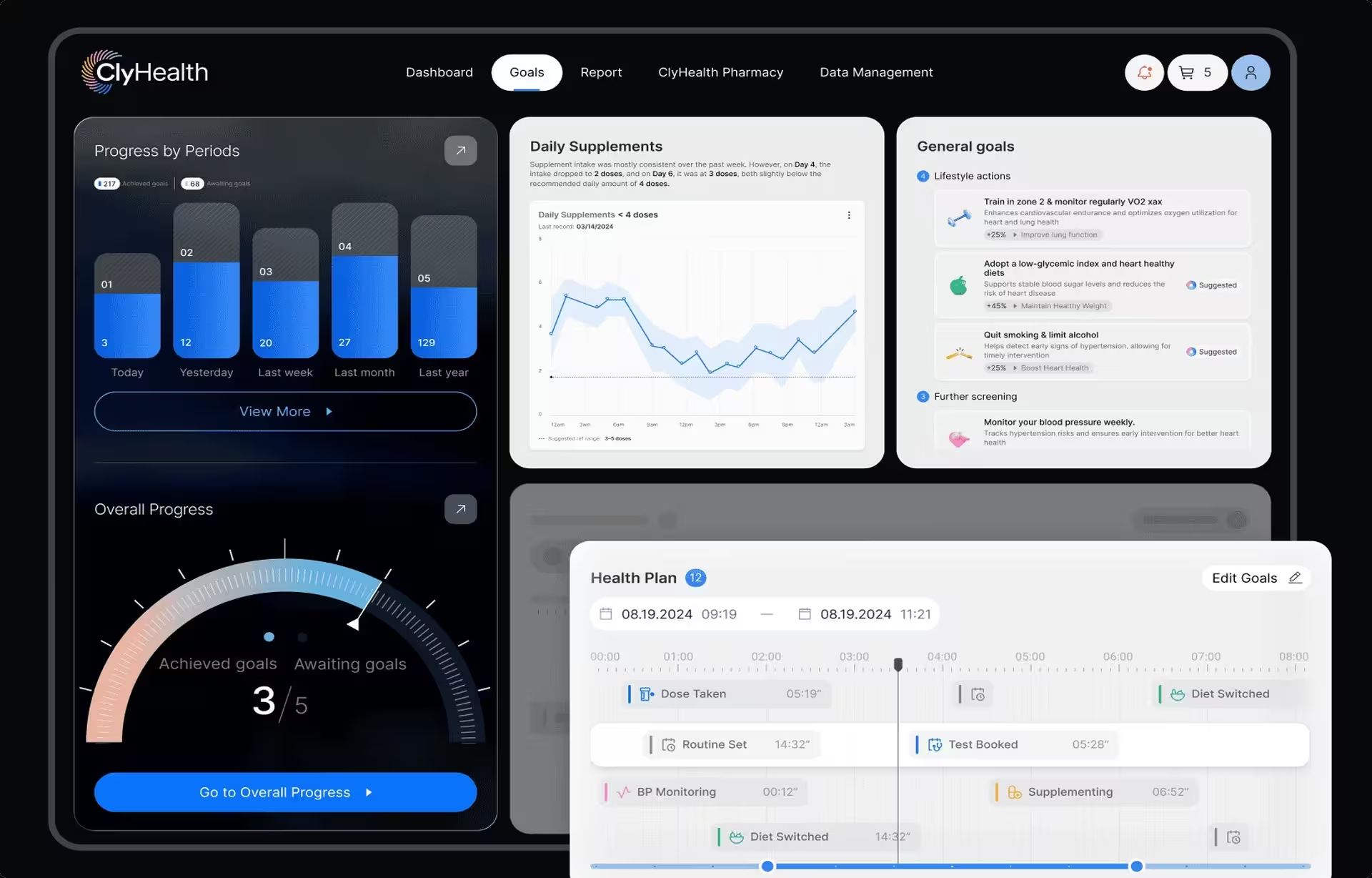
Here is a concrete version from our own work. On ClyHealth, an AI-powered personalized healthcare platform we designed, the system builds a daily supplemental protocol for each patient out of their biomarkers, lab results, and genomic data. The easy way to accomplish this is also the wrong way: show the provider the recommendation and nothing else, a clean answer from a black box. In a clinic, a recommendation like this dies on the screen. A provider will not put their name on a protocol they cannot rationalize with back-up, so they ignore it, and the AI may as well not be there.
What we built instead sets the formulation reasoning directly beside the recommendation, so the provider can read the logic and approve it before it reaches a patient. Same model, same output, but oh man, what a difference in outcomes. The entire difference lives in the interface. In a clinical setting, a recommendation without visible justification does not get followed, which is why showing the reasoning was a design decision, not a feature. That is the work this whole article is about.
Why Washington, D.C. is a center for federal and enterprise AI design
There is a plain reason this work clusters around Washington. The federal government is the largest regulated buyer of AI in the country, and unlike most clients, it specifies exactly what its systems must do. OMB Memorandum M-25-21, signed in April 2025, tells every agency to name a Chief AI Officer, keep a public list of where it is using AI, and wrap documented safeguards around anything high-impact. A second memo, M-25-22, does the same for how agencies buy AI, covering anything they put out to bid from late September 2025 on.
For a design team, none of that is fine print. It is a spec. A high-impact system has to show a clear basis for its answers, give someone a way to challenge a decision, and keep a record of what happened, and every one of those either lives in the interface or it does not exist. We went through what each of these rules actually asks of an interface in our guide to federal AI UX design. Agencies that have never worked under these rules treat them as a compliance pass at the end. The good ones build them in from the first sketch.
People here talk about the DMV rather than just DC. Much of the federal health work that drives these projects lies across the line in Maryland, with NIH in Bethesda and the FDA in Silver Spring, while Northern Virginia hosts many of the contractors and data centers. The three jurisdictions function as one market, which is why a firm in McLean or Baltimore competes for the same federal and regulated work as one in The District.
It does not stop with the government either. Healthcare AI here carries HIPAA and patient-safety weight, financial AI carries its own, and the interface problems across these regulated industries have more in common than you would think. The NIST AI Risk Management Framework has become the shared language for most of it. Accessibility is not optional here. Section 508 covers an AI conversation the same way it covers any federal screen, and chat and agent interfaces raise accessibility questions that most teams have frankly never had to deal with.
This is why a general UX studio that bolted AI onto its list of industries tends to struggle here. The job is not making AI look modern. It is making something that can be wrong safe enough to hand to a nurse, a caseworker, or a fraud analyst. That is what buyers in this market are actually paying for, even when nobody writes it into the brief.
What to look for in an AI design agency
When we are sizing up another firm in this space, We look for three things. One, a real AI or chatbot product they have actually shipped and can name. Two, a straight answer for how their interfaces handle the model being unsure or flat wrong. Three, real work under at least one rulebook, Section 508, HIPAA, or the federal risk controls. A firm that cannot point to a live AI product and instead walks you through general UX work with AI bolted onto the pitch is a generalist hoping the label closes the deal.
The fastest way to find out is to ask how they design for the moment the model gets something wrong. A team that has done the work answers immediately, talking about confidence cues, fallback states, and when to kick a problem over to a human, all before anyone mentions visual style. A team that has not will steer you back to the pretty screens. One answer comes from shipping these products. The other comes from reading about them.
The second test separates design from engineering, and it matters more than it sounds. Plenty of strong shops here build AI, they train models and ship features, but designing the interaction is a different craft with different output. Here is the irony we keep running into: some of the most capable engineering teams build the worst AI interfaces, because a team that trusts the model designs as if it is always right. Ask who actually owns the conversation flows and the recovery paths, and whether that person is a designer or a developer moonlighting as one. If you want a wider, national view, our roundup of top AI UX design agencies runs the same test across a bigger field.
Top AI design agencies in the Washington DC area in 2026
The real field here is thinner than the directories let on. Search for an AI design agency in Washington DC and most of what comes back is a national studio running a local landing page or a marketing shop that will spin you up a chatbot on request. The five below are actual DC-area and DMV firms with real Clutch profiles and a fair claim to AI work. I have ordered them by how closely that work maps to the trust problem this market really has, not by size.
1. Fuselab Creative
Strongest for: enterprise and federal AI interfaces where people have to trust what the model says inside a regulated process.
Fuselab Creative is my firm, so weigh this entry accordingly. We are a UX and UI design shop in McLean, Virginia, started in 2017, and one of the few in the area that runs AI interface design, AI workflow design, and chatbot UI as real practices rather than add-ons. The shipped work includes Stardog Voicebox, a conversational AI interface, the ClyHealth clinical AI platform, and Grid AI, plus government projects for the Department of Health Care Services, NIH, and the Project on Government Oversight. We hold a GSA Schedule, so federal buyers can bring us on without running an open bid. Clutch rating 5.0 across 15 reviews. Pricing runs $100 to $149 an hour, projects from $25,000. Based in McLean, in the DC area.
2. Code District
Strongest for: teams that want the design and the engineering from one shop.
Code District is a full-stack digital agency headquartered in Washington, DC, also founded in 2017, that pairs UI/UX with custom software and AI engineering. Its AI work runs from conversational agents and generative features to PharmaSift, a tool built to flag drug-safety risk. If you already know you will have to build and not just design, this is the kind of shop that keeps the handoffs short. Two things worth checking: the delivery team sits largely in Pakistan and Canada rather than DC, which matters on work with data-residency or clearance constraints, and a shop doing both design and engineering is rarely as deep on pure interaction research as a design-first studio. Clutch rating 4.9 across 35 reviews. Pricing $25 to $49 an hour, projects from $10,000. Based in Washington, DC.
3. Mindgrub
Strongest for: established companies adding agentic AI to a product that already has users.
Mindgrub is a design-and-build agency in Baltimore, around since 2002, with a long enterprise track record for the likes of Exelon, NASA, and Under Armour, and ten straight years on the Inc. 5000. Its recent work leans into agentic AI and AI-driven products, which fits a company bolting automation onto something that already has users rather than starting cold. The draw is range, across design, engineering, and infrastructure. The catch is that interaction design is one of many things they do, not the whole shop. Clutch rating 4.8. Pricing $100 to $149 an hour, projects from $10,000. Based in Baltimore, in the DMV.
4. Brave UX
Strongest for: high-stakes products that need heavy research before anyone draws a screen.
Brave UX is a research-led studio in Washington, DC, founded in 2014 and known for untangling complicated application interfaces in regulated, high-consequence settings. It is on this list for the part of AI work that trips most teams up, the discovery and structure that decide whether a complex tool is usable at all. Its AI projects are not posted as public case studies, so treat it as a strong pick when the hard part is research and getting a room of stakeholders aligned, and ask straight out about any AI engagement, since the public portfolio leads with enterprise UX. Clutch rating 5.0 across 29 reviews. Pricing $200 to $300 an hour, projects from $50,000. Based in Washington, DC.
5. Mobomo
Strongest for: federal site and platform rebuilds that fold AI in along the way.
Mobomo is a digital agency in Reston, Virginia, that designs and builds platforms for federal agencies, with work for NASA, the U.S. Geological Survey, and FERC. Its AI and machine-learning work usually rides inside a bigger modernization program rather than standing on its own, which makes it a fit when you are replacing an aging system and want some intelligence built into the rebuild. If your project is a standalone chatbot or agent, the AI focus here will feel thinner than at a specialist. Clutch profile with 18 reviews. Pricing $100 to $149 an hour, projects $30,000 to $300,000. Based in Reston, Virginia.
How we evaluated these agencies
We held every firm to the same five checks: real UI/UX design ability rather than engineering alone, AI or intelligent-interface work we could actually find and verify, a base in the DC area or the wider DMV, a Clutch profile with public reviews, and some evidence they have worked under federal or regulated constraints. A firm had to clear the first three to make the list at all. The order reflects how close the AI work sits to the trust problem, not how big the firm is or how loud its marketing runs.
Here is the part the listicles skip: the qualified field is short. Search for an AI design agency in Washington DC and you will get dozens of names, but most are national studios with a local page, marketing firms that will build a chatbot on the side, or engineering shops with no real design practice. Strip those out and you are left with a handful. That is worth knowing on its own. The market looks crowded. It is not.
AI design agencies in DC compared
How to choose the right AI design agency for your project
Choosing between these firms really comes down to one question: what is the hardest part of your project, and which one is actually built for it? If the hard part is regulatory and the system is high-impact, weight federal and compliance experience over everything. If it is shipping fast with engineering attached, weight the build side. The classic mistake is hiring on how the portfolio looks when the real risk sits somewhere the portfolio never shows you.
Start with the failure case, not the demo. Ask each firm to walk you through a time the model was wrong in production and what the interface did about it. The answer tells you whether they have actually designed the confidence cues, the recovery, and the handoff that keep people using a tool, or whether they have only ever designed screens that assume the model is right. The ones who have shipped real AI answer this fast, and in detail.
Keep the budget question separate from the rate question. A higher hourly rate from a specialist often costs less in the end than a cheap rate from a generalist who burns three rounds learning how model uncertainty works, because rework is where AI budgets disappear. Project minimums around here run from about $10,000 for something contained to $50,000 and well past that for an enterprise or federal build. Compare the total cost of getting to a working interface, not the sticker rate. For the wider local picture beyond AI, our guide to the best UX design agency in Washington DC covers more ground.
Match the engagement to the work, not just the firm. A fixed-scope project fits one clear interface, like a single chatbot. An embedded or staff-augmentation setup fits a product team that needs design hands working next to its own engineers. A longer retainer fits a system that keeps learning after launch and needs its interface tuned as the model shifts under it. Pick the wrong shape and even a good agency turns into a frustrating engagement.
Last, sort out the procurement path before you fall for a portfolio. Federal buyers move faster with a firm that holds a GSA Schedule, since it skips the open bid. And any regulated buyer should press on how the agency handles your data while it designs and tests, because prototyping against a live model can leak real records when nobody set that boundary up front. None of this is a design question. All of it decides whether the work can even start.
Frequently asked questions
What is an AI design agency?
An AI design agency designs the part of an AI product people actually use: the conversation flows, the signals that show when the model is unsure, the controls to correct it, and the handoff to a human. It is not the same as an AI development firm, which trains and builds the model itself. The design agency owns what the user sees and does, not the algorithm underneath.
What does an AI design agency in Washington DC do?
An AI design agency in Washington DC designs AI interfaces for the federal agencies, hospitals, and enterprises packed into the region, where anything that ships has to meet specific governance and accessibility rules. The work usually means chatbots, agent and workflow screens, and AI-assisted dashboards. On federal projects it also means designing for documented risk controls and Section 508 from the start, not as an afterthought.
How is an AI design agency different from a general UX agency?
An AI design agency designs for systems that can hand back a confident, wrong answer, so its real work is confidence cues, error recovery, and escalation, not just layout. A general UX agency designs software that simply accepts or rejects what you put in. The gap shows up most in how each one handles the moment the system is wrong, which a general agency usually has not designed for at all.
What is the difference between a chatbot UI and an AI agent interface?
A chatbot UI handles a conversation inside a set scope, like support or product questions, and the surface is mostly back-and-forth chat. An AI agent interface is for a system that takes actions across tools, so it has to show each step, its status, and a way to step in or stop it. Agent interfaces carry more risk, because the system is doing things, not just answering.
How much does it cost to hire an AI design agency in the DC area?
Hiring an AI design agency in the DC area usually runs from about $10,000 for a contained scope to $50,000 and up for an enterprise or federal build, with specialist rates between $100 and $300 an hour. The spread depends on how many screens are involved, the regulatory load, and whether engineering is part of the deal. What matters is the total cost of getting to a working interface, since rework is where AI projects overspend.
How do I choose an AI design agency for a federal project?
Choosing an AI design agency for a federal project starts with proof it has designed under federal AI rules and Section 508, not just commercial UX. Confirm a shipped government or regulated AI product, and check whether the firm holds a GSA Schedule, which lets agencies hire it without an open bid. Then ask, in plain terms, how its interfaces handle the documented risk controls a high-impact system needs.
How long does an AI interface design project take?
An AI interface design project usually takes six to twelve weeks for a clear scope like one chatbot or a single agent workflow, depending on how many surfaces there are and the regulatory load. A discovery phase that scopes the work first runs two to four weeks. A multi-phase engagement that covers launch and the first weeks in production tends to run four to six months.
In this market, designing an AI product is less about making it look smart and more about making it safe to act on, and that is exactly where DC’s federal and regulated experience earns its keep. Start your shortlist with the firm whose best work matches your hardest problem, then make them prove it on something they have actually shipped before you sign anything.