AI agent examples: where they actually work in business

AI agent examples that companies report running in production include Ramp’s Policy Agent reviewing every company expense, Microsoft’s triage agent closing false phishing alerts at St. Luke’s University Health Network, and Deutsche Telekom’s RAN Guardian adjusting a live mobile network on its own. The part worth studying in each is the handoff: the point where the agent stops and the screen a person sees when it does.
AI agent examples at a glance
The clearest AI agent examples in business come from nine functions: customer service, IT helpdesk, finance, sales, security, healthcare, data analysis, network operations and visual inspection. For each function, the table shows what the agent does alone and what a person reviews. Two sources say nothing about human review, and the table marks both.
Here, an agent means software that takes a step on its own, such as answering, sending, closing or changing something, rather than only suggesting one. Every example comes from the company’s or vendor’s own case study, so the figures are self-reported. Read them as best cases, because vendor case studies rarely report rollbacks or failed pilots. This guide adds the right-hand column, which most vendor lists leave out.
AI agent examples in customer service
Customer service agents answer routine questions from account data and pass the rest to a person with the case already prepared. 1-800Accountant reports that its Salesforce Agentforce agent resolves 70% of chat conversations without a person, and OpenTable’s agent decides when to escalate from a live score of the customer’s intent and sentiment.
OpenTable’s rule is one the team can see and tune. Each chat starts from a baseline score that the agent updates as the diner replies. Asking for help scores 5, asking for a representative 10, and all caps or extreme frustration up to 20, according to Salesforce. The agent uses the score to keep helping, open a case or escalate, and OpenTable can move the threshold.
The same agent cannot complete account merges itself, so it gathers the details and opens a support case with the full context. The rep does not need to call the diner back. At 1-800Accountant, the old chatbot answered only 10% of questions, so clients booked 30-minute CPA calls for simple ones. Now the agent answers tax questions from client data, and CPAs focus on cases that need their expertise.
AI agent examples for an IT helpdesk
Password resets, account unlocks and access changes follow a fixed policy, which makes them the first work IT helpdesk agents take on. Oh, and takes away the most hated tasks by IT help staff. ServiceNow says that since September 2025 its own service desk has resolved every routine first-line request, known as Level 1, without a person. Moveworks reports that Broadcom’s agent, built on its platform, resolves 88% of support issues unaided.
ServiceNow reports cutting resolution time from 75 minutes to less than 10, which makes it one of the few examples here where the vendor claims full autonomy in production. Broadcom’s Moveworks agent runs inside Google Chat and got there in stages. It resolved about 10% of requests at launch, then 54%, then 88%, though the page gives no dates for those stages.
What happens to the other 12%? Neither source describes what a person sees when the agent does not resolve a request, and at Broadcom that is still about one request in eight. Those tickets are where the design work sits. If a ticket arrives without the reason the agent stopped, the analyst repeats the agent’s first steps. The last section of this guide walks through what that ticket should show.
AI agent examples in finance
Finance agents do first-pass review: they check every expense or invoice against written policy, approve what clearly fits and send the rest to a person. Ramp says more than 1,000 finance teams use its Policy Agent and that reviewers now spend their time on the 10 to 15% of transactions that need judgment.
When the policy is silent. The Ramp Policy Agent shows which policy rules it relied on and flags the ones that are outdated or unclear. When a seat upgrade is not covered, it sends the expense for review and points out the gap. Once the controller writes the missing rule, that exception stops coming back, so each review also fills a gap in the policy.
Ramp’s accounts payable agents work earlier in the chain. They code invoices, check for fraud and recommend approvals, and a person decides. Ramp reports 90,000 recommendations with a 90% acceptance rate, based on its September 2025 data. That rate needs reading in both directions: a falling rate means recommendations are drifting from how the team decides, and a rate near 100% can mean reviewers have stopped reading them, but let’s stay positive and assume this points to amazing efficiencies.
AI agents in sales
Sales agents start with the leads human reps rarely get to, such as people who showed only light interest or arrived through social media. They send the first emails, answer product questions and offer a way to book time. When the prospect replies or books, a rep takes over, and every message the agent sent is already on the record.
At Salesforce itself, the Engagement Agent has reached 100,000 leads and created 1,500 opportunities, and Salesforce says it is on track for $60 million in pipeline, meaning sales opportunities rather than closed revenue. Equipter, a construction equipment maker with six salespeople, saw response rates on its social media leads rise from 4% to nearly 10% once an agent began emailing them within minutes.
What the rep sees first. A full conversation history is not enough by itself. The details that cause trouble are buried in it: a price, a delivery date, a resource the agent promised to send. The screen a rep needs lifts those commitments out of the thread and lists them above it, so the first call starts from what the company has already said.
AI agents in security
Alert triage is where security agents earn their place: they close the false positives and pass real threats to an analyst with an explanation attached. At St. Luke’s University Health Network, Microsoft’s Security Alert Triage Agent decides whether user-reported emails are phishing. The network’s associate CISO says it is saving nearly 200 hours a month.
The agent closes thousands of false positives by itself and explains each decision in plain text, Microsoft reports, and over time the analysts stopped rechecking every incident. The story reports the explanations and the growing trust together without measuring the link. Even so, the explanation is the screen detail to copy, because a verdict that shows its reasoning can be checked in place.
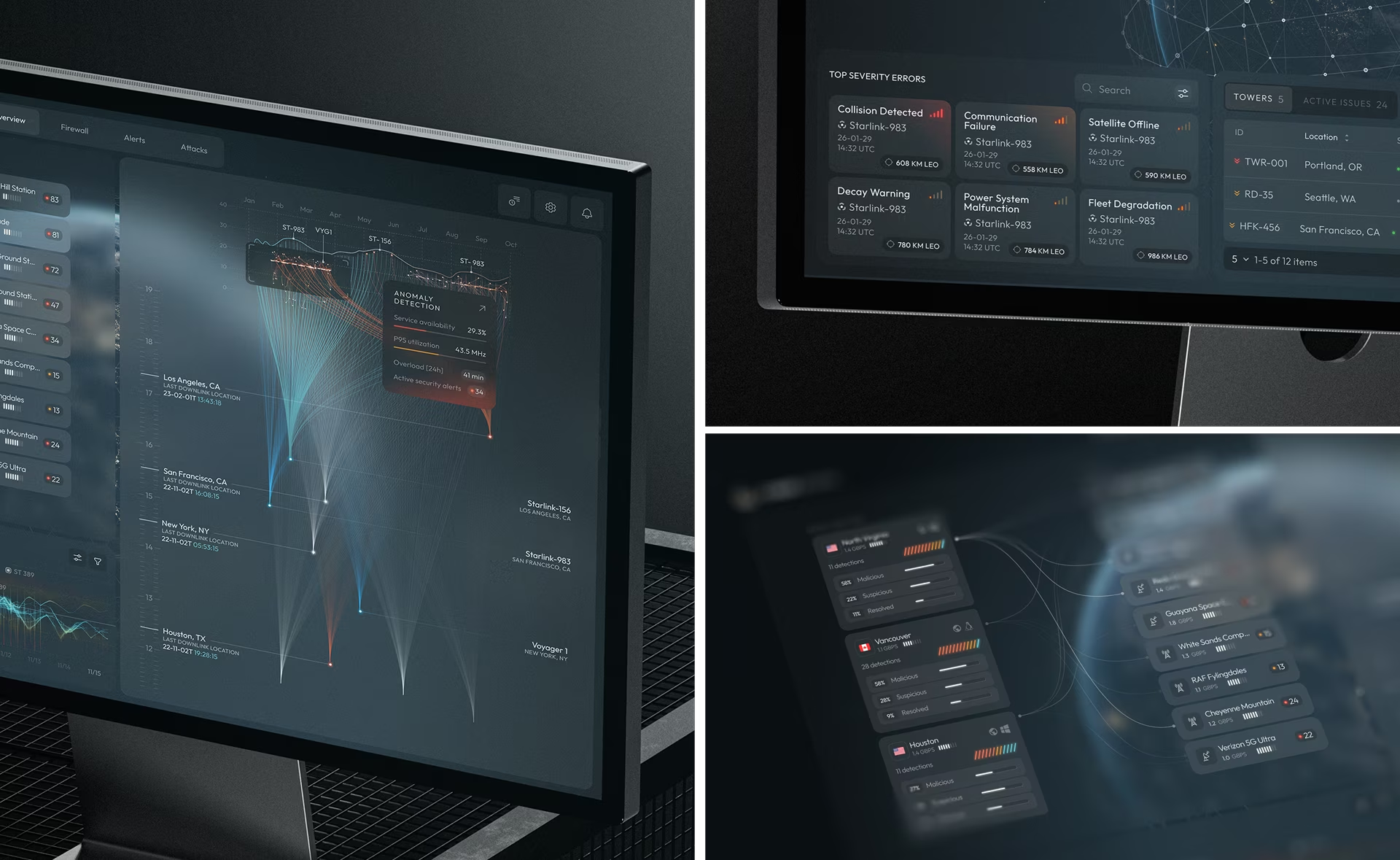
Anomaly detection has the same evidence problem. On CyberDefend, a satellite operations platform, flagged events surface alongside their activity logs. The analyst reads each alert in the context of the log it came from, in the same view, instead of switching to a separate tool to look it up. This resulted directly from our extensive user research and complaint log reviews.
AI agents in healthcare
Healthcare agents handle structured patient contact and hand anything clinical back to a nurse or provider. Universal Health Services uses Hippocratic AI agents for post-discharge calls that go over discharge and medication instructions, ask about new or worsening symptoms, and answer questions. UHS reports an average patient rating of 9.0 out of 10.
The handoff is a callback request. The agent messages the nurse that the patient wants a call back about a specific question, so the nurse knows the question before dialing. Treatment plans need more than a message. On the ClyHealth platform, each AI-generated plan includes its reasoning, and a provider reviews that reasoning before approving the plan.
AI agent use cases in data analysis
Data analysis agents turn plain-language questions into queries, charts, and summaries. They answer but take no action, so strictly speaking they are what most people would call assistants. They are included because they raise the review question every agent raises: before relying on an AI-generated answer, a person has to judge whether it matches the data.
DIRECTV answers that question with a number. Hundreds of its analysts and business users query a customer dataset of more than 1,200 attributes through Databricks Genie. The team built an evaluation framework that scores responses on correctness, faithfulness to the source data and clarity, and each answer shows a confidence score.
The Stardog Voicebox design takes a different route, a two-state marker: each answer is flagged either as generated with high confidence or as needing manual review. A split panel keeps the fund data table beside the chat, so a financial analyst can check the answer against the measured data without leaving the screen; a huge improvement from the prior workflow! A score leaves the cutoff to the reader, while the marker tells the analyst which answer to check.
Prominence is the other lesson from the Voicebox case study. Markers that are too prominent undermine trust in every answer, accurate ones included, and markers that are too subtle get ignored. Neither design fixes an overconfident model, either. The screen can only show the confidence the model reports, so an answer the model is wrongly sure about will look as safe as a correct one.
AI agents for network operations
On a live network, the agent acts first and reports afterward. Deutsche Telekom’s RAN Guardian Agent watches the radio access network, the masts and antennas phones connect to, during major events and adjusts individual sites when traffic spikes. Telekom says that in its first month after launching in November 2025, it made more than 100 such fixes during Christmas market events.
Deutsche Telekom says the agent has cut the time needed to manage a major event from hours to around a minute, yep, you read this right, from what used to take hours down to one minute. During Carnival, it checked 611 mobile sites in advance, serving about 130 events and parades. Only five sites reached peak traffic, and the agent adjusted those five.
Who reads the log? An agent that acts alone needs a different screen, because the person reviews what already happened. That screen is a log of what changed, where, when, under which rule, and how to reverse it. Telekom’s announcement does not say who reads that log, and a buyer evaluating a similar agent should ask that before anything else.
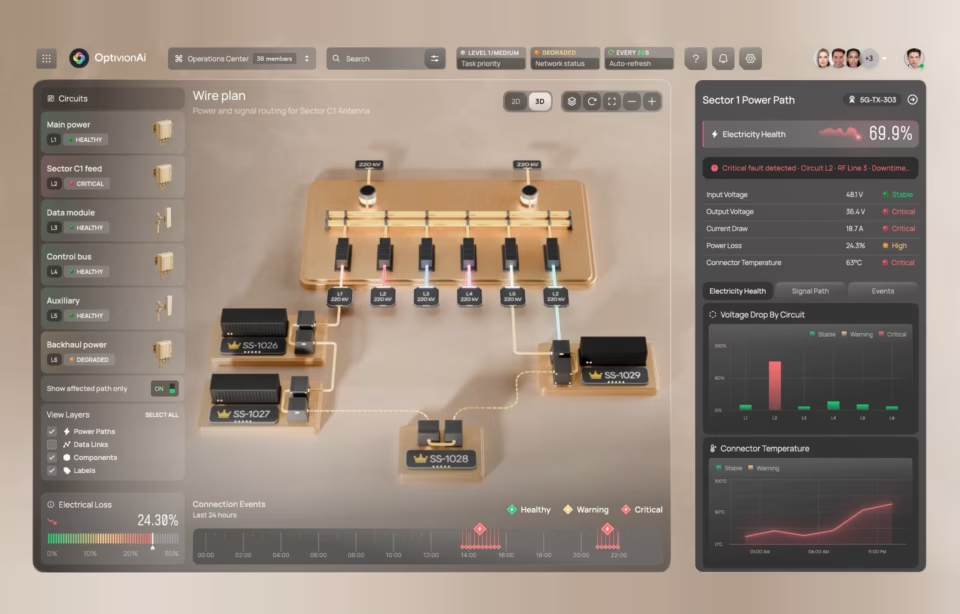
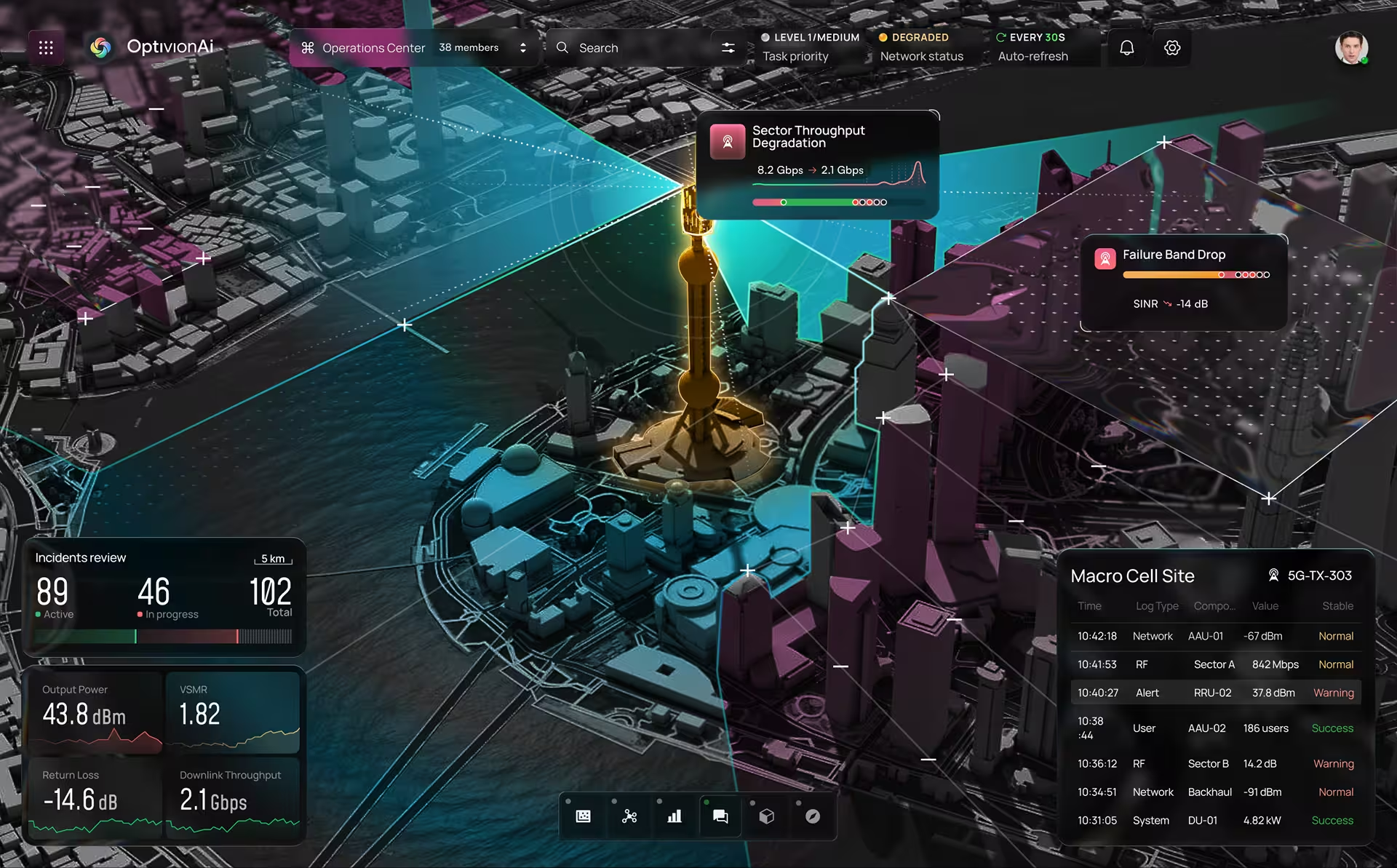
OptivionAI, an AI-assisted telecom operations platform, is designed around the record a person reads after an alert. Each incident opens one record that runs from a national map down to a single antenna module, with severity, the event trail and recommended actions. The engineer at the operations desk and the technician on the roof read the same record.
AI agents for visual inspection
Cameras let an agent watch a physical process, spot errors as they happen and alert the worker who can fix them. At Pegatron, an Assembly Guiding Agent built on NVIDIA’s video analysis tools catches mistakes such as a forgotten screw, and the worker gets a real-time alert. NVIDIA credits it with a 7% cut in labor costs per line and a 67% drop in defects.
Operators can also open a short video snippet of each incident and ask the agent questions about it, NVIDIA reports. For a decision as small as whether a screw is missing, a few seconds of footage is the right amount of evidence. A dashboard of defect rates would answer a different question, the one a plant manager asks at the end of the week.
The Digital Management Framework, a smart city operations platform we designed, is not an agent deployment, but it has the same review problem on the alert side. Operators view and control live camera feeds and pull up recorded footage, while the building management system raises AI-driven alerts. With both on one platform, the footage that can confirm an alert is within the operator’s reach.
Where AI agents should stop, and what the person sees
Every agent on this page stops somewhere. Two decisions sit behind that stop. The first is the boundary, meaning which tasks the agent hands back to a person. The second is the handoff screen, meaning what that person sees when it does. Most of this guide has been about the second, because it decides whether the reviewer saves any time.
How much an agent can do alone depends on the task’s risk, not a fixed list of forbidden work. A few questions set the level:
- What does a mistake cost? A wrong password reset costs minutes. A wrong payment or treatment recommendation costs far more.
- Can it be reversed, and can it wait? A network adjustment can be rolled back but often cannot wait for a person. A sent email or released payment usually cannot be reversed.
- Is there a written rule to check against? Ramp’s agent approves only what the policy clearly covers and sends the rest to a person.
- Must a named person answer for it? Clinical, legal, and financial approvals need someone who signs off, so the agent prepares the work and that person decides.
When a mistake is cheap, reversible and covered by a clear rule, the agent can act alone, as with ServiceNow’s password resets. Work that is reversible but cannot wait suits acting first and reporting after, as Telekom’s agent does. Costly or one-way decisions suit recommend-and-wait, as with Ramp’s accounts payable agents. Enterprise AI agents can also mix levels: Ramp’s Policy Agent approves in-policy expenses alone and routes the rest.
Microsoft’s triage agent shows where the framework needs care. It acts alone, but only on emails it classifies as false positives, and a real phishing email closed by mistake would be costly and hard to undo. The risk lies in the classification itself, which is why plain-text explanations matter: analysts check them when a call looks wrong.
The trigger that moves a case to a person has to be just as specific. The deployments here use four triggers: a score crossing a threshold (OpenTable), a policy gap (Ramp), a request the agent couldn’t resolve (Broadcom), and a customer asking for a person (UHS). Clinical cases add their own triggers, covered in the separate guide to agentic AI in healthcare.
Every deployment that documents its handoff passes the person context along with the work: case history, policy gap, explanation, or video clip. The six questions below test for that on any pilot, and you should ask them about the handoff screen employees will actually use.
Take a typical request an IT agent cannot close on its own: an employee asks for access to a finance system. A handoff ticket that answers the six questions shows them in the same order, top to bottom, so the analyst reads each answer at the moment it is needed:
- Why it stopped. One line, such as “Access to finance systems needs manager approval,” so the analyst knows what kind of problem this is.
- What it already did. Identity verified, manager looked up, approval request not yet sent. The analyst skips the finished steps.
- The evidence. The employee’s request in their own words, beside the access policy the agent checked it against.
- How sure it is. The agent’s reading of the request, such as “matched ‘finance system’ to the accounts payable app,” with a marker saying whether that match is certain or needs a check. The evidence in step 3 is what the analyst uses to verify it.
- What changed. Nothing yet, and the ticket says so. If the agent had changed the account, each change would be listed here with its reversal step, or a plain note where a change cannot be reversed.
- The decision. The analyst cannot grant this access, because only the manager can. The choices are to send the approval request to the manager, decline the request or reassign the ticket, with the agent’s suggestion marked but not preselected.
When the analyst disagrees. Overriding the agent’s suggestion asks for a short reason in the analyst’s own words. When the same reason keeps coming up, it points to the rule the agent is missing, which is the same discovery Ramp’s controllers make when the policy is silent. The UI design for AI agents guide covers how to define each stop point before the agent is built.
Frequently asked questions
What is an example of an AI agent?
An example of an AI agent is Ramp’s Policy Agent, which reviews every company expense against written policy, approves what clearly fits and sends exceptions to a person. Other examples of AI agents in production include Microsoft’s triage agent closing false phishing alerts at St. Luke’s University Health Network and Salesforce’s Engagement Agent following up on sales leads.
What are examples of agentic AI in business?
Agentic AI examples in business are systems that act on their own toward a goal, taking steps without waiting for a person to approve each one. Deutsche Telekom’s RAN Guardian Agent monitors a live mobile network and adjusts sites by itself, and ServiceNow says its internal service desk resolves every routine first-line IT request without a person. Both work on tightly scoped tasks.
How is an AI agent different from rule-based automation?
An AI agent differs from rule-based automation in what happens when a request does not match a fixed step. A rule-based workflow stops or fails at that point, while an agent interprets the request within the policy it was given, chooses the next step and decides when to hand the work to a person.
Which tasks should not be given to an AI agent?
Tasks where a mistake is costly, hard to reverse or must be signed off by a named person should not be left for an AI agent to finish alone. That covers most clinical, legal and payment decisions, plus work with no written rule to check against. The agent can still prepare that work, while a person makes the final call.
What are AI agents used for in business?
AI agents for business handle high-volume, rule-bound work such as answering support questions, resolving IT tickets, reviewing expenses, triaging security alerts and following up on sales leads. Some also adjust live networks or watch factory assembly lines. The right use depends on how well the task is defined and how costly a wrong answer would be.
How do companies keep people in control of AI agents?
Companies keep people in control of AI agents by deciding in advance which actions an agent may take alone and which it must send to a person, then logging every action. Ramp’s controllers, for example, set which in-policy expenses the agent may approve. Reviewers also need a screen that shows why the agent stopped, what it already did and how to undo a change.
Which AI agent examples make a good first pilot?
The best first pilots are narrow, repetitive tasks with a clear success test, such as password resets or first-pass expense review. Start from tickets or chat transcripts to find the requests that repeat and the ones that escalate, and agree before launch who owns the outcome and how accuracy will be measured.