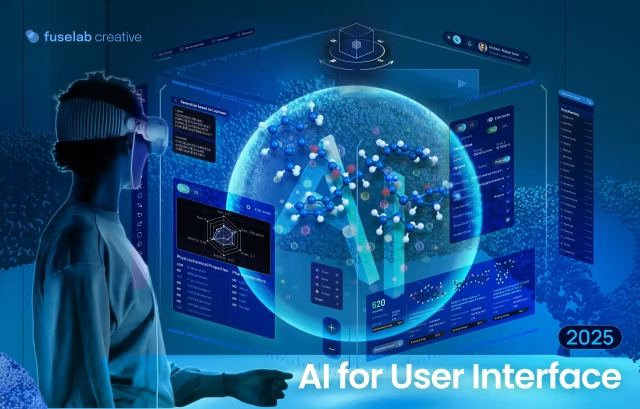
An AI design agency builds the screens, interactions, and trust signals between AI systems and the people using them, translating model outputs into workflows teams can act on safely. Fuselab Creative has delivered AI interfaces for Grid.ai, Stardog, ClyHealth, and Lightning AI since 2017, working from McLean, Virginia with clients across healthcare, government, financial services, and enterprise SaaS.
Enterprise clients include
NASA, Fiserv, Uber, NIH, California DHCS, Mozilla, Aircraft Bluebook (Informa), and the Project on Government Oversight.
AI-specific work spans Grid.ai, Stardog Voicebox, ClyHealth, studio/ml, and Lightning AI.
Capability covers AI dashboards, clinical decision-support interfaces, conversational AI over enterprise knowledge graphs, voice and multimodal interfaces, and generative AI with confidence signals, fallback paths, and override controls.
Signature approach: design the failure case first, before the happy path. This is why regulated-industry buyers keep choosing the team for production AI work.
UI UX Agency
Work Samples






Dashboard and data-heavy AI interfaces
Dashboard and data-heavy AI interfaces are Fuselab’s strongest AI design category, covering ML workflow platforms, model-assisted analytics, and decision-support tools where an operator needs to see what the model is doing and why. The Grid.ai and studio/ml projects both shipped with live model state, drill-down into contributing signals, and explicit override paths for any AI-driven recommendation.
Design decisions in this category start with the data hierarchy and the operator’s decision rights, not the visual system. An AI dashboard that surfaces a recommendation without showing the signals behind it is a liability the first time a regulator or auditor asks how the decision was made. Fuselab’s AI dashboard design work treats auditability as a first-class design requirement, not a compliance afterthought.
Clinical AI and regulated-industry interfaces
Clinical AI and regulated-industry interfaces add two requirements to standard AI interface design: every AI-assisted decision has to be auditable after the fact, and compliance boundaries (HIPAA, WCAG 2.2, Section 508, HL7, FHIR) have to be baked into the interaction pattern at the sketch stage rather than added during legal review.
Fuselab’s ClyHealth work treated clinical override as the default path and automated recommendation as the supporting signal, which is the opposite of how most consumer AI products are built. For healthcare and government buyers, this design orientation is the difference between a product that ships and a product that stalls in procurement review. See the Fuselab healthcare UX page for the full clinical AI capability set.

AI agent and conversational interfaces
AI agent and conversational interfaces take on more autonomy than a traditional screen-based product, which makes the design of control, override, and recovery patterns the main work. An agent that takes multi-step action on a user’s behalf needs explicit consent checkpoints, reversible operations, and a visible audit trail of what it did and why.
Fuselab’s work on Stardog Voicebox (conversational AI over enterprise knowledge graphs) and Lightning AI covered these patterns in production. The team also ships patterns for partial automation, where the agent drafts an action and a human approves it before it executes. See the AI chat interface design and UI design for AI agents pages for the full capability set.

Voice and multimodal AI interfaces
Voice and multimodal AI interfaces carry the hardest design constraints in the AI interface design category. A voice product cannot fall back on buttons, menus, or search fields to communicate state, which means every confidence signal, every clarification request, and every recovery path has to work through audio or through combined audio-visual cues.
Fuselab has designed voice and multimodal interfaces for Mozilla Common Voice contribution flows and adjacent voice recognition work across dozens of languages, and for enterprise voice assistants where the cost of a misheard command is operational rather than trivial. See the voice user interface design page for the full voice and multimodal capability set.
Frequently asked questions
Common questions about hiring an AI interface specialist, evaluating AI design work, and Fuselab's AI design capability across healthcare, government, fintech, enterprise SaaS, transportation, and aerospace products.
What is an AI design agency?
An AI design agency specialises in the interface between AI models and the people using them, including confidence signals, fallback paths, override controls, and the audit trail regulated buyers require. General UX agencies may offer AI services, but AI design agencies ship production AI products as their primary work. Fuselab Creative has worked exclusively in this category for enterprise and regulated-industry clients since 2017.
How is an AI design specialist different from a general UX agency?
AI design specialists work with probabilistic model outputs rather than deterministic user flows, which changes every phase of design. Error states become confidence thresholds, loading states become model latency indicators, and success criteria include trust and adoption over time rather than task completion alone. General UX agencies without shipped AI products cannot produce these patterns from first principles.
Which industries does Fuselab serve with AI design work?
Fuselab works across six industries where AI interface decisions carry compliance, clinical, operational, or financial consequences: healthcare and clinical AI (ClyHealth and adjacent medical device work, HIPAA-compliant), government and regulated public sector (NASA, NIH, DHCS, under GSA contract), financial services and fintech (Fiserv, ATB Financial, Blis), enterprise SaaS with AI workflows (Grid.ai, studio/ml, Stardog, Lightning AI), transportation and logistics (Uber, Geotab, Automatize), and aerospace and aviation (NASA, Aircraft Bluebook).
What is the difference between an AI design agency and an AI development agency?
AI development agencies build the models, backend infrastructure, and training pipelines. AI design agencies design the interfaces between those models and the people using them, including the decision paths, override controls, and audit trails. The two roles are complementary and sometimes combined in one firm, but they require different talent and produce different deliverables across different project scopes.
How much does it cost to hire an AI design agency?
Pricing varies widely by location and scope. US-based specialist agencies typically charge $100 to $300 per hour with projects starting at $25,000 for focused scope. Offshore agencies with US LLCs charge $25 to $80 per hour but cannot access FedRAMP-adjacent federal work or regulated healthcare projects. Fuselab’s rates fall in the US specialist range at $100 to $150 per hour with projects starting at $25,000. Verify current pricing on Clutch before engaging any agency.
How long does an AI interface design project take?
AI interface design projects typically run 8 to 20 weeks depending on scope, compliance requirements, and whether the work includes a full design system. Regulated-industry AI projects with audit trail requirements tend toward the longer end because compliance review cycles add time that product teams often underestimate. Fuselab scopes each engagement with named milestones so buyers see progress before final handoff.
What should I look for in an AI design agency's portfolio?
Look for at least one named client where AI drove the product, not a bolt-on feature. Verify the portfolio shows shipped production work rather than concept mockups. Ask about specific interface patterns the agency used for confidence signals, fallback behaviour, and auditability of AI-assisted decisions. Portfolios without these details describe AI capability the agency has not yet delivered. Fuselab’s ClyHealth, Grid.ai, studio/ml, and Stardog engagements document each of these patterns in production.
Related Services and Solutions


Contact Us
Fill out the form!
UI UX Agency
AI Design Blogs
UI UX Agency Insights